dailynewsnblog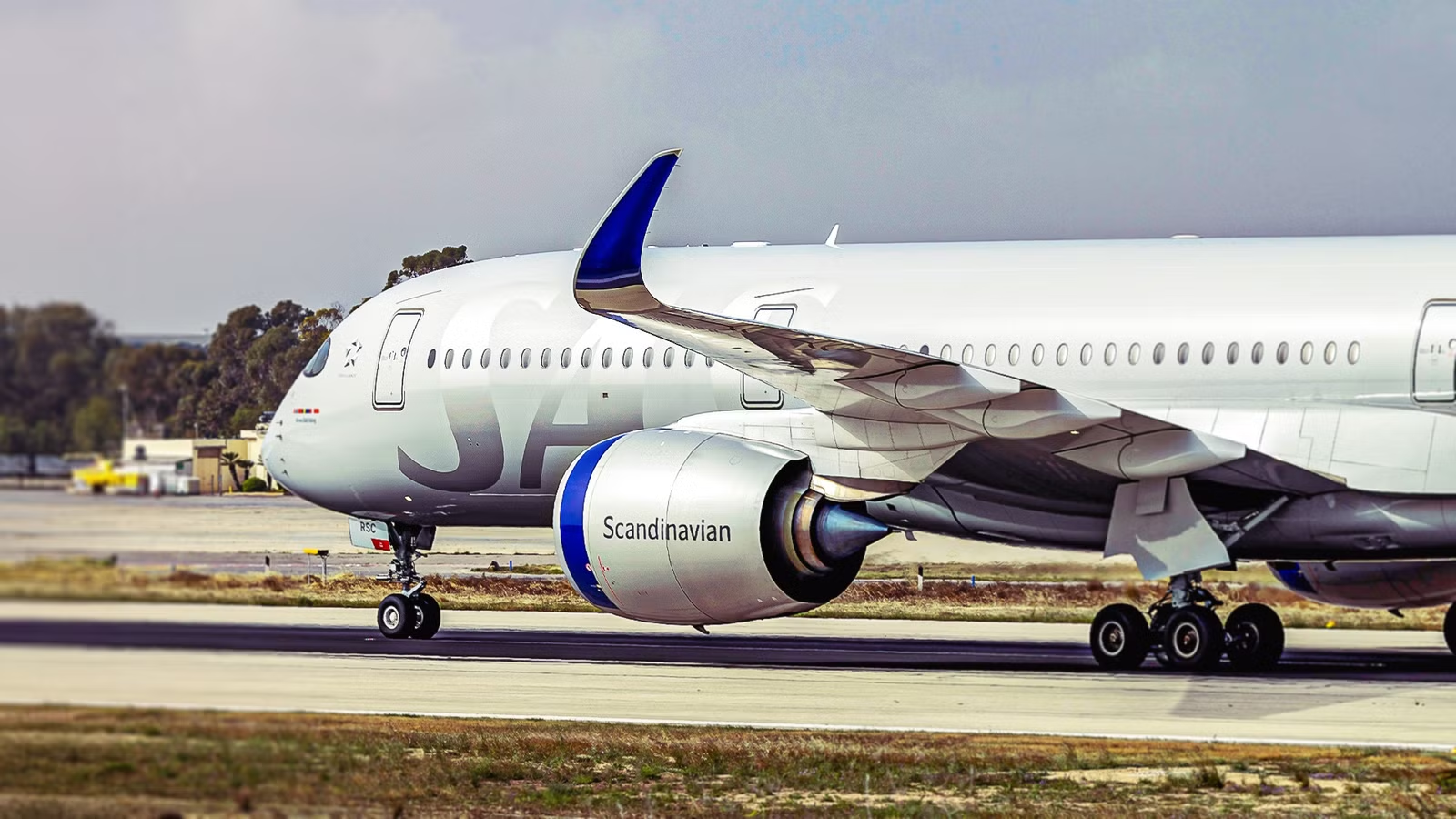
Back in 2024, the Air France-KLM Group acquired a 19.9% minority stake in  Scandinavian Airlines (SAS) following the airline’s restructuring. This investment was part of a larger investment consortium that injected over $1 billion into the struggling carrier. Within this consortium was also American investment firm Castlelake, one of the private equity investors currently in a bidding war to acquire the British low-cost carrier easyJet.
Following this investment, the joint flag-carrier of Denmark, Norway and Sweden left  Star Alliance, of which it was a founding member, in favor of the
  SkyTeam Alliance. A few months later, Air France-KLM announced the group intends to increase its share to a 60.5% majority share. It is expected that this deal will be completed in the second half of 2026, with regulatory approval still pending. However, SAS is already gearing up for future growth, seizing what might be SAS’ opportunity to finally live up to its potential as a true global airline, centered around one increasingly important hub at Copenhagen Airport (CPH).
Why SAS Is Doubling Down On Copenhagen

CPH is by no means a small airport, and with over 32 million passengers in 2025, it is the 19th busiest in Europe. However, over the past decades, the airport has mostly served as a regional hub connecting Northern Europe, with limited intercontinental destinations. Contributing to this has been the fragmented nature of SAS’ operations, which has historically relied on a multi-hub model.
Importantly, SAS, which stands for Scandinavian Airlines System, was originally founded as a political compromise between Denmark, Norway, and Sweden to establish a global airline despite the limited size of their individual markets. In the decades since, this political element never completely disappeared, and the airline was forced to operate a fragmented network split across Copenhagen, Oslo, and Stockholm to appease their respective governments. This never allowed SAS to truly exploit scale benefits at one core hub, translating into a long history of financial struggles and a lack of profitability.
Today, Denmark still retains a 26.4% stake in the airline, which the country will continue to do even after Air France-KLM acquires a majority share. Sweden completely lost its share in the airline as part of the company’s restructuring in 2024, while Norway sold its stake back in 2018. The reason for Denmark’s continued involvement with the airline is likely a result of the government’s favorable attitude towards aviation. This was previously highlighted and praised by Ben Smith, the CEO of Air France-KLM, and is quite contrary to what the group is experiencing with the Dutch government at  Amsterdam Schiphol Airport(AMS).
SAS’ Expected New Shareholder Structure (AeroTime) | ||
|---|---|---|
Shareholder | % | Remark |
Air France-KLM Group | 60.5% | Majority owner after acquiring Castlelake’s 32.0% and Lind’s 8.6%. |
Danish government | 26.4% | |
Other (including staff) | 13.1% | |
Another element is geography, with Copenhagen’s position within Northern Europe being more convenient as a large connecting hub than, for example,  Oslo Gardermoen Airport (OSL) or Stockholm Arlanda Airport (ARN).
However, it is not only connecting traffic that makes Copenhagen Airport so attractive. The airport benefits from a cross-border catchment area with over ten million inhabitants within a four-hour drive. Moreover, Scandinavians have some of the highest disposable incomes and longest annual leave allowances in the world, translating into immense local demand for leisure travel. Besides this, Copenhagen and its surroundings are home to numerous multinational companies, leading universities, and pharmaceutical research centers, generating significant high-yield premium demand.
The Future Of SAS’ Fleet

SAS currently has fewer than twenty long-haul capable aircraft in its fleet, including the Airbus A330-300, A350-900, and A321LR. This is about to change, however, and last month on June 30, SAS announced the company’s largest investment ever. The carrier placed an order for up to 40 A330s, including 10 older -300s for short-term and 20 brand-new -900s, with an option for 10 more. When combining this order with the airline’s current widebody fleet, it means the fleet will grow to at least 44 aircraft, which is comparable to airlines such as  Iberia and SWISS International Air Lines.
The large widebody order came a year after SAS had placed another historic order for 45 Embraer E195 E2, plus another ten options. These regional jets will join SAS Link, the carrier’s regional subsidiary, with the first deliveries scheduled towards the end of 2027. At the time of the announcement, SAS said that the regional aircraft will be vital in enhancing connectivity across Scandinavia and Europe, highlighting how “its size and range are ideally suited to complement SAS’ existing fleet and route structure, allowing for more frequencies, better network flexibility, and lower trip costs“.
Considering the size of the order, it appears SAS is opting for a strategy similar to its new sister KLM Royal Dutch Airlines in Amsterdam. The Dutch airline operates a dense feeder network, using a large fleet of Embraer E-Jet family aircraft under the KLM Cityhopper brand.
The Latest SkyTeam Routes From Copenhagen

While Copenhagen was already the carrier’s largest hub before the pandemic, the airport’s dominance within SAS’ network continues to grow. According to aviation data and analytics firm Cirium, Copenhagen represented over half of the airline’s capacity last year and served the largest number of routes. Something that is expected to intensify as additional aircraft enter the fleet.
In preparation for SAS’ entry into SkyTeam, the airline commenced a route between Copenhagen and  Delta Air Lines’ largest hub,
  Hartsfield-Jackson Atlanta International Airport (ATL) in the summer 2024 with an official codeshare agreement between the two airlines following a few months later after SAS had entered into SkyTeam.
In the spring of 2025, this agreement was expanded, and SAS launched flights from Copenhagen to  Seattle-Tacoma International Airport (SEA), while Delta itself opened a new route from
  Minneapolis-St. Paul International Airport (MSP) and SAS’ new global hub. The US airline also expanded its seasonal service between
  John F. Kennedy International Airport (JFK) and Stockholm. SAS is also in the process of integrating into the transatlantic joint venture of Air France, KLM, Delta, and Virgin Atlantic.
New SkyTeam Routes From Copenhagen | |
|---|---|
Airline | Destinations |
Scandinavian Airlines | Atlanta, Seattle, Dubai, Krabi, Phuket, Mumbai, Seoul |
Delta Air Lines | Minneapolis-St. Paul |
China Eastern Airlines | Shanghai |
Vietnam Airlines | Ho Chi Minh City |
Outside the US, SAS has started new services to Korean Air’s hub at  Seoul Incheon International Airport (ICN). This summer, a new route to
  Chhatrapati Shivaji Maharaj International Airport (BOM) in Mumbai is also scheduled to start, but regulatory hurdles have created some hindrance. For the upcoming winter, capacity across the carrier’s existing long-haul network is being increased further, as two new A350-900s enter the fleet. Moreover, the airline is opening a number of leisure-focused winter routes, including Krabi and Phuket in Thailand, as well as Dubai. Erik Westman, Chief Revenue Officer at SAS spoke about the carrier’s expansion of its network.
“With additional A350 aircraft and increased capacity on key routes across Asia, the Middle East, and North America, we are strengthening our global network while continuing to deliver the reliable, world-class punctuality our customers expect from SAS. This expansion reflects the strong momentum of our transformation and our ambition for sustainable growth,”
Other SkyTeam members that have started serving Copenhagen following SAS’ entry into the alliance include China Eastern Airlines and Vietnam Airlines. The former serves the Danish capital three to five times weekly from  Shanghai Pudong International Airport (PVG) using an A330-200, while Vietnam Airlines offers three weekly flights from Ho Chi Minh’s Tan Son Nhat International Airport (SGN) on a Boeing 787-9 Dreamliner.
SAS’ Short-Haul Growth Potential From Copenhagen

Besides long-haul growth, it will also be interesting to see where SAS will deploy its new short-haul capacity over the next few years. Since Copenhagen sits roughly in the center of Northern Europe, much of Northern Germany, Scandinavia, the Baltics, Finland, and Poland, and the Netherlands are reachable within a roughly one-to-two-hour flight.
This makes Copenhagen an ideal regional hub, and since Copenhagen sits more to the south of the Nordics, the airport serves as an ideal connection point for short-haul O&Ds throughout the rest of Europe, a position SAS will likely continue to strengthen.
It will also be interesting to see what Scandinavian Airlines’ long-term strategy will be in the German market. Northern Germany, in particular, appears to be an attractive market for SAS to gain market share. After Air Berlin’s bankruptcy in 2017, a lot of capacity disappeared from the northern part of Europe’s largest economy, while the Lufthansa Group has increasingly opted to reduce domestic feeder flights and concentrate operations at  Munich Airport (MUC) and
  Frankfurt Airport (FRA). Moreover, Germany’s aviation market has still not recovered to its pre-pandemic levels.
Another interesting factor here is that a new state-of-the-art high-speed railway line will connect Hamburg, Germany’s second-largest city, in under three hours to Copenhagen and its airport from the beginning of the next decade. In essence, this adds Hamburg to Copenhagen’s direct catchment area. At the same time, Germany’s national railway, Deutsche Bahn, the first intermodal member of Star Alliance and an important part of Lufthansa’s domestic feeder strategy, is expected to continue struggling with reliability issues between Hamburg and Frankfurt Airport for the foreseeable future.