dailynewsnblog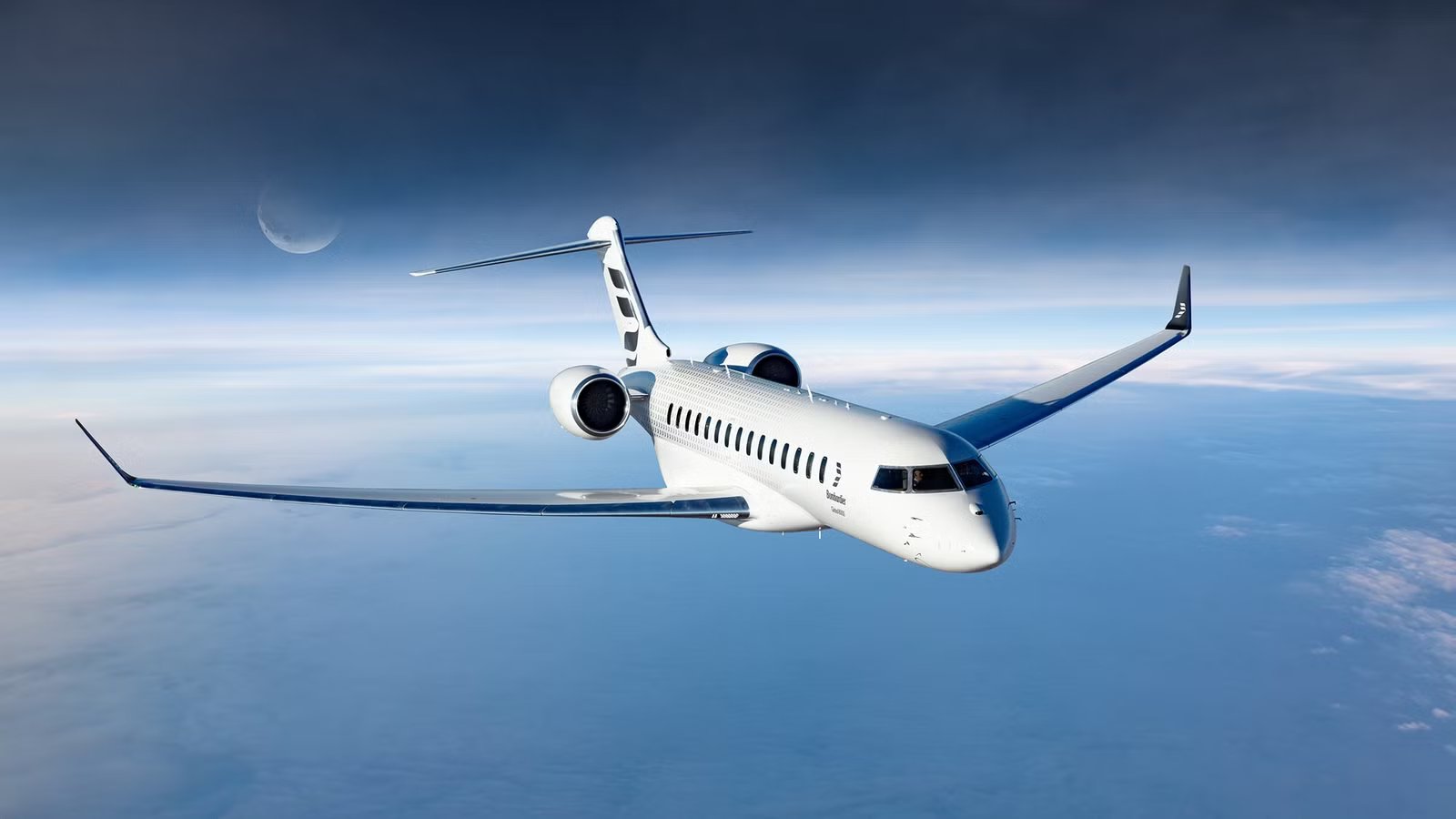
President Donald Trump has opened a new front in the United States‘ aviation dispute with Canada, declaring on September 7 that Bombardier should no longer be allowed to sell aircraft in the US unless it builds them there. The White House has yet to explain how such a restriction would work, while Reuters notes that Bombardier already has a substantial American presence. The company has also been making major expansions to its US service network, making Trump’s ultimatum potentially consequential well beyond Bombardier’s Canadian factories.
Yet the latest threat did not appear from nowhere. Bombardier was already caught in a confrontation between Washington and Ottawa earlier this year after Canada appeared to delay the certification of four Gulfstream business jets. Trump threatened tariffs and certification action against Bombardier in retaliation; Canada subsequently approved the Gulfstreams, and the issue appeared to recede. Seven months later, the argument has returned with a much broader demand: build Bombardier aircraft in America, or risk losing access to its biggest market.
How The Gulfstream Dispute Put Bombardier Back In Trump’s Crosshairs

The dispute began in January, when Trump accused Canada of unfairly withholding certification of the US-built Gulfstream G500, G600, G700 and G800. All four had FAA approval, but still required Canadian validation before being sold and operated there. Canada maintained that its regulator was following its normal certification process, but Trump argued that the delay benefited Canadian rival Bombardier and threatened to retaliate against its aircraft. At the time, FAA administrator Bryan Bedford said that the FAA expects other countries’ aviation authorities to accept its certifications:
“Our concern is whether or not sufficient resources are being applied to US products equal to the resources that we’re applying to certify foreign products. We just want a level playing field.”
Trump’s initial response was dramatic: he threatened to decertify Canadian-built Bombardier aircraft in the US, and impose a 50% tariff on Canadian aircraft unless the Gulfstream situation was resolved. That raised an unusual aviation-safety question because aircraft certification is normally a technical process rather than a trade-policy instrument. A threatened decertification would also have been considerably more disruptive than a tariff, although neither measure was ultimately implemented.
Transport Canada approved the G500 and G600 on February 15, and followed with the G700 and G800 later that month. Transport Minister Steven MacKinnon insisted that the approvals were the result of the normal regulatory process rather than US pressure. The underlying competition is significant: at the very top of the private-jet market, Gulfstream’s G700 and G800 go directly up against Bombardier’s Global family, particularly the new Global 8000.
But the dispute apparently never left Trump’s mind, and today, he was back on the offensive against Bombardier:
Trump’s latest statement is no longer simply conditional on Canada certifying Gulfstream aircraft; it demands US manufacturing by Bombardier. Given that US manufacturing already exists, and further capital investment by the Canadian manufacturer in the US market appears unlikely in the current trade climate, it’s not clear whether the statement is an empty threat or will result in further actions. Washington has not yet said whether this could translate into tariffs, import restrictions, certification action or another mechanism, leaving both Bombardier and its American customers waiting to learn what the threat means in practice.
Any action against Bombardier could also have very direct consequences for American aerospace manufacturing. Bombardier employs more than 3,000 people across nine US facilities, and supports thousands more jobs through 2,800 American suppliers. Its flagship Global 8000 is already partly made in the US: the aircraft’s wings are manufactured at Bombardier’s Red Oak, Texas facility, while its GE Aerospace Passport engines are assembled in Lafayette, Indiana. The Challenger 3500, meanwhile, uses Honeywell‘s HTF7000-family engine, whose production is centered in Phoenix, Arizona.
In other words, although final assembly remains in Canada, a significant part of the economic value generated by every Bombardier sold flows through an already deeply integrated North American aerospace supply chain, representing thousands of US jobs and billions of dollars of value to the US economy.
These Are The Bombardier Jets That Could Be Affected

Bombardier today is very different from the company that once built Bombardier CRJ regional jets, Learjets, and the Bombardier CSeries airliner. Its commercial aircraft businesses have been divested, with the CSeries becoming the Airbus A220, while Mitsubishi Heavy Industries acquired the CRJ program and its type certificates in 2020. That leaves Bombardier focused principally on its Challenger and Global business-jet families.
Family | Current Model | Approximate Range | Segment |
|---|---|---|---|
Challenger | Challenger 3500 | 3,400 nm | Super-midsize |
Challenger | Challenger 650 | 4,000 nm | Large cabin |
Global | Global 5500 | 5,900 nm | Long-range |
Global | Global 6500 | 6,600 nm | Long-range |
Global | Global 7500 | 7,700 nm | Ultra-long-range |
Global | Global 8000 | 8,000 nm | Ultra-long-range flagship |
The Challenger 3500 is arguably the most important model to watch because it is deeply embedded in the US fractional-ownership market. At the opposite end of the range spectrum sit the Global 7500 and 8000, some of the highest-value aircraft Bombardier produces. The Global 7500 has already accumulated over 150 city-pair speed records, while the Global 8000 now extends the family’s advertised range to 8,000 nautical miles and competes directly with Gulfstream’s latest flagships.
Those aircraft also underline why Trump’s manufacturing demand cannot be fulfilled overnight, or even in his time remaining as president. Bombardier’s modern production system, workforce, and tooling are centered on its final assembly lines in Montreal (Challenger) and Toronto (Global). Moving these lines, or duplicating them in the US, is much easier to suggest politically than to execute commercially. Just as unlikely as if Canada were to retaliate by saying its airlines would drop their current 120+ orders for US-manufactured aircraft unless  Boeing moved their production from Seattle to Saskatchewan.
NetJets And Flexjet Have The Most At Stake

Any restriction specifically targeting new Bombardier aircraft sales would principally hit business aviation and fractional-ownership operators. The most striking American exposure belongs to Netjets. Bombardier revealed in 2024 that the Berkshire Hathaway-owned operator had placed a firm order for 12 Challenger 3500s with options for another 232, giving the agreement potential scope for as many as 244 aircraft and more than $6 billion in value if every option were exercised.
Flexjet is another major Challenger operator and describes itself as the longest-standing fractional operator of the family, with 86 Bombardier Challenger 300/350/3500-series aircraft on its US operating certificate.
US Operator | Bombardier Exposure | Why It Matters |
|---|---|---|
NetJets | Challenger 350/3500 | 12 Challenger 3500s firm + 232 options |
Flexjet | Challenger 350/3500 and other Bombardier types | Challenger is a core fractional platform |
Airshare | Challenger 3500 | Agreements covering up to 40 aircraft across two commitments |
Wheels Up | Challenger 300/350 series | One of only two aircraft families in its modernized jet fleet |
Kansas City-based Airshare has also made the Challenger central to its fractional strategy, announcing an agreement for up to 20 additional Challenger 3500s in 2023 on top of an earlier commitment for up to 20. Wheels Up presents a somewhat different case: it completed a fleet overhaul in April 2026 that left its own revenue jet operation centered exclusively on the Challenger 300 series and Embraer Phenom 300. How much either company would be affected therefore depends heavily on whether Washington ultimately targets only newly manufactured Bombardiers, or adopts broader measures involving imports, certification or support.
For now, Bombardier cannot simply relocate aircraft production to the United States in response to a presidential demand, leaving tariffs, negotiated concessions or another form of trade restriction among the possible next steps. And regular readers of Simple Flying will know that there is an intriguing precedent for all of this antipathy towards Bombardier. Back in 2017, Trump’s Commerce Department threatened the Bombardier CSeries with enormous duties at the urging of Boeing, following a large  Delta Air Lines order.
The US courts ultimately ruled against those duties, saying that Boeing had not suffered material injury, but not before Airbus had acquired control of the CSeries program and created the A220. That was very bad news for Boeing, but ultimately good news for the US workers at Airbus’ final assembly in Mobile, Alabama. Which all goes to show that these sorts of trade fights can have unintended consequences far beyond the tariffs originally being debated. What this one produces remains to be seen.