dailynewsnblog
 Emirates is widely regarded as a premium-focused airline, and much of its long-haul strategy is built around premium cabins. Over the years, the carrier has built a strong reputation for its business class product, which is considered one of the best in the industry. In fact, in Skytrax’s 2025 rankings, the airline placed 11th globally for business class. Currently, it offers business class across its fleet. Undoubtedly, the Airbus A380remains its most well-known business class product. Business class passengers receive a range of premium perks, including chauffeur services in select markets, access to the onboard lounge, lie-flat beds, and premium dining throughout the flight.
But of course, that comes at a price. Business class tickets on routes from hubs like Dubai to New York or London can cost anywhere from around $2,500 to well over $5,000 one way, while round-trip fares can easily reach $10,000 depending on the route and travel period. Not everyone can afford that. Still, it is possible to find significantly cheaper tickets on the same aircraft and routes, and the main difference often comes down to when the ticket is booked.
Emirates Uses Dynamic Pricing Rather Than Fixed Fares

Over the years, the aviation industry has seen significant technological development across almost every area, from aircraft and engines to navigation, communications, and passenger systems. Airline pricing has also evolved alongside those changes. Up until the late 1970s, airline fares were heavily regulated (especially in the US), which meant carriers had far less flexibility in how they priced seats.
Deregulation changed that and allowed airlines to adjust fares more freely based on market conditions and demand. Today, airlines generally use static, dynamic, and continuous pricing strategies, as explained by OAG. Dynamic pricing, in particular, has become common in recent years. In simple terms, it means fares can move up or down depending on factors such as demand, seasonality, remaining seat availability, booking timing, and competitor pricing.
Like most major airlines, Emirates uses this type of pricing model for its Airbus A380 business class cabin. Instead of offering seats at a fixed price, the airline adjusts fares constantly based on demand and booking activity. That is why the exact same business class seat can cost thousands of dollars more or less depending on when the ticket is purchased.
The Biggest Factors Affecting Emirates A380 Business Class Fares

One of the factors that can determine the price is when the booking is made. Cheaper business class fares are usually limited, meaning passengers booking months in advance are more likely to find lower fares before those tickets sell out. Once those are sold, Emirates gradually moves to more expensive business class categories. Prices can increase significantly closer to departure, especially on routes with strong corporate demand, where travelers often book late and have far less flexibility with their schedules. In fact, some travel experts suggest booking long-haul flights at least six to eight weeks before departure to improve the chances of finding lower fares.
There is also a common belief that booking a middle-of-the-week flight, particularly on Tuesdays and Wednesdays, can sometimes be cheaper because airlines may adjust fares to stimulate bookings during slower periods. However, opinions on this vary, and many industry observers consider the idea of Tuesday being the “cheapest day” to book flights more of a long-standing travel myth than a guaranteed rule. Furthermore, some broader airline pricing data have also suggested that if you look for off-peak hour flights, such as late at night or early morning, you might find some cheaper options, although this is not something specific to Emirates.
Seasonality also plays a major role. During holidays, school breaks, major international events, and peak tourism periods, when travel demand is naturally much higher, fares can increase sharply. Besides, competition on a route can also influence pricing. In markets where Emirates faces strong competition from airlines such as  Qatar Airways,
  Etihad Airways, Turkish Airlines, Singapore Airlines, or British Airways, fares may become more competitive as carriers try to attract premium travelers.
On routes where Emirates has a stronger market position or a more convenient network offering, fares can remain higher. Additionally, certain routes also naturally command more expensive business class tickets than others. Major business and luxury travel markets such as Dubai–London, Dubai–New York, Dubai–Sydney, and Dubai–Paris tend to generate strong premium demand throughout the year. Passengers flying on these routes are often willing to pay more for comfort, premium service, and convenience.
What Are The Benefits Of Flying In Emirates’ Business Class?
Taking luxury to another level.
How Much Emirates Airbus A380 Business Class Actually Costs

As noted earlier, Emirates uses a dynamic pricing model, meaning there is no fixed price for a ticket. The amount passengers end up paying depends on the route they are flying, the booking period, demand levels, and the fare category that they choose at the time of purchase. In general, passengers booking well in advance can often find Emirates A380 business class fares within the range of roughly $2,500 to $4,000 one way, particularly during fare sale periods. Round-trip fares booked early can often fall between $7,000 and $9,000.
However, prices can rise sharply closer to departure. On high-demand routes such as New York–Dubai, one-way business class fares can regularly range between $4,000 and $7,000, while last-minute bookings can sometimes climb as high as $12,000 to $13,000 for the same seat. In addition, Emirates currently offers three different business class fare categories on most routes, including Saver, Flex, and Flex Plus.
|
Business Savers |
Lowest prices, limited availability and flexibility |
|---|---|
|
Business Flex |
Mid-range pricing with change and cancellation option for a fee (around $150) |
|
Business Flex Plus |
Highest prices, maximum flexibility, complimentary change and cancellation |
Fares between those categories can vary by several thousand dollars on the same flight. The main differences between those fare types are flexibility, refund conditions, and loyalty benefits. Lower business class fares generally come with higher change fees and stricter refund rules, while more expensive fare categories include greater flexibility. Emirates Skywards mileage earning rates can also vary depending on the fare selected.
What Passengers Can Expect When Flying Emirates A380 Business Class

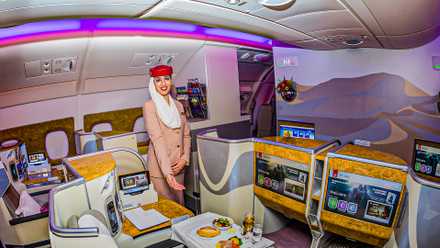
No matter how much a passenger ends up paying for an Emirates Airbus A380 business class ticket, they are guaranteed to get one of the most premium experiences. It starts well before departure. In many major cities, Emirates offers complimentary chauffeur-driven transfers for business class travelers, usually using premium sedans or SUVs. Passengers also receive access to dedicated lounges across the airline’s network. In fact, at  Dubai International Airport (DXB), the airline operates a large dedicated business class lounge with dining areas, beverage stations, shower facilities, and quieter seating spaces for long-haul travelers.
It also offers priority check-in services and increased baggage allowances for business class passengers. Travelers can check in up to 40 kilograms (88 pounds) of baggage, alongside two carry-on bags weighing up to seven kilograms (15 pounds) each. Furthermore, on board, the airline offers lie-flat seats arranged in a 1-2-1 configuration, based on the Safran SkyLounge platform. Each seat includes personal storage areas, individual reading lights, and an 18-inch inflight entertainment screen.
Additionally, business class passengers receive a multi-course dining service inspired by both international and regional cuisines, with menus often varying depending on the route being operated. Besides, Emirates A380 business class passengers also get access to the airline’s onboard lounge at the rear of the upper deck. The space includes a curved bar area with seating, which allows passengers to order drinks and light snacks or simply leave their seats and move around during long-haul flights.

Why Does Emirates Keep Upgrading Its Airbus A380s?
The carrier has committed strongly to the superjumbo.
Some Emirates A380s Are Getting New Business Class Seats

Over the years, Emirates has continued to invest heavily in its premium products. In recent years, the airline has been carrying out a large-scale cabin retrofit program covering both its A380 and 777 aircraft. Much of that work has been focused on introducing premium economy across the fleet and updating older business class cabins on 777s. Regarding its A380s, many retrofitted aircraft have mainly received incremental upgrades, including refreshed interiors, updated finishes, and improved technology.
However, the next stage of the program goes much further. Last year, Emirates confirmed plans to update the interiors of 111 aircraft, including 60 Airbus A380s, with the aircraft finally set to receive completely new business class seats. Starting from August 2026, the airline plans to begin installing its newer Airbus A350 business class seats on the A380 fleet. It is introducing Safran’s S Lounge seating concept, which has already appeared on recently retrofitted Boeing 777 aircraft.
The updated seats are expected to feature newer technology, including 4K ICE entertainment screens, USB-C charging, wireless charging support, and improved connectivity features. Emirates President Tim Clark noted, “Emirates’ retrofit program is about continuously elevating standards across our entire fleet…we’re taking this commitment a step further with the aim of delivering product consistency at scale, in tandem with next-generation innovations in seating, entertainment, and connectivity being brought into service with our newly delivered fleet.”
The Same Seat, Very Different Prices

Even with the upcoming upgrades, one thing that is unlikely to change is the overall experience passengers receive while flying Emirates Airbus A380 business class. From chauffeur-drive services and dedicated lounges on the ground to lie-flat seats, premium dining, and access to the onboard lounge during the flight, the airline continues to position the product among the most premium business class offerings in the industry.
Of course, that experience comes at a cost. Emirates A380 business class fares can range from around $2,500 to $4,000 one way when booked well in advance, while prices on high-demand routes and last-minute bookings can climb well beyond $10,000 for the same cabin. At the same time, passengers can still find significantly cheaper fares depending on when the booking is made and which fare category is available at that moment.
Because Emirates uses a dynamic pricing model, ticket prices constantly change based on factors such as demand, seasonality, seat availability, route competition, and proximity to departure. As a result, two passengers sitting in the same business class cabin on the same flight may have paid completely different fares for a nearly identical experience.
Catch what other trackers miss
Emergency squawks, holds, NOTAMs — live signals, no signup.
Open tracker
Catch what other trackers miss
Emergency squawks, holds, NOTAMs — live signals, no signup.
Open tracker