dailynewsnblog
More than half of all United States Air Force (USAF) combat jets are made up of Lockheed MartinF-16s, an aircraft that first flew in 1974. That single fact says more about the state of American airpower than any defense budget document. The USAF currently operates five major combat jet fleets, spanning over fifty years of aviation history. Some are growing, some are being quietly retired faster than Congress will admit.
This article examines the five largest combat jet fleets currently operated by the US Air Force, ranked by total airframe numbers across active-duty, Air National Guard, and Reserve components. The picture that emerges is one of stark contrasts: aging designs kept alive far longer than their architects intended, ambitious new programs moving slower than planners hoped, and a service wrestling with what it means to maintain global air dominance while the definition of air dominance continues to shift beneath its feet.
5
Fairchild Republic A-10C Warthog
162 examples

The Fairchild Republic A-10C Thunderbolt II, or “Warthog”, was never designed for air-to-air combat. It was built from the ground up around its iconic GAU-8 Avenger 30mm rotary cannon, conceived as a flying tank-killer for a potential Soviet armored thrust into Western Europe. After the Cold War, that role shifted rather than disappeared. Weapons like the AGM-65 Maverick missile expanded its flexibility, but the core concept remained largely unchanged.
Today, around 162 aircraft remain in service with the USAF, as confirmed by the FY2026 Pentagon budget request.
That’s a steep drop from more than 700 at its Cold War peak. The pace of retirements has picked up: 39 jets were sent to Davis-Monthan Air Force Base in 2024 alone, compared to 17 the year before.
The FY2026 defense budget proposed retiring all remaining 162 A-10s at an accelerated timeline, requesting $57 million to complete the drawdown by 2027, two years ahead of the previously planned schedule. Congress has once again intervened, citing a lack of viable replacement for the dedicated CAS mission.
Despite its dwindling numbers, the Warthog fleet continues to demonstrate operational relevance in a way that embarrasses retirement advocates. They’ve also been used more broadly than many expected, including maritime strike roles and combat search and rescue support. A-10s were deployed to the Middle East under CENTCOM throughout 2025, actively intercepting Shahed-type drones, a mission for which their endurance and gun accuracy proved unexpectedly well-suited, as proved by Militarnyi.com.
Since the 2026 Iran Crisis, Warthogs have been employed against naval targets, and in one recent incident involving a downed F-15E Strike Eagle crew, A-10s were part of the response package. On April 3, an A-10 crashed, though the pilot was recovered safely.

Which Country Has The Most Superior Military Jets In The World?
Discover why the US leads global air power with over 13,000 aircraft, cutting-edge fighters like the F-35, and sixth-gen tech like NGAD and B-21.
4
Lockheed Martin F-22 Raptor
180 examples
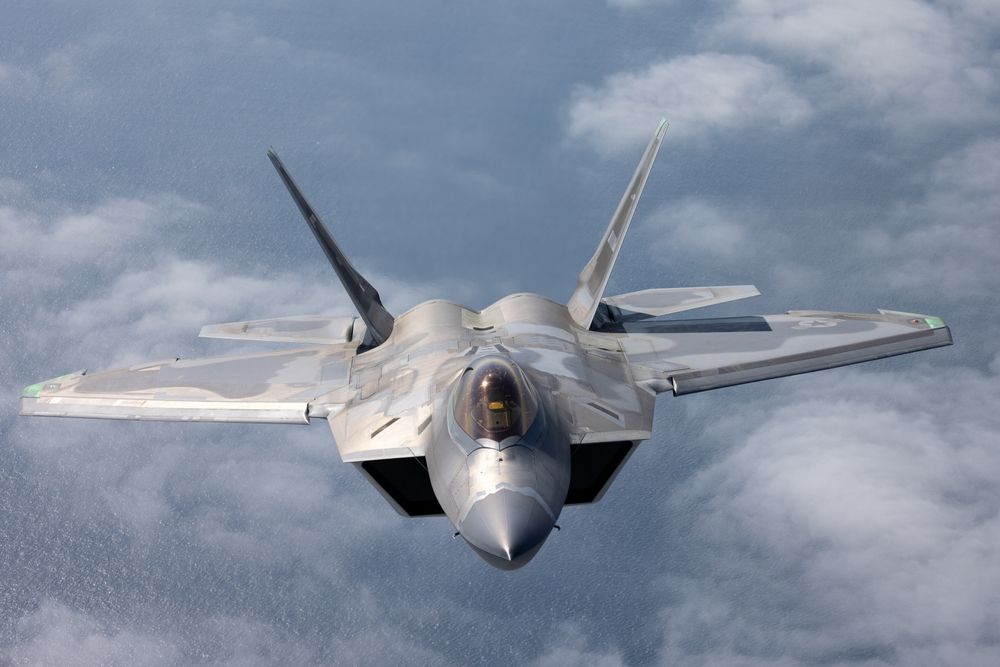
The F-22 Raptor represents one of the most consequential procurement decisions in the history of military aviation, and not for the reasons its advocates would prefer. The aircraft itself is, by most credible assessments, the finest pure air superiority fighter ever built. It combines super cruise — the ability to sustain supersonic flight without afterburner — with thrust-vectored super maneuverability, all-aspect stealth across multiple frequency bands, and a sensor fusion architecture that integrates radar, electronic warfare, and infrared data into a single coherent tactical picture for the pilot.
In a theoretical one-on-one engagement, or in a scenario involving small groups of aircraft, there is currently no peer adversary platform that can match the Raptor’s combination of these attributes. The problem is not the aircraft. The problem is how few of them exist. The USAF currently operates approximately 180 F-22As, with 32 of those in an older Block 20 configuration used primarily for training and testing rather than combat.
The root of the problem is one of the most debated procurement decisions in modern aviation history. The USAF originally planned to buy 750 F-22s; that number was progressively cut to 381, then to 187, as per-unit costs ballooned when development expenses were factored in. One airframe has since been lost, and the Air Force has repeatedly requested retirement of the 32 non-combat-coded Block 20 jets — a move Congress has blocked each time.
The Raptor’s successor was formally unveiled in March 2025, when the Pentagon confirmed that Boeing had been awarded the Next Generation Air Dominance contract, designating the new platform the F-47. R&D funding for the F-47 stands at $2.6 billion in the FY2026 request. Until that aircraft reaches operational service, the F-22, in its limited numbers, remains the only true fifth-generation air superiority fighter in the US inventory, a burden the fleet was never sized to carry alone.
3
McDonnell Douglas F-15 Eagle Family
385-400 examples

The F-15 family has been in US Air Force service since 1976, when the aircraft was manufactured by McDonnell Douglas , and remains a central part of the tactical fleet. Today, the combined inventory of F-15C/D air superiority fighters, F-15E Strike Eagles, and the new F-15EX Eagle II stands at roughly 385-400 aircraft. According to 2025 fleet data, this includes around 137 F-15C/Ds, 218 F-15Es, and a small but steadily growing number of F-15EXs.
The future of the fleet is increasingly tied to the F-15EX. The latest variant introduces a fully open-architecture mission system, the Eagle Passive/Active Warning Survivability System (EPAWSS), and a significantly expanded weapons capacity—up to 22 air-to-air missiles in a single sortie. The FY2026 budget request includes funding for 21 additional aircraft, with Boeing aiming to increase production to 24 jets per year by 2027, although industrial delays have raised some uncertainty around that timeline.
Despite its size, the F-15 family now ranks third among USAF combat fleets, having been overtaken by the F-35A Lightning II. What keeps it relevant is not stealth, but capacity. In scenarios where range and payload matter more than low observability, the F-15, particularly the EX, offers a level of missile carriage that no other USAF fighter currently matches.
The outlook for the F-15E Strike Eagle, however, is considerably less optimistic. USAF planning documents indicate that combat-coded Strike Eagles could decline from approximately 133 aircraft today to roughly 78 by 2030, driven by accelerating parts obsolescence and sustainment challenges on an airframe that entered service in 1988. The Eagle family as a whole ranks third among USAF combat fleets, a position it holds not through stealth or cutting-edge avionics, but through sheer payload capacity and the accumulated operational experience of more than four decades.

Why Does The US Air Force Still Fly The F-15?
Discover how the Eagle remains vital in modern warfare and why the new F-15EX will keep it flying for decades!
2
Lockheed Martin F-35A Lightning II
439 examples

The Lockheed Martin F-35A Lightning II has quickly become the centerpiece of the US Air Force’s combat fleet. With around 439 aircraft currently in service, it is now the second-largest fighter fleet in the inventory, having overtaken the entire F-15 Eagle family. The 500th jet was delivered in August 2025, but with a total program record set at 1,763 aircraft, the USAF is still only partway through the build-up.
What sets the F-35 apart is not just low observability, but how it handles information. Its AN/APG-81 radar, EOTS, and Distributed Aperture System are designed to work together, giving the pilot a single, fused picture rather than separate streams of data. Compared to fourth-generation aircraft, the difference is less about raw performance and more about situational awareness—what the pilot sees, and how quickly decisions can be made.
That capability is still evolving. Block 4 upgrades, tied to the Technology Refresh 3 (TR-3) hardware package, are gradually being introduced across the fleet, bringing new weapons options and expanded electronic warfare functions. Progress has not been entirely smooth, however. Delays with TR-3 have slowed the rollout, and aircraft still operating with earlier configurations risk falling behind as the standard shifts. Procurement pace is the F-35’s primary vulnerability — the FY2026 budget cut orders from 44 to 24 jets, well below the 72 per year deemed necessary for recapitalization.
1
Lockheed Martin F-16 Fighting Falcon
912 examples

The F-16 Fighting Falcon fleet remains, by a clear margin, the largest in the US Air Force. With roughly 762 F-16Cs and 150 F-16Ds in service, the total comes to around 912 aircraft spread across active-duty units, the Air National Guard, and the Air Force Reserve. In practice, that means the “Viper” still accounts for more than half of the USAF’s tactical fighter inventory, a status it has held since the early 1980s.
That scale is the result of both numbers and longevity. More than 3,000 F-16s were built for the US military, and a large portion of that fleet is still flying today in progressively upgraded configurations. The type has been continuously upgraded: AESA radar upgrades, Sniper Advanced Targeting Pods, modernized electronic warfare systems, and structural service-life extensions have kept hundreds of jets operational well beyond their original design limits. Combat-coded F-16s are projected to remain at roughly 488 aircraft through the end of the decade, despite gradual retirements of early-block examples.
The fleet is no longer growing, but it is not disappearing either. Originally designed as an affordable complement to the F-15, the F-16 evolved into one of the most versatile fighters ever built. Capable of nuclear strike, SEAD, close air support, and beyond-visual-range combat, its adaptability is unmatched. While the fleet is gradually being drawn down as F-35 numbers grow, the Viper remains the backbone of USAF tactical aviation, a testament to a design that has endured more than four decades of operational demands.