dailynewsnblog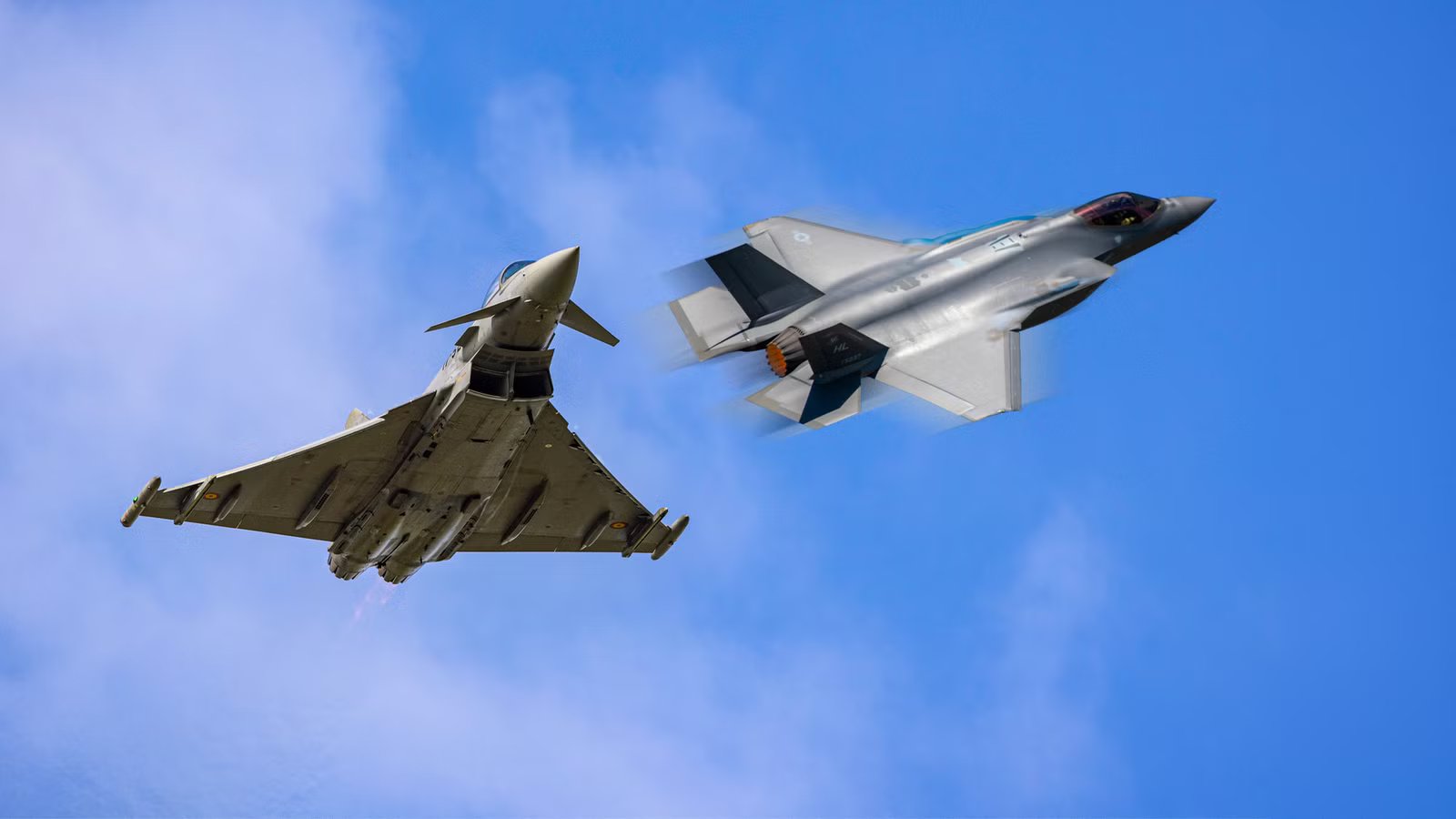
The race to dominate the electromagnetic spectrum has become as important in modern air combat as the ability to fly fast or carry more weapons. When comparing the Eurofighter Typhoon and the Lockheed MartinF-35 Lightning II, two of the Western world’s most capable combat aircraft, the conversation inevitably turns to their fire-control radars. These complex systems define how far each jet can see, how well it can fight, survive, and adapt in an increasingly contested battlespace.
Both platforms carry Active Electronically Scanned Array (AESA) radars that represent the cutting edge of their respective design philosophies. The Typhoon’s CAPTOR-E, and its forthcoming ECRS Mk2 upgrade reflect a doctrine of raw sensor power and electromagnetic flexibility befitting a fourth-generation-plus air superiority fighter. The F-35’s AN/APG-81, meanwhile, is engineered as a node in a broader, deeply integrated sensor-fusion architecture. Understanding how these two systems compare requires looking beyond headline specifications to the strategic philosophies that shaped each aircraft.
Two Different Radars Built On Two Different Doctrines

Comparing the hardware level, both radars belong to the same broad family of AESA technology, but they were born of fundamentally different requirements. The AN/APG-81 was designed by Northrop Grumman specifically for the F-35 program as a successor to the AN/APG-77 fitted to the F-22 Raptor. Its antenna array consists of 1,676 transmit/receive (T/R) modules, with production expected to exceed 3,000 units through contracts running beyond 2035. From the outset, it was conceived as a stealthy, low-probability-of-intercept (LPI) radar that would function as one sensor among many in an integrated avionics suite.
The CAPTOR-E, developed by the Euroradar consortium for the Eurofighter Typhoon, takes a markedly different approach. As the Typhoon is not a stealthy airframe, the CAPTOR-E was engineered to maximize what the fighter’s nose cone can physically accommodate: a bigger antenna, more power, and a uniquely mechanically steered AESA array that gives it a field of regard no fixed-plate radar can match. The radar incorporates gallium nitride (GaN) T/R modules, a technology step that brings greater transmitted power, wider bandwidth, and improved thermal management compared to older gallium arsenide components.
The F-35 was designed around the principle that stealth and sensor fusion create a decisive first-look, first-shot advantage. The Typhoon, never pursuing low observability to the same degree, instead doubled down on raw electromagnetic performance and agility. Both bets have merit, and the comparison between these two radars is, in many ways, a proxy for a deeper debate about how future air battles will actually be fought.
Aperture Size And Detection Range: Where Physics Favors The Typhoon

When it comes to raw detection performance, the Typhoon holds an advantage that stems from a simple, unavoidable fact of physics: a bigger antenna aperture produces a more powerful radar beam. The Typhoon’s wider nose cone allows for a physically larger antenna than the F-35’s stealth-optimized, slightly rearward-angled array, and that difference translates directly into greater detection range and resolution. The F-35’s radar was deliberately sized and angled to minimize its radar cross-section from the front, a trade-off that costs some raw antenna area.
The numbers, while drawn from open-source estimates rather than classified specifications, paint a telling picture. The AN/APG-81 is generally estimated to be capable of tracking a one-square-meter target, roughly the radar cross-section of a small fighter, at approximately 90 to 100 miles. The CAPTOR-E, and particularly the upcoming ECRS Mk2 upgrade, pushes that figure to around 120 miles. That is a meaningful margin in beyond-visual-range combat, where detecting and engaging an opponent before they can do the same is everything.
Radar Detection Range & Hardware Comparison
|
Feature |
Typhoon CAPTOR-E / ECRS Mk2 |
F-35 AN/APG-81 |
|
T/R Modules |
1,000+ (Mk2) |
1,676 |
|
Est. Detection Range (1m² target) |
~120 miles |
~90–100 miles |
|
Antenna Technology |
GaN AESA (steerable) |
GaN-capable AESA (fixed) |
|
Aperture Size |
Larger (bigger nose) |
Smaller (stealth-optimized) |
|
Field of Regard |
~200° |
~120° |
It is worth noting that the ECRS Mk2, while projected to carry over 1,000 T/R modules ( fewer than the APG-81 on paper), benefits from being a newer design with a potentially larger physical aperture, and is expected to outperform the earlier radar in detection terms. Raw module count, it turns out, is not the whole story: antenna size, signal processing architecture, and waveform management all play a role in determining real-world performance.

How the Eurofighter Typhoon Stacks Up Against the US F-35
Dogfight agility meets stealth supremacy. The Eurofighter and F-35 redefine air combat in a clash of speed, power, and cutting-edge tech.
The Steerable Array: The CAPTOR-E’s Most Distinctive Advantage

Perhaps the most striking differentiator in the CAPTOR-E’s design is its mechanically steerable AESA antenna. Rather than a fixed-plate array like virtually every other AESA radar in service today, the CAPTOR-E mounts its antenna on a rotating pivot mechanism.
The result is a field of regard, the total angular volume the radar can cover, of approximately 200 degrees, compared to roughly 120 degrees for conventional fixed AESA systems, including the AN/APG-81. That is a 50% wider scan arc, and it has real tactical consequences.
In a high-speed, close-turning engagement, or when tracking multiple fast-moving targets distributed across a wide angular spread, the CAPTOR-E’s ability to slew its antenna off-boresight without demanding the pilot point the nose at every threat is a genuine combat advantage. For a platform like the Typhoon that was designed with close-in maneuver combat as a core mission, alongside its beyond-visual-range role, this gives pilots a sensor picture that more naturally matches the geometry of a dynamic air battle. The F-35’s fixed array, optimized for the forward sector and shaped partly by stealth requirements, simply cannot replicate this.
The trade-off, of course, is complexity. A mechanically steerable AESA introduces moving parts and maintenance considerations that a fully solid-state, fixed-array avoids. Whether that complexity is worth the performance gain depends on the operational scenario — but for a nation that needs its Typhoons to fight across the full spectrum from low-observable threats to legacy aircraft in contested airspace, the CAPTOR-E’s scan agility is a meaningful capability.
Electronic Warfare: The Battle Inside The Electromagnetic Spectrum

Both radars do more than detect targets; they are also weapons in the electromagnetic domain. The AN/APG-81 has carried electronic warfare capability since its earliest production versions, with the multifunction array enabling electronic protection, electronic attack, and electronic support measures. This means the F-35 can use its own radar to suppress enemy air defenses, jam adversary systems, and gather electronic intelligence, all while conducting its primary detection mission. That capability has been integral to the jet since 2006.
The ECRS Mk2, however, is being engineered to take that concept even further. The defining change of the Mk2 upgrade is the addition of full offensive electronic attack capability directly within the radar system, thus allowing the Typhoon to blind or disrupt an adversary’s radar using its own fire-control sensor. This collapses what was previously a distinction between dedicated electronic warfare jamming pods and the fighter’s own radar into a single, highly capable system. In a dense electromagnetic environment, where suppression of enemy air defenses and the ability to deny an adversary’s radar picture may be as decisive as kinetic weapons, this makes the ECRS Mk2 a particularly formidable tool.
The UK Ministry of Defence committed £204.6 million to the ECRS Mk2 program in June 2025, with initial production radars expected to enter service from 2028. When they do, Typhoon operators will have an electromagnetic weapon of unusual breadth: one that integrates detection, multi-target tracking, and offensive jamming into a single coherent system, pushing the boundaries of what a fighter radar is traditionally understood to do.

Why Will The Eurofighter Typhoon Never Be A Stealth Fighter?
Why the Typhoon can’t be “stealthified.”
Stealth, Sensor Fusion, And Why The F-35 Is More Than The Sum Of Its Radar

Here is where the comparison becomes more nuanced, and where isolating radar performance in a vacuum risks missing the bigger picture entirely. The AN/APG-81 does not operate alone. It is one node in the F-35’s deeply integrated sensor fusion architecture, which links the radar’s output with data from the Distributed Aperture System (DAS), the Electro-Optical Targeting System (EOTS), the aircraft’s electronic warfare suite, and offboard sensors via datalinks. The result is a composite battlespace picture of a richness and coherence that no comparable platform can fully match today.
Crucially, the F-35’s Very Low Observable (VLO) airframe means that an adversary radar, even one as capable as the CAPTOR-E, faces a drastically reduced target to work with. The Typhoon’s larger forward-facing antenna, while more powerful in raw terms, also makes the Typhoon considerably more visible to enemy radar warning receivers. The F-35’s antenna is deliberately angled backward to improve its own stealth signature. An aircraft that can detect an adversary at 90 miles while being seen by that adversary’s radar only at 30 miles holds a decisive engagement advantage, regardless of which jet’s radar is technically more powerful on a range chart.
System-Level Comparison
|
Factor |
Typhoon + CAPTOR-E |
F-35 + AN/APG-81 |
|
Sensor Fusion |
Improving (via AETHER programme) |
Best in class |
|
Stealth / LO airframe |
No (4.5-gen) |
Yes (5th-gen VLO) |
|
IR sensors integrated |
Partial |
DAS + EOTS (360°) |
|
Offboard data integration |
Yes (Link 16) |
Yes (MADL + Link 16) |
|
SAR ground mapping |
Yes |
Yes (high-fidelity) |
The F-35 also carries a unique synthetic aperture radar (SAR) function that can pinpoint ground targets with extreme fidelity — a capability that, combined with the jet’s stealth and sensor fusion, makes it a uniquely capable strike platform. The Typhoon is catching up through capability roadmaps, but the gap in integrated avionics architecture remains real.
What Comes Next For Both Radars

Neither radar is standing still. The AN/APG-81, despite being one of the most capable fire-control radars in service, is already slated for replacement on the most advanced F-35 variants. Reports from January 2023 confirmed that the new AN/APG-85 will be integrated into Block 4 F-35s — a next-generation system that promises even greater performance within the F-35’s stealth-optimized form factor. The evolution of the F-35’s sensor suite is, in many respects, just beginning.
For the Typhoon, the ECRS Mk2 represents a generational leap. With the UK MoD’s £204.6 million investment confirmed and initial production radars due from 2028, the Mk2 will give Eurofighter operators a radar that is not merely competitive with the AN/APG-81 in detection range, but that adds a dimension of offensive electromagnetic attack the original CAPTOR-E never offered. For European air forces operating Typhoons without access to the F-35’s fifth-generation stealth and fusion, the ECRS Mk2 is a credible answer to the question of how to remain relevant in a battlespace increasingly defined by low observability and electronic warfare.
The honest conclusion is that these two radars are expressions of different visions of air power. The CAPTOR-E and its ECRS Mk2 successor excel in raw sensor power, scan geometry, and electromagnetic agility, making the Typhoon a formidable platform in high-end peer adversary environments where electromagnetic dominance is the prize. The AN/APG-81, by contrast, derives its decisive edge not from what it can do in isolation, but from what it enables when embedded in the F-35’s broader architecture: a stealthy, fused, all-domain sensor system that may well be the most sophisticated airborne detection and engagement capability ever fielded. Choosing between a more powerful flashlight and the best night-vision goggles available has never been a simple calculation — and in this case, it probably depends on who you are fighting, and where.