dailynewsnblog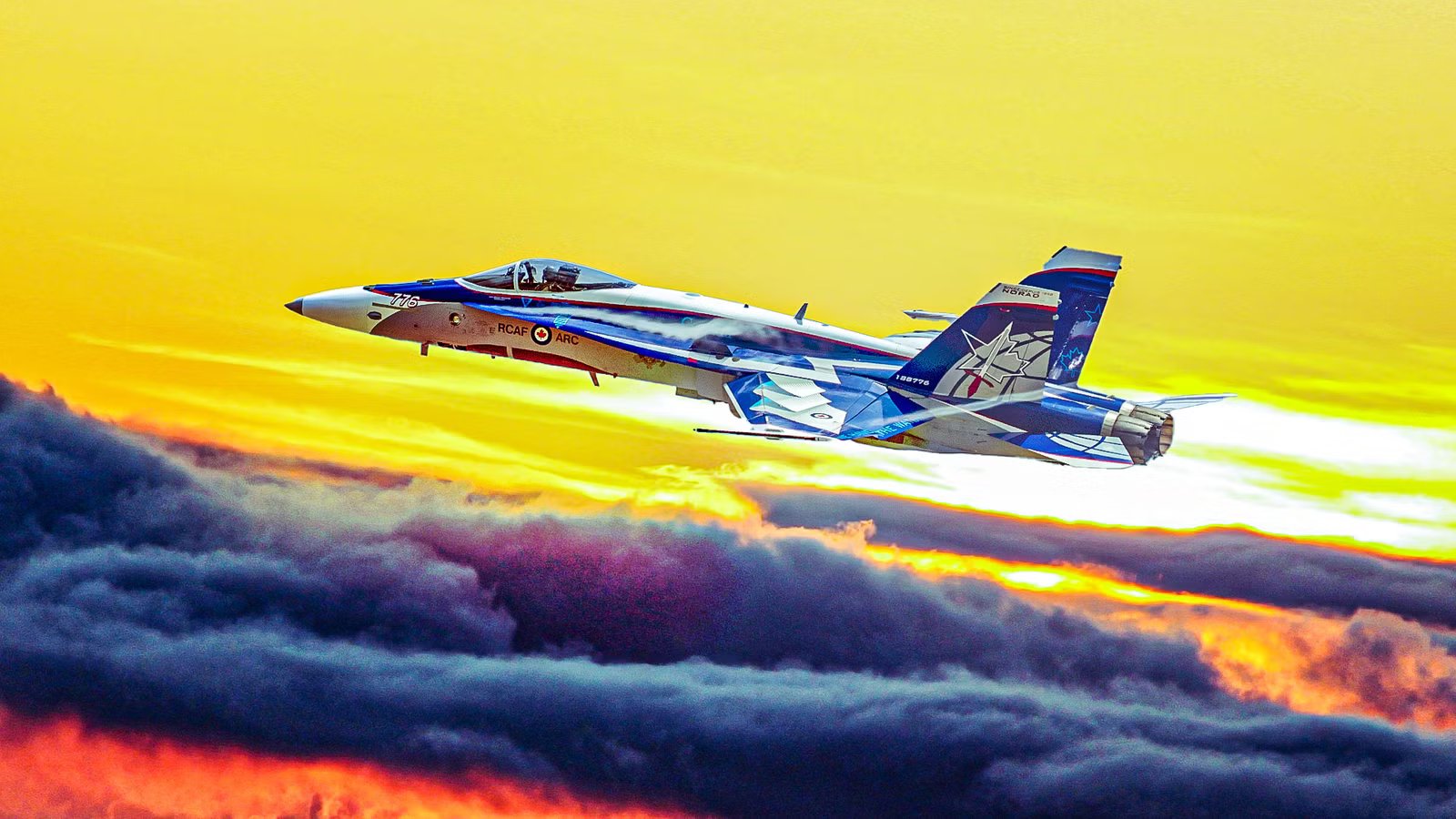
Canada is replacing its McDonnell Douglas CF-18 Hornet fleet with 88 Lockheed Martin F-35A Lightning II fighters, with the first aircraft set for delivery in 2026 and entry into Canadian service beginning in 2028. The decision reflects a clear operational reality: the Royal Canadian Air Force (RCAF) can no longer sustain a fleet in which only around 40% of aircraft are mission-ready, while simultaneously meeting its NORAD and NATO commitments. As confirmed by the Government of Canada, the program represents the country’s most significant air power investment in more than 30 years.
Based on fleet readiness data, Auditor General findings, and NORAD operational requirements, this analysis examines four key drivers behind the transition, from the CF-18’s extended but finite lifespan to the operational, geopolitical, and industrial factors that ultimately made the F-35A the only viable long-term solution.
A Fleet That Has Given Everything It Has

Canada’s CF-18s were acquired in the early 1980s to serve two core missions: continental air defense under NORAD and expeditionary operations alongside NATO allies. At the time of their introduction, they were among the most capable fighters in the Western world. Decades later, and through an impressive series of upgrade programs, they remain operational, but with significantly reduced performance margins.
As 19FortyFive has noted, the CF-18 was designed and conceived in an analog, pre-stealth era, and no amount of modernization work can change that fundamental reality; its radar cross-section still belongs to that era, even with better avionics bolted on.
Throughout the 2000s, the Incremental Modernization Project gave Canada’s Hornets a digitized cockpit, Link 16 datalink capability, enhanced electronic warfare systems, and improved sensors. Center-barrel replacements and structural work extended service lives well beyond what anyone originally anticipated. But those upgrades could not address everything: in some cases, the onboard electronic systems struggled to cope with modern adversary air defense networks and advanced air-to-air missiles. Some avionics and electronics grew so outdated that sourcing spare parts became genuinely difficult, a logistical headache that affected an already strained maintenance pipeline.
By the mid-2020s, the math had become unforgiving. According to Wings Magazine, Canada’s CF-18s are expected to run out of usable service life by around 2032, at which point some airframes will be approaching 50 years old. That is a remarkable run for any fighter jet, but it is also a hard limit. There is no further structural extension on the table, no new modernization program that can push the fleet another decade. No further structural extension is possible. The Hornet has given the RCAF everything it has, and what comes next must be fundamentally different. What comes next has to be something entirely different.
NORAD, NATO, And A Readiness Crisis Nobody Wanted To Say Out Loud

The operational consequences of running an aging fleet on a stretched budget became impossible to ignore by the late 2010s. The RCAF’s CF-18 fleet was unable to meet Canada’s commitments to NATO and NORAD due to a lack of pilots and technicians: aircraft that were, in some cases, nearly 20 years past their original expected replacement date, and that had not received a significant combat upgrade since 2008. Training pipelines had not kept pace with attrition, and the CF-18’s growing maintenance burden was consuming work hours that a smaller, overstretched technical workforce simply could not sustain.
According to the CBC, Auditor General reports highlighted that only around 40 percent of Canada’s fighter inventory was considered serviceable at any given time, mainly due to the CF-18’s age and maintenance burden. For a country with two major alliance commitments: one covering the entire North American continent, one requiring the ability to deploy expeditionary air power to Europe, that readiness rate represented a genuine strategic gap that posed real risks as Russian and Chinese air activity intensified in the Arctic and the Pacific.
What made the situation particularly acute was the shifting threat environment. As previously reported by Simple Flying, recent years have seen a notable spike in NORAD responses to Russian Tu-142 aircraft operating near Canadian airspace, highlighting the need for persistent and capable air patrols. A fighter fleet in which fewer than half the aircraft were serviceable on any given day was not a credible answer to those challenges, and senior Canadian and American defense officials knew it.

The World’s Largest Air Forces By Number Of F-35s
A closer look at some of the leading F-35 armadas around the world.
The Arctic Dimension: Why Geography Makes This Non-Negotiable
To understand the urgency behind Canada’s fighter recapitalization, it is essential to understand what NORAD actually requires of the Canadian Armed Forces and what happens if Canada cannot deliver. NORAD defense covers 360 degrees around the North American continent, from the Arctic avenues of approach in the north to both coasts and the southern border. Canada and the United States are more than simply partners in this arrangement; they are mutually dependent. Without Canada covering its Arctic approaches, the United States is left completely exposed to threats from the north. That is not a theoretical concern; it is the operational reality that has underpinned continental defense for more than six decades.
The Arctic, in particular, has become an increasingly contested strategic space. Russia’s continued investment in long-range aviation and hypersonic weapons systems means that any credible NORAD posture requires persistent, capable patrol capacity across Canada’s vast northern territory. That is an enormous operational demand, covering some of the harshest and most remote airspace on the planet. The CF-18, even at its best, was designed for a different threat environment and a different era of air warfare, making it a fundamental mismatch against the modern threats now regularly probing North America’s northern approaches.
The F-35A addresses that mismatch directly. Its fifth-generation sensor fusion, low-observable characteristics, and advanced electronic warfare capabilities give it the ability to survive and operate in contested, high-threat environments that no legacy platform can match. For Canada’s Arctic sovereignty mission and its NORAD obligations, it is a strategic necessity, and that calculation drove much of the logic behind selecting the F-35A over any of its competitors.
How The F-35A Won The Competition And What Canada Is Actually Getting

Canada’s formal future fighter competition launched in 2017 and drew bids from  Boeing with the F/A-18 Super Hornet, Saab with the Saab JAS 39 GripenE, and Lockheed Martin with the F-35A. The evaluation framework covered three broad categories: operational capabilities, economic benefit to Canada, and airframe and lifecycle support costs, and the F-35A ultimately prevailed across all three. Its interoperability with the United States and NATO allies, and its ability to operate effectively in contested airspace proved decisive factors that no competing platform could fully replicate.
On January 9, 2023, the Government of Canada formally confirmed the acquisition of 88 F-35A aircraft. The deal covers not just the airframes themselves but also associated equipment, weapons systems, infrastructure, information technology, and long-term sustainment. Canada secured the latest Block 4 variants of the F-35A, the most advanced configuration currently available, with the first aircraft expected to be delivered to Luke Air Force Base in Arizona in 2026 for pilot training, and the first jets arriving in Canada itself in 2028.
The industrial dimension of the deal was also a stated evaluation criterion from the outset. More than 110 Canadian companies have contributed to the F-35 supply chain since the program’s inception, with over $3.3 billion USD in contracts awarded to Canadian industry as of January 2025, and both Lockheed Martin and Pratt & Whitney signing Economic Benefits Arrangements with Canada. With annual F-35 production running at roughly five times the rate of any other allied fighter currently being built, Canadian suppliers are plugged into a global manufacturing network of extraordinary scale.

Why The F-35 Is The US Air Force’s Most Important Fighter Jet
Discover why the F-35 is the US Air Force’s most critical fighter — from stealth and sensors to strategy, readiness, and future upgrades
The Complications: Costs, Delays, And Political Turbulence

The F-35 program has faced sustained scrutiny in Canada, driven by rising costs and political uncertainty. Initial projections of roughly CAD $19 billion have grown significantly, with updated estimates exceeding CAD $27 billion, a shift that has intensified public and parliamentary debate. As reported by Simple Flying, this escalation has fed broader concerns about affordability, particularly when lifecycle costs, infrastructure, and sustainment are taken into account.
Beyond cost, the program has been complicated by political signaling that introduced uncertainty into what had appeared to be a settled procurement. Discussions within Ottawa about potentially diversifying the fighter fleet, including renewed interest in alternatives such as the Saab Gripen, have raised concerns among allies. Such signals have been closely watched in Washington, where policymakers view Canada’s fighter choice as directly tied to NORAD integration and collective defense planning.
This political dimension has implications that extend beyond domestic debate. The United States has expressed concern that any deviation from the F-35 plan could complicate interoperability and require adjustments in continental defense posture. As the article highlights, Canada’s fighter procurement is not viewed in isolation, but as a key component of a binational system in which uncertainty—even temporary—can have strategic ripple effects.
Locked In: Why The First Phase Of Canada’s F-35 Program Is No Longer Reversible

Despite the turbulence surrounding the program, a number of concrete steps have already moved Canada beyond the point of easy reconsideration. The country’s long-standing participation in the Joint Strike Fighter program, dating back to 1997, has created deep industrial and institutional ties. These ties are not easily unwound, particularly given the integration of Canadian firms into the global F-35 supply chain and the broader defense relationship with the United States.
Operational commitments further reinforce that reality. Canada’s F-35 acquisition is closely aligned with NORAD requirements, and US officials have made clear that any disruption to the plan could create capability gaps requiring American compensation. This dynamic raises both practical and political costs, as it would shift more of the continental defense burden onto the United States while undermining the long-standing expectation of shared responsibility.
Most importantly, the first tranche of aircraft has already transitioned from planning to execution. Payments have been initiated, training arrangements are in place, and delivery timelines are set, anchoring the program in real, ongoing activity. While future adjustments may remain theoretically possible, the initial phase of the F-35 acquisition is now effectively locked in, with reversal carrying consequences that extend well beyond procurement into strategy, alliance management, and operational readiness.
In the end, Canada’s decision to transition from the CF-18 to the F-35A is a recognition that the strategic, operational, and technological realities of modern air defense have fundamentally changed. The Hornet fleet, despite decades of upgrades and exceptional service, has reached the limits of what it can deliver in an era defined by contested airspace, advanced adversaries, and relentless readiness demands. Faced with declining availability rates, growing maintenance burdens, and expanding obligations under NORAD and NATO, maintaining the status quo was no longer a viable option. The F-35A, with its fifth-generation capabilities and deep integration with allied forces, represents a reset that aligns Canada’s air power with the demands of the next several decades.