dailynewsnblog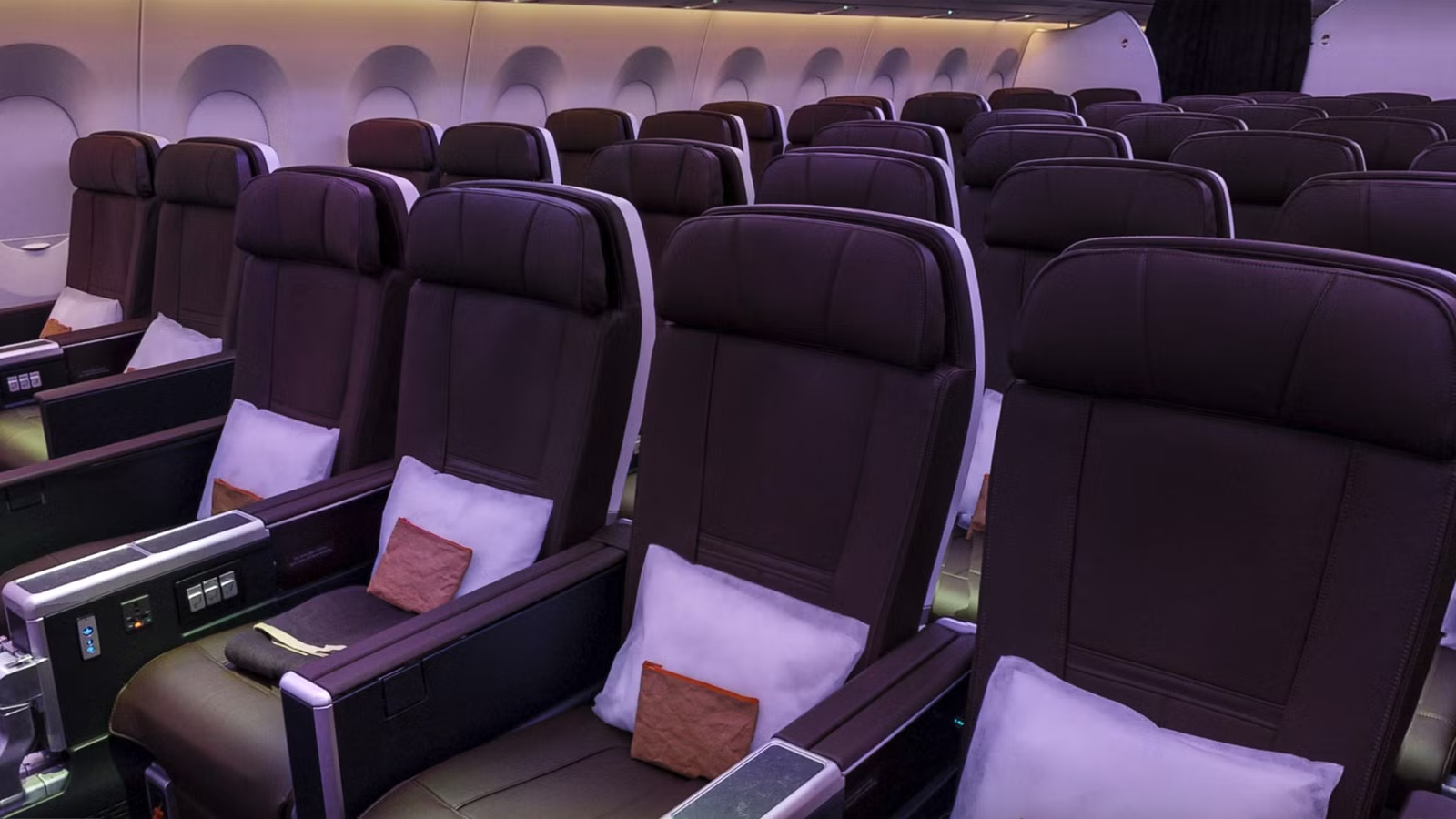
Deciding what the smarter fare is and what is ‘worth it’ is as much a subjective personal decision as it is an objective one. The right decision hinges on personal taste, personal budget, the duration of the flight in question, and other factors. The ‘smart’ choice can even vary within the same airline depending on discounts offered (or price spikes), route, specific aircraft, time of day of the flight, specific aircraft, and more.
Many passengers may put a higher premium on business class lie-flat seats on overnight flights than daytime flights. With this being said, there are some airlines where premium economy does appear to be a bargain relative to the airline’s business-class offerings.
In the US, premium economy is marketed and priced differently compared with many Asian and European carriers, and no US-based airline makes this list. In this article, we will consider factors like premium economy and business class rankings by Skytrax, the average price ratio, and other factors.
EVA Air
First adopted premium economy in 1992

Taiwan-based EVA Air essentially invented the modern premium economy. In 1992, it launched what it called Evergreen Deluxe Class, which offered a dedicated cabin with wider seats, greater legroom, upgraded meals, better service, and an increased baggage allowance. Today’s industry standard for premium economy is based on EVA Air’s initial Evergreen Deluxe Class. Today, EVA Air remains a world leader in premium economy, with Skytrax ranking its offerings the fifth best in the world.
Only Virgin Atlantic, Japan Airlines, Emirates, and Singapore Airlines beat it. The airline says its 787-9s feature “28 seats arranged in a 2-3-2 configuration with an industry-leading seat pitch of 42 inches. The cradle motion recline mechanism allows the seat cushion to slide forward and upward simultaneously, creating a comfortable recline equivalent to eight inches while preserving space for the passenger behind.”
Meanwhile, its business-class seats are ranked the 12th best in the world (the same as the airline overall). EVA’s premium-focused approach, having one of the best premium economy products in the industry (spacious seats, excellent service, good food, and thoughtful amenities), narrows the quality gap with business class. With that being said, the cost of upgrading is also one of the narrower ones in the industry, with business seats typically priced at three to four times that of premium economy.
Emirates
First adopted premium economy in 2022 (full-scale rollout)

Emirates is an interesting airline. In 2025, it was the world’s most profitable airline. It has the largest widebody fleet in the world; it connects Dubai to almost all major international hubs in the world, and it only operated A380s and 777s until late 2024, when it received its first A350s. It also leans heavily into the luxury market, and its aircraft boast almost half of the world’s remaining First Class seats. For years, Emirates was wary of premium economy.
Emirates initially saw premium as a risk to its lucrative business class seats and a risk to its premium branded image. However, the airline eventually did introduce premium in its cabins. In the words of Emirates President Tim Clark, ” we have been absolutely shocked at the demand for the [premium economy] seats.” Emirates is ranked the fourth-best airline in the world overall with the 11th best business class, while its premium economy class is ranked the third best.
Emirates is listed here partly because of its high premium economy ranking and partly because passengers are voting with their wallets. When people vote with their wallets and feet, it is arguably more convincing than how passengers answer surveys that ask them to rate their satisfaction with the class. Tim Clark has said that “people have been clamoring to get into them. They have been paying whatever we’ve asked them to pay to get into the cabin,” adding that they sell “like hot cakes.”
Japan Airlines
First adopted premium economy in 2007

Japan Airlines is one of the few remaining airlines that still configures its international Boeing 777s nine-abreast in economy class and even has some Boeing 787s configured eight-abreast. It is the last airline to have eight-abreast configured economy class Boeing 787 seats. This arguably makes it a candidate for flying Economy. With that being said, this list is a contest between premium economy and business class.
JAL offers one of the world’s best premium economy cabins with seats having a pitch of around 42 inches, a large recline, and excellent Japanese service. It is ranked the sixth-best airline overall, and its business class offerings are ranked the eighth-best. Even better, its premium economy class is ranked the second best in the world.
Japan Airlines fits in the smaller gap category when it comes to the price ratio between premium economy and business, with a price ratio closer to the 2-2.5x range. This would typically make business more attractive, but premium economy is typically fine even on long-haul flights. It should be noted that JAL is one of the airlines that permits passengers to make cash bids to upgrade their booked and purchased economy or premium economy tickets to the next cabin.
Bidding can often offer significant discounts compared with purchasing those fares at their listed values. A hack for passengers willing to engage and ‘risk it’ is to purchase an upgradable economy class ticket and then bid to upgrade to premium economy. Alternatively, purchase an upgradeable Premium ticket and then bid to upgrade to business. Success is not guaranteed as it depends on factors like the computer system assessing whether premium/business seats are going to be left unsold by the time of the flight.
Air New Zealand
First adopted premium economy in 2005

Air New Zealand is another interesting example with excellent premium economy. Overall, the small national airline is ranked the 24th best airline in the world, with its premium economy ranked 12th, but its business class failing to make the top 20 list. Air New Zealand has long been highly ranked by the alternative airline ranking platform, AirlineRankings.com, where it receives a seven out of seven safety rating and an award as a Seven Star PLUS airline.
When flying premium economy, passengers can expect a large recliner, high-quality meals, excellent wines, and great service. AirlineRankings.com says that”Air New Zealand is renowned for its high level of service, which reflects New Zealand’s hospitable culture. The airline offers a range of services designed to accommodate the needs of diverse travelers, including premium offerings that cater to business travelers and cost-effective options for tourists.”
Air New Zealand’s fleet | Number in operation (per Air NZ) | Premium economy seats (Y/N) |
|---|---|---|
Boeing 777-300ER | 10 | Yes |
Boeing 787 Dreamliners | 14 (10 more on order) | Yes |
Airbus A320ceo – Domestic NZ | 17 | No |
Airbus A320neo / Airbus A321neo | 20 (Four more on order) | No |
ATR72-600 | 31 | No |
De Havilland Q300 | 23 | No |
On its fleet of Boeing 787-9s, premium passengers enjoy a generous 41-inch seat pitch. Air New Zealand operates a mixed widebody fleet of Boeing 777-300ERs and 787s, with more Dreamliners on order. It uses its fleet of A320 family aircraft to serve some domestic routes, many Australian routes, and other routes in the Pacific. Most domestic flights are with turboprop aircraft.
While Air New Zealand offers a great premium economy, its business class is also typically quite pricey, costing up to three times more than premium economy. Even so, Air New Zealand can tend towards a relatively modest gap compared with many legacy carriers, although this does vary by the route.
Premium economy is sufficient on routes to Australia where widebodies are used. These are typically daytime flights and average between three and five hours. Air NZ’s premium economy leans toward punching above its weight, while business offers a less dramatic step-up in value.
Virgin Atlantic
First adopted premium economy in 1992

Virgin Atlantic operates an all-widebody fleet focusing on transatlantic and other long-haul destinations from its hubs at London Heathrow and Manchester. This means that almost all Virgin Atlantic flights are long-haul flights, and often passengers are willing to pay extra for a more comfortable passage. Notably, in 2025, Virgin Atlantic won the Skytrax award for the world’s best premium economy class.
Virgin’s Business Class also performed well in the rankings, coming in as the tenth best in the world. Impressively, its Business class was ranked one above Emirates. While the specifics may vary between Virgin’s aircraft, its premium economy typically offers 38-inch pitch seats, excellent food and drinks, priority check-in, a generous baggage allowance, and one of the widest premium economy seats in the industry.
Virgin Atlantic often directly competes with British Airways on many transatlantic routes, and these are often routes that are driven by strong business class demand. Business class seats are often priced at three to four times or even more than premium economy on many of these prestige routes.
Arguably, Virgin Atlantic is one of the best cases to argue that its excellent premium economy offerings coupled with its wide cost gap with Business class means it makes sense to stay with premium. This is particularly true for the airline’s daytime flights. This said, sometimes Virgin can offer business class seats at very competitive rates that make upgrading much more attractive. It is also worth noting that Virgin Atlantic was one of the world’s first airlines to adopt premium economy in 1992.