dailynewsnblog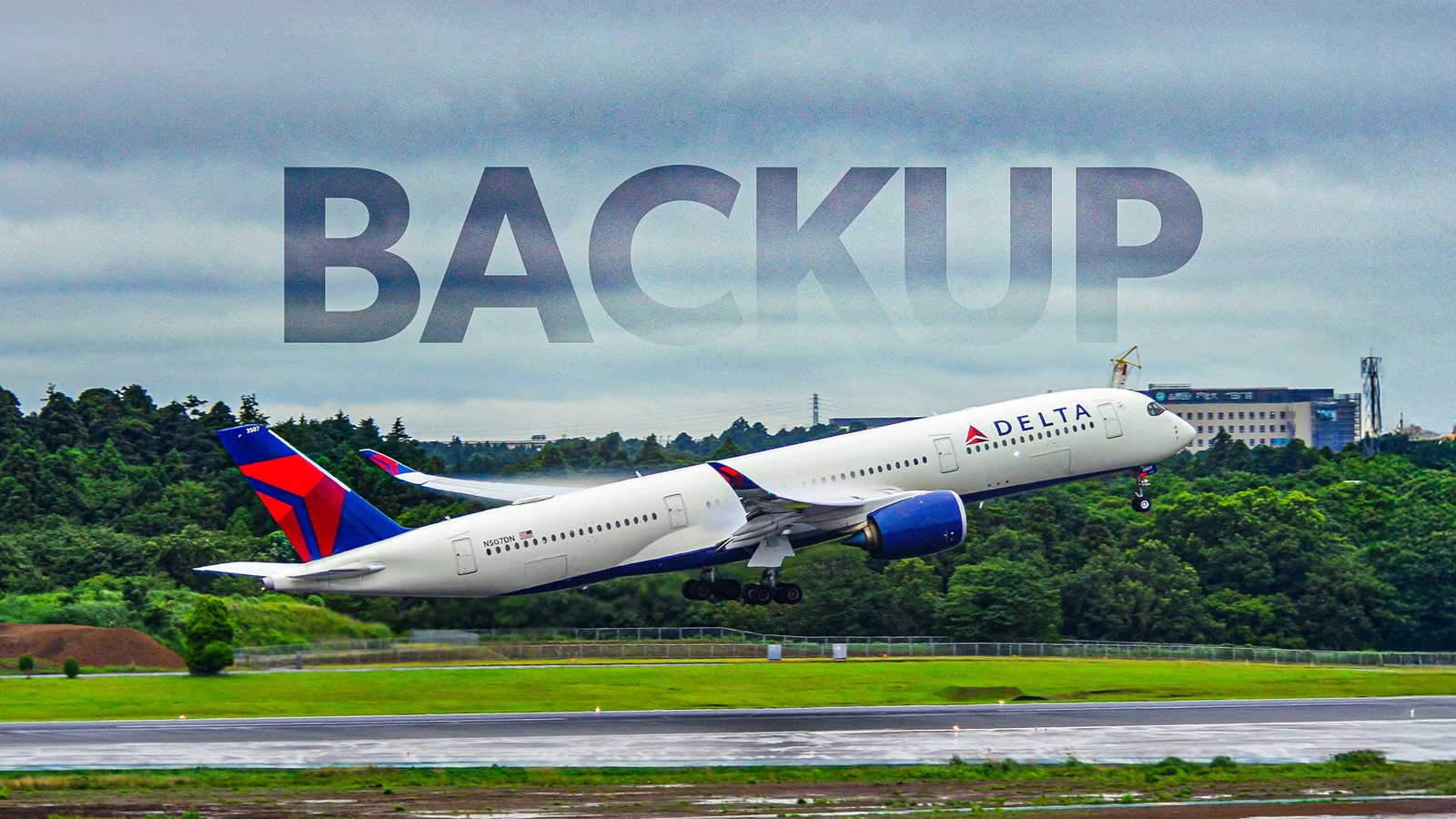
The Airbus A350 is supposed to make ultra-long-haul flying easier. Yet on  Delta Air Lines‘ longest route, the airline deliberately sends an aircraft that carries dozens fewer passengers than it could. The reduced-capacity cabin isn’t primarily about selling more premium seats or improving comfort. It’s an operational compromise built into the airplane itself, one that quietly solves a problem airlines have wrestled with for decades without ever appearing on the timetable.
That raises an obvious question. If the Airbus A350 already has the range to fly nonstop between Atlanta and Johannesburg, why does Delta dedicate a small subfleet of lower-density aircraft to the route? The answer lies in a combination of airport physics, payload limits, and a design decision that effectively turned the cabin into the airline’s contingency plan, without passengers ever realizing they were looking at one.
A Route That Sits At The Edge Of What The A350 Can Do

Delta’s nonstop service between Hartsfield-Jackson Atlanta International Airport (ATL) and O.R. Tambo International Airport (JNB) occupies a unique place within the airline’s global network. While Delta serves destinations across Europe, Asia, South America, Africa, and the Pacific, no regularly scheduled flight currently asks more of its aircraft than the westbound journey from Johannesburg back to Atlanta.
Scheduled for as long as 17 hours and 5 minutes under certain seasonal conditions, Flight DL201 represents the longest nonstop operation published anywhere in Delta’s timetable, surpassing even many of the airline’s trans-Pacific services. Flight DL201 from O.R. Tambo International Airport (JNB) back to  Hartsfield-Jackson Atlanta International Airport(ATL) is booked for as long as 17 hours and 5 minutes westbound, making it Delta’s longest scheduled nonstop of any kind, as Simple Flying has reported.
The eastbound leg is shorter, but the pairing still covers roughly 8,433 miles (13,572 km) each way, as previously covered by Cirium schedule data. That distance alone would be manageable for the A350-900, whose Rolls-Royce Trent XWB engines give it one of the longest legs of any twinjet flying today, a point covered in this article about why the A350 flies exclusively on that engine family. The problem isn’t range in still air. It’s what happens the moment the jet tries to leave the ground in Johannesburg.
Why Johannesburg Punishes A Full Airplane

For airlines, not every airport possesses the same characteristics. Some airports naturally allow aircraft to depart with maximum payloads under nearly all conditions. Others impose subtle but persistent performance penalties that require careful planning long before passengers arrive at the gate. Johannesburg’s O.R. Tambo International Airport belongs firmly in the second category. The airport sits 5,558 feet (1,694 meters) above sea level, high enough that its runways were once used to test Concorde‘s high-altitude takeoff performance, as documented by Heritage Concorde.
At that elevation, the air is measurably thinner, which means engines produce less thrust and wings generate less lift for a given speed. An aircraft that would climb away easily from a sea-level airport needs a longer runway and a lighter body to do the same job out of Johannesburg, and every extra passenger, bag, or gallon of fuel eats into that thin margin. Airlines call this combination of altitude and heat “hot-and-high,” and for Delta’s Airbus A350, those physics matter even more because of the mission awaiting it after departure.
Unlike an aircraft leaving Johannesburg for a short regional hop, DL201 must immediately begin a nearly 17‑hour journey, so the aircraft cannot simply load less fuel to improve takeoff performance. That fuel is absolutely essential to reach Atlanta nonstop. Dispatchers therefore manage a continuous balancing act between four major variables: passengers, cargo, fuel, and aircraft performance. Every additional passenger adds not only body weight but also checked baggage, carry‑on items, catering provisions, potable water, and associated equipment. Cargo generates valuable revenue but consumes payload capacity. Because the maximum allowable takeoff weight cannot increase indefinitely, gains in one category almost always require reductions in another. Runway length helps offset these constraints, and Johannesburg fortunately offers runways exceeding 13,000 feet (4,000 meters). Even so, runway length alone cannot overcome reduced engine thrust and diminished aerodynamic efficiency. Eventually, the limiting factor becomes climb performance.
Historically, airlines operating long-haul services from Johannesburg frequently accepted payload restrictions during adverse conditions: cargo might be left behind for later flights, and passenger loads could occasionally be capped. In some circumstances, airlines introduced intermediate fuel stops to divide an ultra-long-haul mission into more manageable segments. Rather than removing passengers or cargo whenever conditions deteriorated, Delta permanently reduced the aircraft’s seating capacity. Doing so lowered the baseline operating weight before any individual flight planning calculations even began. Every departure started with greater performance margin already built into the aircraft, providing dispatchers additional flexibility to accommodate fuel requirements without routinely sacrificing operational reliability.
When Delta’s Backup Plan Was A Literal Stop In Senegal

Delta’s first solution to Johannesburg’s range problem wasn’t a special aircraft or a lighter cabin—it was another airport. When the airline launched service in 2006 with the Boeing 767-300ER, the aircraft simply couldn’t cover the mission nonstop. Flights to Johannesburg and Cape Town International Airport (CPT) instead stopped in Dakar, Senegal, where they refueled before continuing south. The contingency plan wasn’t hidden inside the airplane; it was built directly into the route.
Cape Town’s own nonstop service from Atlanta didn’t arrive until 2022, and only then because Delta had the A350-900 to make the range work without stopping. The carrier’s fleet has moved a long way since those 767 days, a shift traced by Simple Flying’s reporting on Delta’s 767-300ER phaseout. Importantly, however, the introduction of the A350 did not erase Johannesburg’s unique performance challenges. What changed was Delta’s approach to accommodating those constraints.
The benefits became especially evident when Delta expanded service to Cape Town. Launching nonstop flights from Atlanta to Cape Town in 2022 would have been extraordinarily difficult, if not commercially impractical, with the previous generation of aircraft. The A350 provided the range needed to make the operation feasible, demonstrating how improvements in aircraft technology could unlock entirely new network opportunities rather than merely replacing older airplanes. Instead of inserting a fuel stop into the schedule, the airline increasingly solved the problem through aircraft optimization. Replacing a fuel stop with a nonstop flight sounds like a straightforward technological upgrade. In reality, Delta simply moved the compromise from the route map into the aircraft’s cabin—a far less visible solution that raises an obvious question: what exactly did the airline change inside the A350 to make that work?
Catch what other flight trackers miss
Emergency squawks, holds, NOTAMs — live signals, no signup.
Open tracker
Catch what other flight trackers miss
Emergency squawks, holds, NOTAMs — live signals, no signup.
Open tracker
The New Backup Plan Is Baked Into The Airplane

Delta’s modern solution to the Johannesburg challenge is remarkable because it is largely invisible to passengers. Rather than advertising a specialized aircraft or promoting a unique operational procedure, the airline quietly embedded its contingency plan into the cabin itself. The dedicated 275-seat Airbus A350-900 configuration assigned to demanding long-haul missions carries substantially fewer passengers than Delta’s standard-density A350 layout, reducing overall payload while simultaneously increasing the proportion of premium seating.
Instead of scheduling a stop, Delta now scores the ATL-JNB route with a dedicated cabin layout built for exactly this kind of payload-limited flying. That configuration seats just 275 passengers: 40 Delta One suites, 40 Premium Select recliners, 36 Comfort+ seats, and only 159 in the main cabin, versus roughly 226 on a standard-density A350-900, as Simple Flying’s breakdown of Delta’s longest routes has detailed. Fewer passengers and less cargo mean a lighter jet at brake release, which translates directly into stronger takeoff performance out of Johannesburg’s thin air and enough range to reach Atlanta nonstop, even westbound against Atlantic winds. From a commercial perspective, the arrangement also reflects broader changes in airline economics. Premium cabins occupy more physical space but generate considerably higher revenue per passenger.
A fully occupied Delta One Suite may produce several times the revenue of an economy seat while requiring only one passenger and one set of baggage. Consequently, the reduction in total seat count does not necessarily translate into proportionally lower revenue. Instead, it aligns operational requirements with an increasingly premium-focused business model.
South African officials have made clear how much is riding on Delta keeping that math solved. The CEO of South African Tourism, Sthembiso Dlamini, commented on the route as follows, as covered by Simple Flying:
“North America is a key market for us, and we are confident that this Delta non-stop flight will boost South Africa’s efforts to grow business and leisure tourists’ arrivals out of this market.”
Losing the nonstop, even temporarily, would push Atlanta-bound travelers back onto one-stop European itineraries — the very outcome Delta engineered its way around nearly two decades ago.
A Playbook Now Spreading Across Delta’s Widebody Map

What began as a practical solution for one exceptionally demanding route appears to represent a broader philosophy guiding Delta’s long-haul fleet strategy. The premium-heavy, lower-density Airbus A350 configuration is no longer confined to Johannesburg. As Delta expands its international network with additional ultra-long-haul services, the same aircraft layout has been assigned to routes where operational flexibility and extended range provide meaningful advantages, including its new Los Angeles-to-Hong Kong service launched in June 2026, which runs the identical cabin for the same reason: maximum range with minimum weight penalty.
That pattern lines up with the wider shift flagged in Simple Flying’s analysis of Delta’s Premium Select expansion, where new widebody deliveries carry roughly 15% more premium seating than the jets they replace. What looks like a revenue strategy on paper is also, on Delta’s most demanding routes, an operational one.
The airline is not alone in hunting for margin at the edges of its widebody performance envelope, either —as Simple Flying reporting on Delta’s shark-inspired riblet film trials shows a carrier chasing efficiency gains anywhere it can find them, from the paint on the fuselage to the seat count in the cabin.
The Real Contingency Was Never A Second Route

For all the complexity surrounding Delta’s Johannesburg operation, perhaps the most striking fact is what no longer appears anywhere in the schedule. There is no planned fuel stop, no intermediate airport waiting to rescue the flight on difficult operating days, and no permanent compromise built into the passenger experience. The airline simply publishes the service as a nonstop between Atlanta and Johannesburg, even though it remains one of the most demanding missions in its entire network.
That reliability is possible because Delta changed where it absorbed the route’s biggest constraint. During the Boeing 767 era, the answer was geography: stop in Dakar, refuel, and continue south. Today, the answer is payload. By assigning a dedicated low-density Airbus A350-900 with just 159 economy seats, Delta effectively converts cabin space into performance margin. Every seat removed reduces weight, allowing more flexibility to carry the fuel needed for a westbound departure from Johannesburg without routinely sacrificing operational reliability.
The airline didn’t solve its longest Airbus A350 route by finding a better diversion airport or resurrecting the Dakar fuel stop that once made Southern Africa possible. It solved it by redesigning the economics of the airplane assigned to the mission. On paper, the difference is simply a lower seat count. Operationally, however, those missing economy seats are the margin that allows one of Delta’s most demanding nonstop flights to depart Johannesburg and make the journey back to Atlanta without looking for another runway along the way.