dailynewsnblog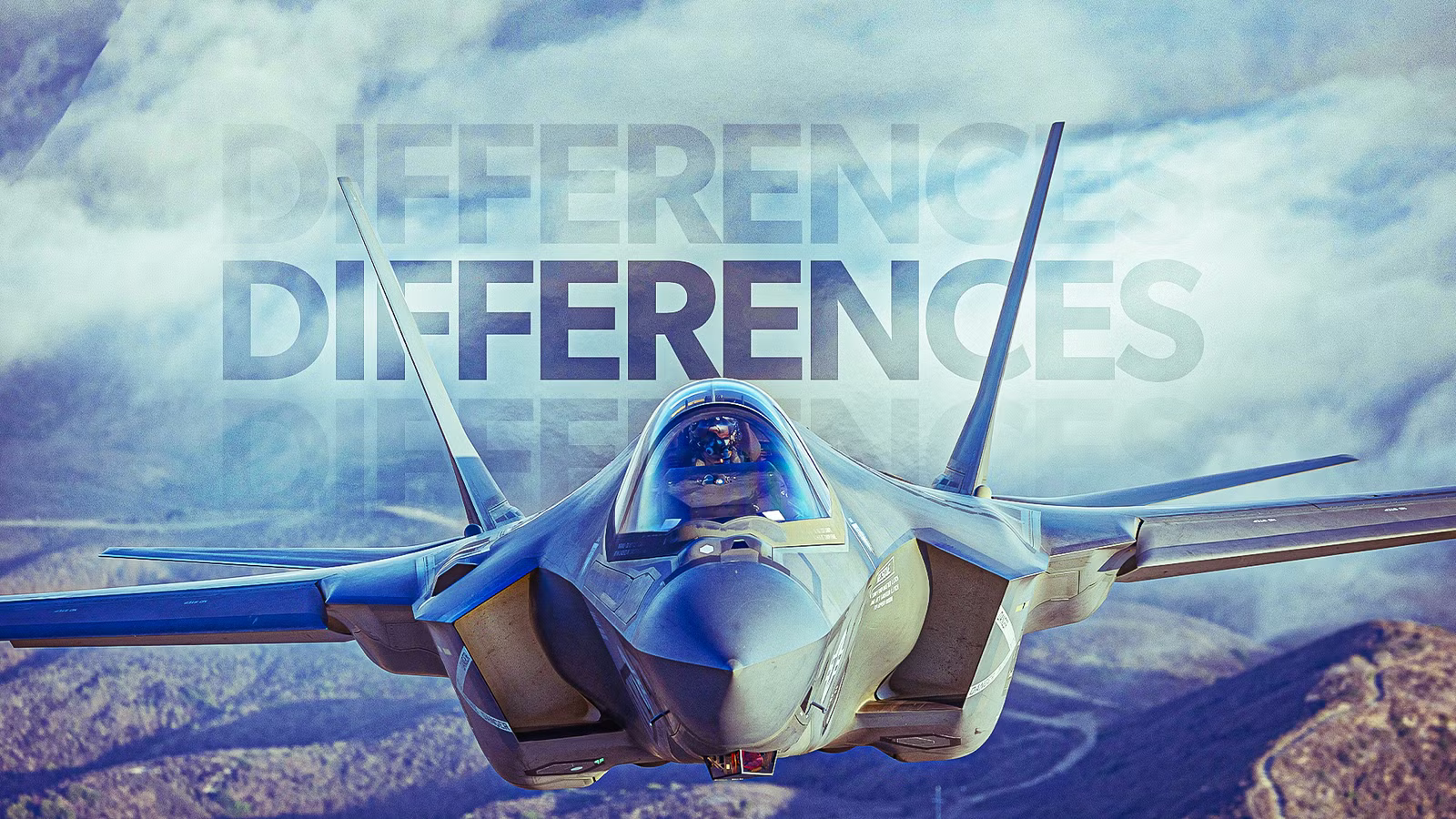
The Joint Strike Fighter program is founded on the principle that one multiple stealth fighter airframe could serve as a template to replace several legacy airframes. So Lockheed Martin packaged three different kinds of fighter jets with their own unique features into the F-35 Lightning II family.
The F-35A was meant to succeed the F-16 and the A-10 for the Air Force, the F-35B to replace the AV-8B Harrier for the Marine Corps, and the F-35C to take over from the legacy F/A-18 Hornet for the Navy. There are significant similarities between all three variations despite the major differences in configuration and capability.
Lockheed used an engineering technique based on ‘cousin components.’ Forcing 100% part commonality across all three services would compromise the aircraft. Thus, F-35 parts have the same geometric shape but are drastically scaled up or down in thickness and materials to satisfy the unique structural stresses of each model. To solve the challenge of the JSF, Lockheed Martin categorized all aircraft parts into three distinct groups: common parts, unique parts, and cousin parts.
The F-35A As The Baseline

The land-based A-model serves as a conventional takeoff and landing fighter. It is the lightest, most agile, and most cost-efficient option of the JSF lineup. Its design avoids the heavy structural reinforcement and specialized hardware required for shipboard operations, allowing it to pull aggressive 9-G maneuvers that place it on par with most legacy air-superiority fighters in tight dogfights.
While the cousin concept successfully saved billions in initial manufacturing tooling and allowed all three variants to be built on the same production line, it ultimately reduced the amount of identical shared parts between the variants down to roughly 20% overall. Far lower than the Pentagon’s original high-commonality goals.
The Pratt & Whitney F135 engine, internal cockpit layout, radar system, weapons suite, and baseline weapon compatibility are all the same in all versions. Examples of subsystems exclusive to a single variant are no better than the F-35B’s shaft-driven LiftFan propulsion system, which replaces much of the fuel tank space. The carrier-capable C-variant is the most different design, containing about 40% entirely unique parts.
By The Numbers: Stacking Up The Lightning II

By shedding the heavy gear, arrestor gear, and airframe reinforcement required by its sea-going siblings, the F-35A maximizes its internal fuel capacity and aerodynamic performance. It is also the only model in the family equipped with an integrated internal cannon mounted directly inside the fuselage, and the only version featuring a dorsal refueling receptacle tailored for the rigid boom system.
Variant Feature | F-35A Conventional Takeoff (CTOL) | F-35B Short Takeoff / Vertical Landing (STOVL) | F-35C Carrier Variant (CV) |
|---|---|---|---|
Primary Launch Method | Standard Runway | Short Takeoff / Vertical Landing | Catapult Launch / Arrested Recovery |
Refueling Mechanism | Dorsal Boom Receptacle | Retractable Probe and Drogue | Retractable Probe and Drogue |
Internal Cannon | 25mm GAU-22/A Built-in | None (Requires External Pod) | None (Requires External Pod) |
Airframe G-Limit | 9.0 G | 7.0 G | 7.5 G |
The cousin component approach allowed the variants to look nearly identical on the outside while differing structurally underneath to handle vastly different requirements. Cousin parts utilized the exact same Outer Mold Line tooling. They used the same mold but adjusted the internal composite lay-ups and thicknesses. This meant the lower-load Air Force variant didn’t carry the ‘scar weight’ of the heavy-duty Navy version.
What The Lift Fan Costs The F-35B

The jump-jet F-35B exists entirely to secure a single operational capability. That is the power to land vertically on tight ship decks and forward airfields. To pull this off, the jet packs a Rolls-Royce shaft-driven lift fan positioned directly behind the cockpit. That is paired with a special swiveling rear exhaust nozzle equipped with its F135 main engine, which can point down at 90 degrees.
While this specialized powerplant lets the jet blast off from a 600-foot runway with a full combat load, the operational cost is apparent in the performance metrics. The massive lifting system adds substantial dead weight while permanently occupying fuselage space that would otherwise hold thousands of pounds of fuel.
Consequently, the F-35B carries the lowest internal fuel capacity, the shortest unrefueled range, and the smallest weapon payload of the entire lineup. To save room for more ordnance payload, it completely drops the internal 25mm cannon, relying instead on a specialized, stealth-contoured external gun pod whenever a mission requires a cannon.
International operators like the United Kingdom, Italy, and Japan view this stiff performance penalty as a necessary sacrifice, because it allows a supersonic stealth fighter to operate from small amphibious assault ships and austere, rough airstrips where conventional jets are useless. But while the model shrinks the fighter’s dimensions to fit small spaces, its carrier-capable counterpart goes the exact opposite direction, enlarging the airframe to handle the extreme demands of naval aviation.
Why The F-35C Looks Different

The carrier-bound F-35C stands out immediately as the only member of the family with a visibly modified airframe. It features a significantly expanded wingspan of 43 feet (13.1 meters) and a massive wing area of 668 square feet (62 sq meters). The size of the tailhook JSF far eclipses the dimensions of its siblings.
This extra surface area comes from enlarged leading-edge flaps and wing area for superior controllability at high angles of attack and slow speeds. Yet it is still compact enough for the hangar deck with its folding wingtip sections designed to save space. Its oversized control surfaces on both the wings and tail are optimized to maintain precise handling during carrier approaches.
Variant Metric | F-35A | F-35B | F-35C |
|---|---|---|---|
Empty Dry Weight | 29,000 lb (13,154 kg) | 32,400 lb (14,696 kg) | 34,800 lb (15,785 kg) |
Internal Fuel Capacity | 18,250 lb (8,278 kg) | 14,500 lb (6,577 kg) | 19,200 lb (8,708 kg) |
Max Weapon Payload | 18,000 lb (8,165 kg) | 15,000 lb (6,804 kg) | 18,000 lb (8,165 kg) |
Max Takeoff Weight | 70,000 lb (31,751 kg) | 60,000 lb (27,216 kg) | 70,000 lb (31,751 kg) |
Unrefueled Combat Radius | 590–760 nmi (1,100–1,400 km) | 505–510 nmi (935–945 km) | 600–670 nmi (1,110–1,240 km) |
To survive the violent impact of arrested flight deck landings, the internal fuselage structure is also heavily reinforced. The hook and heavy-duty landing gear features a longer stroke to absorb bone-jarring ‘traps.’ The nose gear was upgraded to a dual-wheel system to endure slamming into a catapult launcher, forces that would instantly shear off the lighter, single-wheel nose gear found on the land-based model.
The First Carrier-Capable Stealth Fighter In History

This enlarged wing structure of the F-35C provides a massive internal fuel capacity of 19,750 lb (8,958 kg), packing an extra 1,500 lb (680 kg) of gas beyond the standard variant. However, all this heavy structural bracing makes this model the heaviest of the trio at a dry weight of 34,500 lb (15,649 kg). The added fuel gives it the endurance necessary for safe operations at sea, but its structural maneuverability limit drops to 7.5 g, and its thrust-to-weight ratio trails the other two JSFs.
Independent assessments vary on its exact combat range. Some analysts credit the massive fuel stores with expanding the unrefueled combat radius past 700 nautical miles (1,296 km), while others argue the extra structural weight limits its real-world performance to a minor advantage over the land-based model. The total planned procurement stands at 273 jets for the US Navy and 67 for the Marine Corps. Because the United States remains the sole operator of this catapult-launched model, it carries the smallest total production run of the entire program.
How The Variants Perform In Service

The F-35 Joint Program Office only recently disclosed public data after years of keeping per-variant price under wraps as controlled material. The average flyaway cost for Lots 18 and 19 is $92 million for the F-35A, $121.4 million for the F-35B, and $110.8 million for the F-35C.
The engineering complexity of any airframe is directly reflected in these prices. The baseline contract for the airframes alone averaged $82.4 million per aircraft. Meanwhile, the Pentagon’s latest overall acquisition estimate has surged over 10% to $536.2 billion.
This indicates an inflation-driven price surge from earlier lots, an 11.5% increase for the A, up from $82.5 million. The jump jet, F-35B, rose 11.4% up from $109 million, and the F-35C has grown in cost by 8.5%, up from $102.1 million. The F-35B costs $29 million more than the baseline model due to its intricate swiveling exhaust nozzle and vertical-hover hardware. Meanwhile, the F-35C occupies the middle ground due to its enlarged, reinforced airframe and folding mechanisms.
In service, the stealth fleet routinely struggles to meet readiness targets. Fleetwide availability has stalled between 50% and 60%, well below the military’s 65% target. Full mission availability is significantly higher for the land-based F-35A than for its sea-going counterparts.
Yet, older F-35A models show the same poor availability rates as 36-year-old legacy F-16 Fighting Falcons. Government oversight reports confirm that no variant meets its official readiness goals, even as the Air Force burns through $6.6 million per aircraft annually just to operate and sustain the conventional F-35A.