dailynewsnblog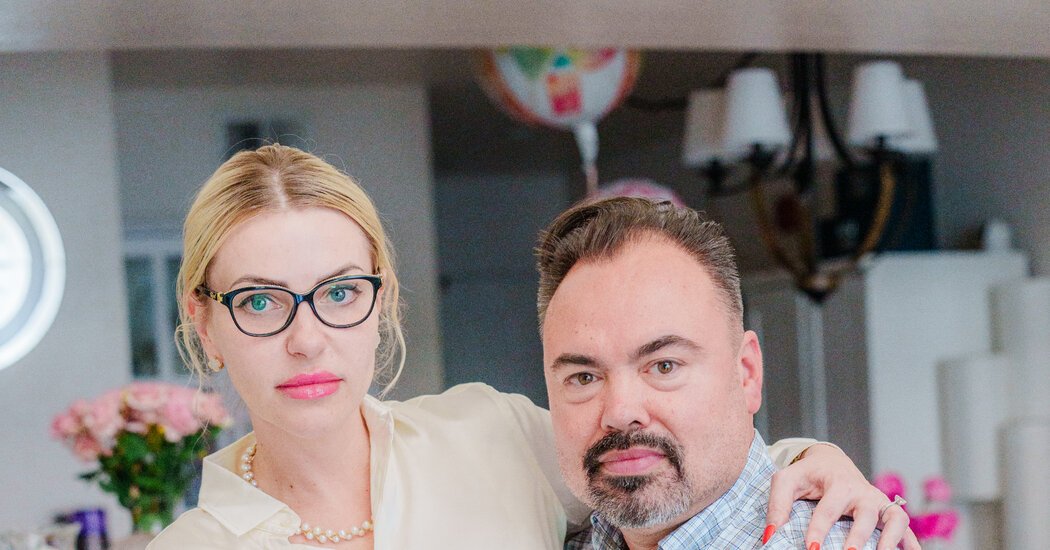
Brent Jindra, a tech salesman, voted for President Trump three times, drawn by his aggressive immigration agenda. He never imagined the crackdown would ensnare his own wife.
Last month, moments after the couple got off their flight in Burbank, Calif., a young man in a brown hooded sweatshirt stopped Galina Bobreneva.
“Congratulations, you’ve been chosen for secondary screening,” he told her, according to the couple’s recollection.
The man was a federal agent, and after questioning Ms. Bobreneva for about 15 minutes, he led her away in handcuffs to an unmarked vehicle.
“I’m only doing my job,” he said. “Everything will be OK.”
So began a 16-day ordeal: a night on the floor of a basement holding cell in downtown Los Angeles; two weeks in a Mojave Desert detention center and a frantic legal effort to win her release.
Freed on a $35,000 bond with an electronic monitor clamped to her ankle, she is now fighting to stay in the United States against federal charges of overstaying her visa.
Ms. Bobreneva, who is from Russia, has a pending green card application, and her lawyer asserts that she was never out of lawful status.
Her case represents a new front in President Trump’s mass deportation drive: arrests at airports of people whose visas have expired but who have active immigration cases and no criminal history.
Although green-card applicants with expired visas can be detained under federal law, previous administrations did not consider them to be in the country unlawfully. But as the Trump administration seeks to nearly double its daily arrests to 2,000 people, it is detaining and attempting to deport thousands of people who believed they were following the rules.
“The allure of the MAGA campaign was around illegal entries of criminals,” said Mr. Jindra, 48. “There was never a mandate for this president to turn the barrel of the gun and start going after people who legally entered.”
In response to questions about Ms. Bobreneva’s case, the Department of Homeland Security said in a statement that she was “an illegal alien” targeted for arrest because “she overstayed her welcome in violation of our nation’s laws.”
“To be clear, work authorization or a pending application do NOT confer legal status in the United States,” the agency said in a statement.
Mr. Trump’s immigration agenda, which helped propel him to the White House for a second term, is becoming a vulnerability for the Republican Party ahead of the midterms as even some members of his base have begun condemning ICE’s hard-line tactics.
Mr. Jindra considered himself a MAGA patriot until his wife’s detention.
“She did not jump a wall, she did not swim a river,” he said. “She came in Trump’s beautiful, big front door.”
Ms. Bobreneva arrived on a tourist visa in late 2021, extended it twice following Russia’s invasion of Ukraine and applied for asylum in 2022. She met Mr. Jindra in March 2025 and by December they were married.
“It was your storybook romance,” he said.
Mr. Jindra petitioned in April to sponsor his wife for a marriage-based green card. They received official confirmation the application had been accepted. She was fingerprinted.
The newlyweds bought a “dream house” in Cleveland, Ohio, where Mr. Jindra was raised, and intended to relocate there soon.
They planned a trip to Sonoma County’s wine country to celebrate Ms. Bobreneva’s 40th birthday on July 16. Mr. Jindra booked a suite at a boutique hotel, prepaid for visits to three vineyards and hired a driver.
They never made it.
On July 13, the couple boarded a flight from San Francisco to Burbank, where Mr. Jindra planned to meet clients and Ms. Bobreneva to see friends.
Approached by plainclothes agents at the airport, the couple first thought it was a ruse.
“When the ICE badge was flipped, you could tell that was legit,” recalled Mr. Jindra, referring to Immigration and Customs Enforcement.
He immediately called their immigration lawyer, but the agents refused to speak with him. They ushered Ms. Bobreneva into a room, leaving her husband on the concourse, flanked by Burbank airport police, he said.
Inside, the agents told Ms. Bobreneva that she had overstayed her visa. “I was absolutely sure this was a mistake,” she said.
She explained that she was in the process of securing a green card and presented documents.
When an agent pulled out handcuffs, Ms. Bobreneva was stunned. She asked to give her engagement ring and other jewelry to her husband. They then led her away, saying that Mr. Jindra would know where to find her.
“A U.S. citizen just watched his wife get dragged away and had no idea where she’s going,” recalled Mr. Jindra.
The white S.U.V. sped off into the darkness. Ms. Bobreneva, alone with two men, said she feared for her safety until they arrived at an ICE facility.
She was held in a frigid room with a handful of women. She recalled a gaunt diabetic immigrant in her 70s pleading for insulin, to no avail. Ms. Bobreneva curled up on the ground under a foil blanket.
About 18 hours later, she was shackled at the ankles, waist and wrists and loaded into an unmarked van with several other immigrants. They bounced up and down in the sweltering vehicle as it raced toward the detention center in Adelanto.
“I felt like a piece of meat, not like a human,” recalled Ms. Bobreneva.
By the time she changed into blue prison garb and was assigned bunk L63 — a lower bed in the women’s section — it was 5 a.m. Thirty minutes later, as she drifted off to sleep, orders blared over the loudspeaker for detainee count and breakfast lineup.
Sleep deprivation was a constant, she said. Lights were always on. Hand-held radios carried by the guards crackled day and night. On her birthday, Ms. Bobreneva recalled, she shared chocolate she had ordered from the commissary with fellow Russian-speaking detainees from Russia, Ukraine, Belarus and Armenia.
Ms. Bobreneva described neglect, filth and people in despair.
For 120 women, there were seven showers; only four worked. Potable water was scarce; ailing people were denied care until they required hospitalization, she said, echoing allegations in a federal lawsuit.
The GEO Group, which operates the detention center, declined to comment on Ms. Bobreneva’s allegations and referred questions to ICE.
In a statement, a homeland security spokesperson said: “Any claim that there are subprime conditions at Adelanto ICE processing facility are FALSE. All detainees are provided with proper meals, water, medical treatment, and have opportunities to communicate with their family members and lawyers.”
ICE did not respond to questions.
“You become a number,” she said. “Nobody cares. There is zero empathy.”
Mr. Jindra visited when allowed, three times a week, and scrambled to secure her release.
Two weeks passed.
Their lawyer, Mr. Valdez, requested a bond hearing, scheduled for July 28. Ms. Bobreneva was released July 29 on a $35,000 bond with an ankle monitor and an order to report to ICE in San Francisco Aug. 5.
Over dinner at a seafood restaurant in Redwood City the night before her appointment, Ms. Bobreneva barely touched her crab cakes. She had been struggling to sleep and was terrified of being detained again.
“I never thought that it was so easy to take freedom from anyone,” she said.
Mr. Jindra, too, was nervous.
“We are living in fear in my own country,” he said.
Early the next morning, they joined a line outside the immigration building that wrapped around the block. Ms. Bobreneva entered with her lawyer more than two hours later.
They emerged with instructions from ICE to report back on Sept. 7.
The couple returned to Redwood City, where unopened birthday gifts and deflating balloons sat on their dining room table, alongside a vase of two dozen wilted roses.
“I cannot celebrate anything,” Ms. Bobreneva said.
Her first court appearance is Oct. 22, but her case will take months to be resolved.
Wearing the electronic monitor, Ms. Bobreneva is confined to a tight perimeter.
Last Sunday, the couple ventured to the beach.
Ms. Bobreneva was “enjoying her freedom,” Mr. Jindra said, “all 75-mile radius of it.”
Kirsten Noyes contributed research.