dailynewsnblog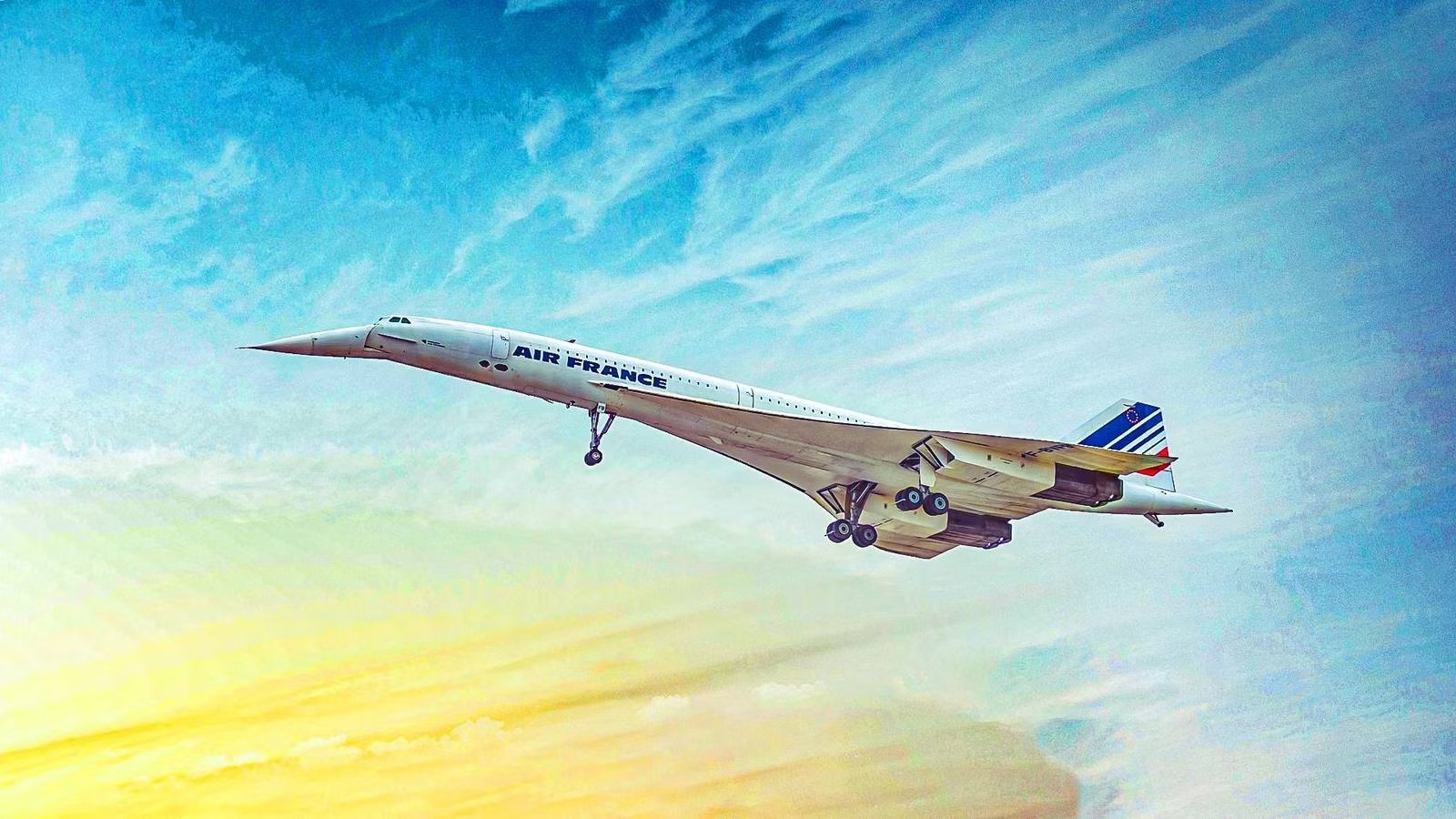
Every Concorde retrospective gets to the nose eventually. It’s the moment the aircraft tips downward and the fuselage looks almost broken, a mechanical bow that made the front pages long before anyone bothered explaining why it was there. Most stories just describe that the mechanism helped the pilots see the runway. That’s true, but it’s not the whole story. The droop nose was a triple-redundant hydraulic system with four fixed positions and a hard rule written straight into the flight manual. Below 250 knots (463 km/h), the crew had no discretion in the matter: the nose had to come down, every time, on schedule, whether the pilot flying that day found the sight elegant or not. This was the closest thing a pure delta wing ever had to a flap.
This article will explain why Concorde’s designers at Aérospatiale and BAC accepted such an unusual solution, how a pure delta wing optimized for Mach 2 flight forced engineers to rethink low-speed operations, and why the droop nose became far more than a cockpit visibility aid. From the 250-knot rule written into the flight manual to the triple-redundant hydraulic system that moved the mechanism, understanding Concorde’s nose reveals the engineering compromise hidden inside one of aviation’s most ambitious designs.
A Delta Wing With No Room For Flaps

A normal airliner slows down and extends flaps and slats to keep generating lift at low speed. It’s a trade-off: give up some cruise efficiency in exchange for extra lift exactly when you need it most, on takeoff and landing. Concorde’s engineers chose a slender delta wing because it was the shape that behaved best at Mach 2.04 (roughly 1,354 mph or 2,180 km/h), the aircraft’s cruising speed, sustained for hours at a time on transatlantic runs. A thin, sharply swept wing kept wave drag low at supersonic speed, gave the airframe the rigidity it needed to handle sustained aerodynamic heating at altitude, where skin temperatures could climb well past 260° F (127 °C), and left almost no internal volume for the kind of moving high-lift hardware a subsonic airliner takes for granted.
The trade-off showed up the moment the aircraft slowed down. Instead of behaving like a conventional wing at low speed, Concorde’s delta relied on vortex lift, rotating sheets of air peeling off the sharp leading edges at high angles of attack. According to a detailed technical answer on aviation.stackexchange.com, that vortex-dependent lift is exactly why Concorde could not carry conventional flaps or slats: deploying them would have disrupted the vortex structure the wing depended on, cutting lift or destabilizing the aircraft at the worst possible moment.
The consequence for the flight deck was severe. To generate enough lift at low speed, Concorde had to fly at a steep nose-up attitude on approach, often in the range of 15 to 17 degrees, well beyond what passengers riding a conventional jet would ever feel. With a nose stretching roughly 30 feet (9 meters) ahead of the cockpit, the same attitude that solved the lift problem created a new one: the pilots lost sight of the runway at precisely the phase of flight where sightlines matter most.
The 250-Knot Rule That Turned The Nose Into A Procedure

Engineers solved the visibility problem with a hinged nose section and a retractable metal visor, but the interesting part isn’t the mechanism itself; it’s how strictly the mechanism was flown. According to Heritage Concorde’s technical archive, the nose and visor moved through four codified positions: 0 degrees with the visor up for supersonic cruise, 0 degrees with the visor down for subsonic cruise, 5 degrees for taxi and takeoff, and 12.5 degrees for landing.
None of that was left to pilot judgment. As Aerofly’s Concorde flight tutorial lays out, the flight manual required the nose to be lowered to at least 5 degrees any time the aircraft’s airspeed dropped below 250 knots (463 km/h), turning the transition into a scheduled procedure triggered by a speed number, the same logic that drives a subsonic airliner’s flap schedule. Simple Flying has covered plenty of the engineering logic hiding behind Concorde’s most photographed quirks, including the surprisingly costly reason a coat of Pepsi-blue paint once put the airframe at risk.
Nose / Visor Position | Flight Phase | Trigger |
0° (visor up) | Supersonic cruise | Standard cruise configuration |
0° (visor down) | Subsonic cruise | Standard subsonic configuration |
5° | Taxi and takeoff | Mandatory below 250 knots (463 km/h) |
12.5° | Landing | Mandatory on final approach |
Scheduling a position on paper is one thing. Moving a multi-ton nose section reliably, on every flight, for 27 years of commercial service between 1976 and 2003, is another problem entirely, and it’s the one Concorde’s hydraulic engineers spent far more time solving than the visor’s four resting angles ever let on.
Triple Redundancy: How The Nose Actually Moved

Concorde’s designers treated the droop nose as flight-critical, and the hydraulics reflected that. Primary power came from the aircraft’s Green hydraulic system, running at 4,000 psi (276 bar), according to a breakdown published by Musée Delta.
If the Green system failed, the Yellow standby system could take over the identical job. And behind that sat a purely mechanical free-fall release that let gravity lower the nose even with no hydraulic pressure available at all — the flight crew could pull a lever and let gravity finish the job. That layering, described in Aeropeep’s technical explainer on the droop nose, meant a single failure could never leave a crew without visibility on final approach.
The movement itself was not instantaneous. Multiple technical sources place a full droop cycle at roughly 12 seconds, with retraction taking less than 20 seconds. While exact figures vary slightly between accounts, the key point remains unchanged: the system was designed to move predictably during a carefully planned phase of flight. Concorde crew therefore treated the nose position as a dedicated checklist item, not a control input to be adjusted on the fly.
Why 12.5 Degrees, Not More

Early Concorde prototypes were cleared for a deeper 17.5-degree droop angle, more nose-down than any production aircraft ever flew. According to Musée Delta’s account of the program, that steeper angle was reduced to 12.5 degrees before Concorde entered commercial service.
The reason was human rather than aerodynamic. While the deeper droop offered an even better downward view from the cockpit, pilots found that the change in sight picture introduced new challenges during the most critical phase of flight. A more extreme nose position altered the relationship between the runway, the aircraft’s attitude, and the pilot’s visual references, potentially making height and flare judgment more difficult on final approach. The problem was not whether pilots could see more, but whether they could interpret what they were seeing quickly and consistently.
The final 12.5-degree setting represented a compromise between visibility and workload. It lowered the cockpit’s line of sight enough to restore the runway view while preserving a more natural and predictable approach picture for the crew. That balance proved successful, becoming the standard landing configuration throughout Concorde’s commercial career from 1976 until the aircraft’s retirement in 2003. The result was a reminder that Concorde’s most photographed mechanical feature was shaped as much by human factors as by aerodynamic necessity. That same tension between clever engineering and human factors would appear again decades later, in a very different form, when a new generation of supersonic aircraft designers faced the same visibility challenge with completely different tools.
Three Fast Aircraft, Three Different Aerodynamic Solutions

Any time a new aircraft claims a speed record, Concorde’s shadow shows up first. When Simple Flying examined what makes the Bombardier Global 8000 the fastest civilian jet since Concorde, the obvious question followed into the piece: does matching part of Concorde’s speed legacy require anything like a droop nose?
It doesn’t, because it isn’t the same problem. The Global 8000 is a conventional swept-wing business jet that cruises well below Mach 1; it lands like every other business jet on the ramp, flaps out, nose comfortably level, full forward visibility the whole way down. It never encounters the low-speed vortex-lift handling problem that forced Concorde’s solution in the first place. The droop nose was a byproduct of one specific wing shape flying at one specific low-speed regime, which is why no aircraft built since Concorde retired, no matter how fast, has needed to reproduce it.
The Soviet Tupolev Tu-144 provides an interesting comparison. Like Concorde, it was a delta-wing supersonic airliner designed to cruise at more than twice the speed of sound. But although it also adopted a drooping nose to improve cockpit visibility during takeoff and landing, the Tu-144 combined that feature with retractable forward canards that improved low-speed handling. The two aircraft faced a similar aerodynamic challenge, but their engineers arrived at different answers.
Engineers did not stop using it because the idea failed; they stopped because almost no aircraft since Concorde combined the same wing shape, speed regime, and operational requirements. The question became relevant again only when a new generation of designers attempted to revisit commercial supersonic travel with a very different set of tools.
Why Boom Walked Away From The Mechanical Nose

Boom Supersonic’s Overture is the first serious attempt at a delta-wing supersonic airliner since Concorde retired in 2003, and it runs into the identical visibility problem: a long nose, a high-angle-of-attack approach, and a pilot who needs to see the runway. According to Boom’s own account of the design challenge, the company’s answer wasn’t a hinge, a set of hydraulic pumps, and a 12-second countdown. It was synthetic vision, obtained through cameras paired with an augmented-reality, head-worn display built by avionics maker Universal Avionics.
Overture relies on a forward-facing external vision system that feeds that display, rather than physically moving any part of the airframe. Simple Flying’s rundown of everything currently known about the Overture program lays out a design philosophy built around cutting weight and mechanical complexity wherever the airframe allows it, and the vision system is a direct product of that approach. Swapping the mechanical nose for cameras and a headset strips out weight, maintenance burden, and an entire category of moving parts that Concorde’s engineers had no way to avoid in the 1960s.
The result is a strange kind of progress. The most complex mechanical high-lift substitute ever certified for passenger flight, three redundant power sources, four flight-manual positions, and a 250-knot trigger, has been replaced, six decades later, by a headset and a camera feed. Concorde’s engineers never had that option; the sensors, processing power, and display technology simply didn’t exist in the 1960s, so they built a hinge instead, and rated it to fail three different ways before it ever failed the crew. That’s the real handoff from Concorde to Overture: not a faster jet chasing a faster jet, but two very different eras solving the identical problem with whatever tools each one actually had.