dailynewsnblog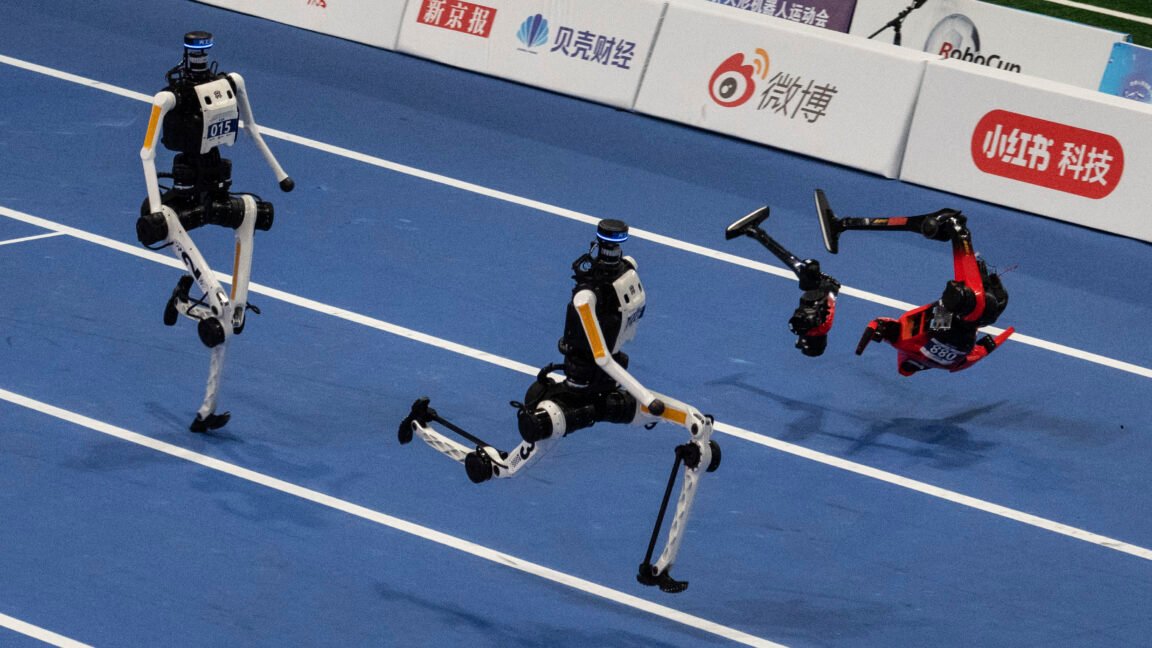
Limits of robot autonomy
The fact that many events still permitted humans to directly control robotic motions shows that autonomous robot systems still have a long way to go, Patel said. Whereas humans can quickly learn many tasks on the fly, robots require much more training through repeated trial-and-error attempts either in simulation or in real-world scenarios.
“You need to have all possible edge cases for a robot to learn from interaction, which is not really feasible,” Patel told Ars. “You can simulate something like 100,000 scenarios for hammering a nail, but that’s just one task from millions of tasks in the world.”
The AI models powering many robots can also learn from huge amounts of visual data involving human demonstrations. But gathering such task demonstration data for robots has proven time- and resource-intensive, despite various companies’ efforts to pay ordinary people to strap cameras on their heads.
“We would have to push the algorithmic development a lot to actually see a robot being able to generalize and do eight-hour work shifts in any random environment,” Patel explained.
Even the more autonomous robots competing in the World Humanoid Robot Competition still rely heavily on cloud computing to help run intensive AI models, rather than running the AI computing directly on their own onboard hardware, according to the South China Morning Post. It described robots being equipped with 5G modules to transmit data to an “embodied-intelligence system” and then receiving instructions on what to do next.
The real test for humanoid robots’ capabilities will necessarily take place in the real world beyond the demonstrations at the World Humanoid Robot Games. Investors have poured more than $6 billion into humanoid robot companies in 2025 alone, with Chinese companies being especially aggressive in testing and deploying such robots.
Meanwhile, US companies like Boston Dynamics and Agility Robotics are also ramping up their own commercialization and deployment plans in factories and warehouses. The US government has even banned the import of foreign-made robots, including China’s most popular humanoid robots.
But not all robotics researchers are convinced that humanoid robots are necessary, especially when the most useful robots currently doing productive work usually come in other shapes and sizes. For his own part, Patel is focused on developing software algorithms that allow many different types of robots to seamlessly switch between tasks.