dailynewsnblog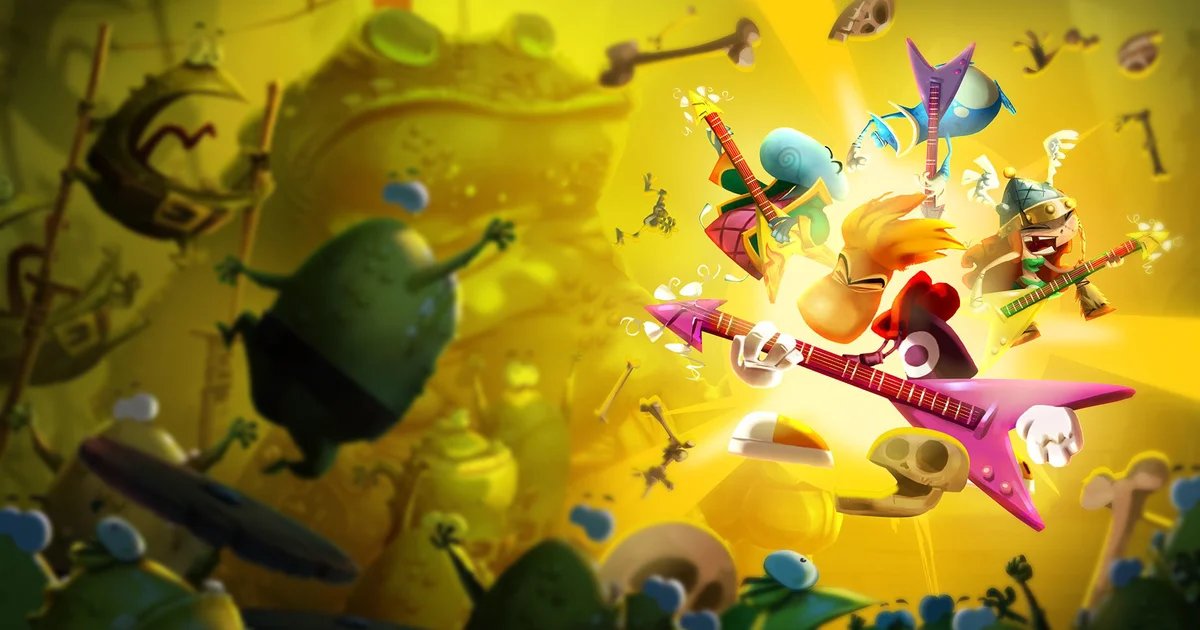
I own Rayman Legends on six platforms. The game, a 2D platformer that launched back in 2013, initially released onto the PS3, Xbox 360, PC, Wii U and PS Vita. A year later, it came to Xbox One and PS4. Fast-forward three years and it’s on Switch, and then in 2021 it came to Stadia, too. It’s been around the block a few times then, and I’ve gone with it each time – I have 1000Gs and a Platinum trophy for it. It’s just a very, very good game.
But what makes it so enduring? It’s the creativity oozing out of every pore. The simple run-and-jump platforming feels excellent in your hands, the animations that back it up are luscious and fun, and the music and sound design treads that precarious line between utterly charming and slightly vexing. As a game, it’s imaginative and generous – a kind-hearted hug that encourages you to move out of deceptively simple normal levels into time trials, assault courses, and gauntlets in a warm and friendly way.
Its musical levels – famous gibberish versions of “Black Betty”, “Eye of the Tiger”, and “Woo-Hoo” – were iconic from launch, and have become crystallised as a highlight of the entire Rayman oeuvre ever since. They encapsulate everything about the playful, slightly silly joy of Rayman: unlikely rhythm-action sections of mild platforming peril. Not too hard, not too easy. As concerned with titillating you as it is with making you smile. When Ubisoft announced Rayman Legends Retold, I was worried that whatever work the twinned studios of Ubi Montpellier and Milan would do would somehow undo whatever magic was woven into these levels 13 years ago – moving from pure 2D to 2.5D, after all, is enough to break the illusion alone.
My fears were unfounded, though. After playing a good three hours of the game – including one old music level and one new one – I realised the team behind Retold must hold the original game in as much esteem as I do; understanding that delicate balance between goofy fun and platforming perfection is an important line to toe. An interview after my preview confirmed my suspicions.
“It has been one of the best experiences of my life, to be honest,” says Marco Renso, animation and realisation director on Rayman Legends Retold at Ubisoft Milan, when I ask him about working on these new musical levels. “As a game dev, I’ve always loved musical levels, but working on new ones… it doesn’t happen often that you get to work on something so creative and enjoyable. Honestly, from the start of the process – coming up with the ideas – to finishing it off with art, music, animation and everything else. Making it all come together is like conducting a composition yourself; every asset, every beat, it has to work together to create a rhythm and pacing experience. It’s one of the most creative environments possible, basically.”
“I will just add to what Marco said, the toughest part has been choosing the tracks,” laughs Loïc Gounon, brand producer at Ubisoft Montpellier, “because there’s so many options early on. But when it comes to the selection of tracks, we wanted to have a bit more choice, you know? We wanted more tracks for everyone. Before, it was not all tracks that we all liked, I would say – we were in a bit of a rush and said ‘OK, let’s put that in the game’. This time, I think we tried to have a bit more thought about trying to please more people.. that doesn’t mean that we’ll do only very trendy types of track, for example. We really want something for everyone.”
Gounon goes on to explain that the team’s biggest wish when it comes to these new tracks is that “older folks and younger folks” will both appreciate the new music that has been added to the game because, after all, music is transgenerational. “It can be a kid saying to his dad ‘oh, that’s my track’ or the opposite, right? A dad telling his kid, ‘oh, you know, I grew up with this song’. You get to enjoy it together.”

So far, we only know about two new musical levels in the game. Firstly, a song inspired by the Macarena (above) where, at one point in the madcap dash through a Mexican wrestling rink-cum-kitchen, you get to see the luchador boss you’ll fight in a later stage doing the iconic Macarena dance. Great, no notes. Secondly, there’s one inspired by U Can’t Touch This by MC Hammer. These will stand alongside the six original songs to make “a dozen” musical levels in the game, all-in-all. So, by my count, that’s another four unaccounted for… what could they be?
Interestingly, the gameplay feels exactly the same as the original games – it’d be heresy if it felt any different, we all know how that worked out for Crash Bandicoot. This is because the engine powering the physics, gameplay mechanics, collision and so on – UbiArt Framework – is running within another engine that’s handling the visuals, audio, and rendering. It’s like a “Russian doll”, Gounon laughs. “It’s still running as it was the first time, you know, but re-rendered more beautifully!”

Renso adds that moving the game from 2D to 2.5D was also an opportunity to “play with depth, with the size of the characters, with the storytelling of [the game],”. This led to new opportunities when it came to the new levels the teams added to Retold, too. “One example is the zip line that you see in several musical levels,” he explains. “At some points, a big and long zip line can be a moment where you don’t need a gameplay input; you can just look at something. So maybe that’s a good moment [to bend the camera] and let you enjoy something in the background.” You can see this in the video above; when the luchador starts dancing, we’re given time to collect ourselves, enjoy the nonsense of it all, before being thrown back into the action.
“Rayman is not Hollow Knight,” says Gounon, when I ask about balancing the difficulty the series is known for (Rayman on the PS1 is still hard as nails in 2026) with the clear intention the devs have of getting parents to play this with their kids. “But still, there is a DNA of die-and-retry platforming here. So it’s not, like, a hyper-casual platformer, but it’s also not the most hardcore Metroidvania, either. So that’s where we are with Rayman: attracting people that like a challenge, but also like to finish the story. We are platforming fans that like to be tested. And even if we play with our kids, we want them to also enjoy that, too.”

Gounon has said in a previous interview that Ubisoft sees Rayman Legends Retold as a ‘new starting point’ for Rayman. But, in chatting to him about this game, I can see that Retold is more than just a cynical cash-in for a platforming mascot – this is a personal project for him. “I’m a bit like you, Dom,” he tells me. “I played the first Rayman on my PS1, as a launch title. So I have a long history with Rayman that started when I was 12 or 13 years old. I played in Rayman 2 before joining Ubisoft, and it was one of the reasons why I joined the company. Then, I worked on a version of Rayman 4 in 2006 with Michel Ancel, and his team that became Raving Rabbids (a franchise I handled for a couple of years). Then we had another run at Rayman 4 – that became Origins – and it all came back to Montpellier.
“It’s really cool to reconnect with the characters of the world [with Retold], and part of what we are doing in world building, storytelling, emotion… It’s all making us think about what will come next. This isn’t just a one-shot remake; it’s part of a much bigger picture that we hope is going to capture original fans, but also their kids, and introduce them to this wonderful world.”
We learned last week that Ubisoft has delayed Rayman Legends Retold in order to “make sure every detail gets the care it deserves”, moving the release date from 1st October to 3rd December. I hope this means the game launches into a slightly less crowded world; one that is ready to take Rayman’s floating hand once again and experience the light-hearted joy of his weird little universe. Lord knows we’ll probably need it after the gritty realism of that other big game launching in November, right?