dailynewsnblog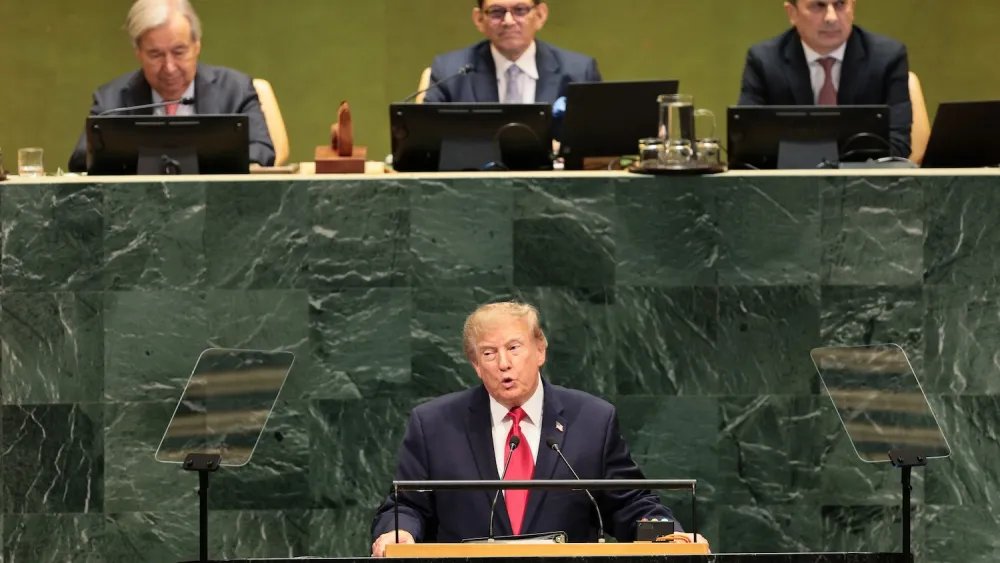
President Donald Trump tried to end the seven-month Strait of Hormuz crisis during his visit to the United Nations on Tuesday—both by ultimatum and by back channel.
In the hours after the U.S. commander-in-chief threatened to “annihilate the Islamic Republic” from the UN General Assembly podium in New York, his envoys sat down with Iran‘s delegation for three hours of talks aimed at concluding the war between the two countries.
Iran’s foreign minister, Abbas Araghchi, met with U.S. special envoys Steve Witkoff and Jared Kushner on the sidelines of the General Assembly, marking the first known high-level meeting since the interim deal Trump and Iran’s President Masoud Pezeshkian signed over the summer collapsed within weeks.
Trump’s 37-minute address to the General Assembly had been anything but conciliatory.
“I have a big decision to make. Will a deal be made with Iran that lets them rebuild and create a far greater country than it ever was before…? Or do I annihilate the Islamic Republic and do it quickly?”
During his speech, Trump called on all nations to help to enforce the complete economic isolation of Iran, accusing Tehran of stalling on a deal to fully restore traffic to the strait until after the Nov. 3 U.S. midterms, and said he expected a deal “right after the election.”
Amid the tense environment, activity in the Strait of Hormuz remains sparse. Seventeen vessels transited the vital oil passage over the weekend, down from 37 a week earlier, according to commodity intelligence firm Kpler.
Provisional data from the analytics company indicated there were just two crossings Monday: a Panama-flagged Supramax and a Liberia-flagged bulk carrier.
Over the weekend, four vessels—two tankers carrying refined products and two empty bulkers and gas carriers—exited the strait on Sunday while two small tankers entered. Five vessels left Saturday carrying agricultural products, liquefied petroleum gas and fertilizer.
Kpler said two commercial tankers were attacked in the waterway since the weekend. The first incident involved the Liberia-flagged tanker Al Maryah being hit by a drone while sailing outside the Strait of Hormuz on Sunday. In another incident, reported Monday, an oil tanker identified by maritime security firm Vanguard Tech was hit by an unknown projectile while navigating the conduit.
A widely circulated report from Japanese news agency Kyodo indicated that Iran offered to reopen the strait for all traffic within seven days if the U.S. took initial steps toward easing military pressure, including ending its naval blockade of Iranian ports.
The report, which was based on an unnamed senior Iranian official, was later denied by Iran’s Fars News Agency, which said its own sources refuted the claims. The Islamic Revolutionary Guard Corps (IRGC) still claims the strait is closed and under its control.
Despite the disputed claims on Iran’s position, Brent crude oil futures declined nearly 4 percent in the hours after the Kyodo report published, falling back under the $100 per barrel mark Tuesday morning. The figures marked the first daily closure under $100 since Sept. 8.
The international commercial shipping industry’s message to governments in the wake of the crisis is hardening.
“The ability of commercial ships to navigate international waterways safely, predictably and without unnecessary impediment, is crucial to international maritime law and to the global trade system,” said International Chamber of Shipping (ICS) secretary general Thomas Kazakos in an address to the UN Security Council last Thursday. “Shipping must not be held to ransom.”
Kazakos rejected attempts to impose transit fees or new clearance requirements on the strait.
But diesel fuel has continued its soaring record pace as wars in both the Middle East and across Ukraine and Russia further constrict oil supply. According to the U.S. Energy Information Administration, diesel prices reached $6.529 per gallon on Monday, up from $6.285 per gallon the week prior.
The excess costs have shifted more freight from trucks to railroads, with multiple Republican lawmakers coming out in favor of banning diesel exports to protect farmers.
President Trump told reporters Tuesday that he supports such a ban. By halting exports, the administration could potentially increase domestic supplies and lower prices in the short term. But analysts warn the ban could drive up global diesel prices and eventually feed higher costs back into the U.S. economy over a longer period.
Trump was due to meet on Tuesday with leaders of the six Gulf Arab states: Bahrain, Kuwait, Qatar, Oman, Saudi Arabia and the United Arab Emirates. According to the Financial Times, the U.S. is discussing a $10 billion joint investment fund with some Arab states to repair energy infrastructure damaged during the Iran war and help the Gulf region circumvent the Strait of Hormuz.