dailynewsnblog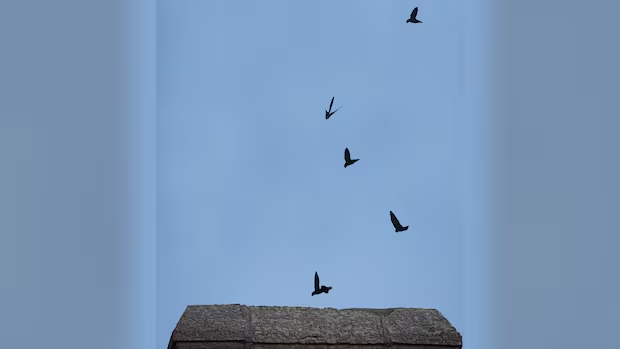
The mysterious metallic chittering noises started this spring.
Nettie and Thomas Rempel-Ong began noticing whispered and rapid, insect-like babbling.
It was coming from inside the house.
“My wife and I kind of had that lightbulb moment of, ‘We should probably call someone about this,'” Rempel-Ong said out in his yard, craning his neck up at a four-metre-high brick chimney extending up from his roof.
“We found out there’s a threatened species that lives in that chimney.”
They had uninvited guests living in their 91-year-old home in Winnipeg’s Old Tuxedo neighbourhood — specifically, chimney swifts, a migratory bird species classified as threatened under the federal Species at Risk Act.
Rempel-Ong, 40, is still wrapping his head around what it means to host a threatened species, but he’s already taken to calling these “musical roommates” his “swifties,” to the embarrassment of his young daughter.
A less cringey, more common nickname is the “flying cigar,” due to the bird’s stubby, cylindrical body and long wings.
Chimney swift populations have declined 88 per cent since 1970, according to survey data.

The Rempel-Ongs’ home in Winnipeg’s Old Tuxedo neighbourhood is now also home to chimney swifts, a threatened migratory bird species in Canada.
How a wild bird became reliant on an artificial structure that belches out smoke and ash largely has to do with European settlement, urbanization and forestry.
Pre-colonization, chimney swifts in North America nested in old growth leafy trees, often dead or dying, with hollows large enough to raise a family in during the summer months.

They build nests by pasting together twig bundles with their spit and affixing those vertically to the inside of a deep tree cavity.
Logging and land-clearing for housing and agriculture eliminated much of their historical habitat.
The birds adapted rather … swiftly.
The internal surfaces of brick smokestacks and chimneys had some of the same features they needed for gluing on their stick-saliva nests.

At one point, many experts believed the arrival of settlers may have boosted swift numbers in North America because of a sudden abundance of chimneys suitable for nests.
That theory didn’t exactly hold up.
Later research suggests the chimneys popping up across the continent weren’t being built at the same pace as the big old growth forests were being felled.
And in the past five decades or so, the style of chimneys that swifts became reliant on fell out of fashion architecturally.

The closure or destruction of large church chimneys that once served as communal roosts dealt a blow, as has the conversion or capping of residential chimneys in homes like the Rempel-Ongs’.
Another reason for their waning numbers relates to bugs.
Chimney swifts are part of the second-most at-risk group of birds in Canada, called aerial insectivores. As the name suggests, they feast on insects in flight, including mosquitoes and beetles, the latter of which have experienced declines associated with DDT pesticide use.
The birds are disappearing faster in their northernmost ranges in Canada than in the U.S., possibly due to climate change, according to Environment and Climate Change Canada.

“Swifts are facing significant pressures from habitat loss and loss of insects and climate change,” said Mackenzie Glover, co-ordinator of the Manitoba Chimney Swift Initiative.
“We try to protect them as much as possible.”
As the Rempel-Ongs tried to discern what might be living in their chimney, they happened upon the initiative.
Nettie called up Glover, an ecological restoration expert, who just inherited the gig at the swift initiative.

She made a house call and spied on the Rempel-Ongs’ chimney from her car for an hour.
“I saw one dive right in — very confident entry,” Glover said.
The entry was evidence enough to extend protected status to the Rempel-Ong home under the federal Species at Risk and Migratory Bird Convention acts.
Now in its 20th year, the Manitoba Chimney Swift Initiative has helped catalogue about 400 such potential chimney habitats in the province, as far north as The Pas and as far south as Emerson at the Canada-U.S. border.
“It’s challenging to keep track of all of the chimneys that we know that they use. They’re always surprising us and using new chimneys, like this one we didn’t know about,” said Glover.
The Manitoba Chimney Swift Initiative’s map of chimney swift locations:
In the fall, Glover and others with the initiative do chimney cleanouts, where they often recover nest materials, poop and eggshells that are used to record whether swifts successfully nested. That data is shared with other researchers tasked with periodically updating recovery strategies.
Homeowners get financial and other support to clean, maintain or repair the chimneys through the chimney swift initiative.
Under federal laws, it’s an offence to kill, capture, injure or harass the birds, or to disturb their nest or eggs without a permit.
Some activities, like chimney cleaning or repair, are allowed without a permit after the birds have left for the winter and before they return in spring.
Glover and others are also helping the Rempel-Ongs uncap and restore a second chimney on their property, in hopes of making it inviting to swifts when they come home to roost next year.
“I feel hopeful that we’re spreading the word, and that people are getting interested and people like Thomas and Nettie are excited to have swifts in their chimney,” said Glover.
“They can eat up to 1,000 mosquitoes a day, so they’re pretty nice to have around.”

Thomas Rempel-Ong likes the sound of that.
“You’re telling me a fireplace that I don’t use can be home to a threatened species that naturally eats mosquitoes every day? This is Winnipeg … tell me what I need to do, because I am more than happy to have mosquito-eating birds living in my chimney,” he said.
“I guess that’s my way of trying to be a good neighbour.”
Listen to the call of the chimney swift:

![9-Hour Flights: Breeze Airways’ 11 Longest Airbus A220 Routes Revealed [Map]](https://dailynewsnblog.com/wp-content/uploads/2026/07/airbus_a220-371_-n216bz-_cn_55172-_-3-11-2024.jpg)