dailynewsnblog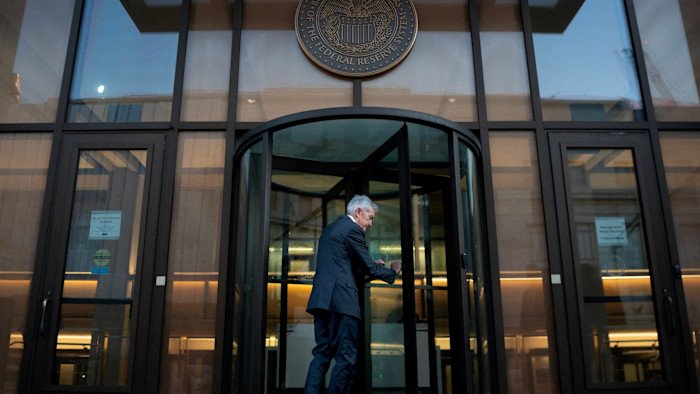
Stay informed with free updates
Simply sign up to the Eurozone economy myFT Digest — delivered directly to your inbox.
The US Federal Reserve is widely expected to keep interest rates on hold when it convenes next week, despite pressure from President Donald Trump for lower borrowing costs and the launch this month of a criminal investigation into the central bank’s chair.
The Fed in December cut the benchmark rate by a quarter point to between 3.5 per cent and 3.75 per cent, taking it to a three-year low. This marked its third consecutive reduction in borrowing costs.
US inflation remained at 2.7 per cent in December, above the Fed’s target but in line with economists’ expectations. Meanwhile, the month’s jobs figure came in below expectations, in a sign that the labour market is slowing.
As a result, futures markets are pricing in very little chance of a rate reduction this month, although they still see it as likely that there will be two cuts later this year.
The decision next week comes after the Department of Justice this month launched a criminal probe into outgoing Fed chair Jay Powell, related to a $2.5bn renovation of the central bank’s headquarters.
“This new threat is not about my testimony last June or about the renovation of the Federal Reserve buildings,” Powell said in response to the probe.
“This is about whether the Fed will be able to continue to set interest rates based on evidence and economic conditions — or whether instead monetary policy will be directed by political pressure or intimidation,” he added. Zehra Munir
Is growth slowing in the Eurozone?
After a shortlived flare-up of US trade tensions, with President Donald Trump scrapping his threat of additional tariffs against eight European countries, the focus of investors in the Eurozone will return to more mundane data next week.
Eurostat’s initial estimate of fourth-quarter GDP growth, published on Friday, will offer the latest indication of the bloc’s economic momentum.
Economists polled by Reuters expect that the pace of the expansion will have slowed slightly to 0.2 per cent, compared with the previous quarter when the economy grew at 0.3 per cent. Yet this would be the ninth consecutive quarter of growth, underpinning the Eurozone’s unexpected resilience despite geopolitical tension and somewhat bolstered by Germany, which seems to be slowly returning to growth as the government’s debt-funded investment programme kicks in.
The European Central Bank upgraded its GDP forecasts for the second time in December, now predicting growth of 1.2 per cent this year, down from an estimated 1.4 per cent in 2025.
Hopes of a quicker recovery suffered a minor setback on Friday when an index of euro area business activity was unchanged, against expectations of a rise.
“The Eurozone’s economy is currently stuck in a halfway house with growth neither being weak enough to be concerned nor being strong enough to get excited,” said Carsten Brzeski, ING’s global head of macro. Olaf Storbeck
Is the Bank of Canada’s next move an increase or cut in rates?
Traders are expecting Canada’s central bank to hold its policy rate steady at 2.25 per cent when it announces its latest monetary policy decision on Wednesday.
Swaps contracts imply a roughly 10 per cent chance that it could surprise investors with a quarter-point cut to its benchmark rate. Generally, traders are betting the Bank of Canada is done cutting, and instead the bigger question for investors is when it might start to raise rates again.
Recent robust jobs data for November prompted bets that an increase in borrowing costs could come by the end of this year. Currently, the market is implying a roughly 50 per cent chance of a quarter-point rise by December. But weak GDP figures, including a contraction in October, might suggest an economy in need of further support.
“We don’t believe a return to policy tightening is in store until 2027 at the earliest,” said Bradley Saunders, an economist at Capital Economics, adding that softer economic data since the last meeting in December “made us wonder whether we were too quick in taking further easing out of our rate forecasts”.
Any further scaling back of hawkish bets will be crucial to the Canadian dollar, which has had a topsy-turvy year and a half given the path of US-Canada relations, but is roughly flat so far this year. Ian Smith