dailynewsnblog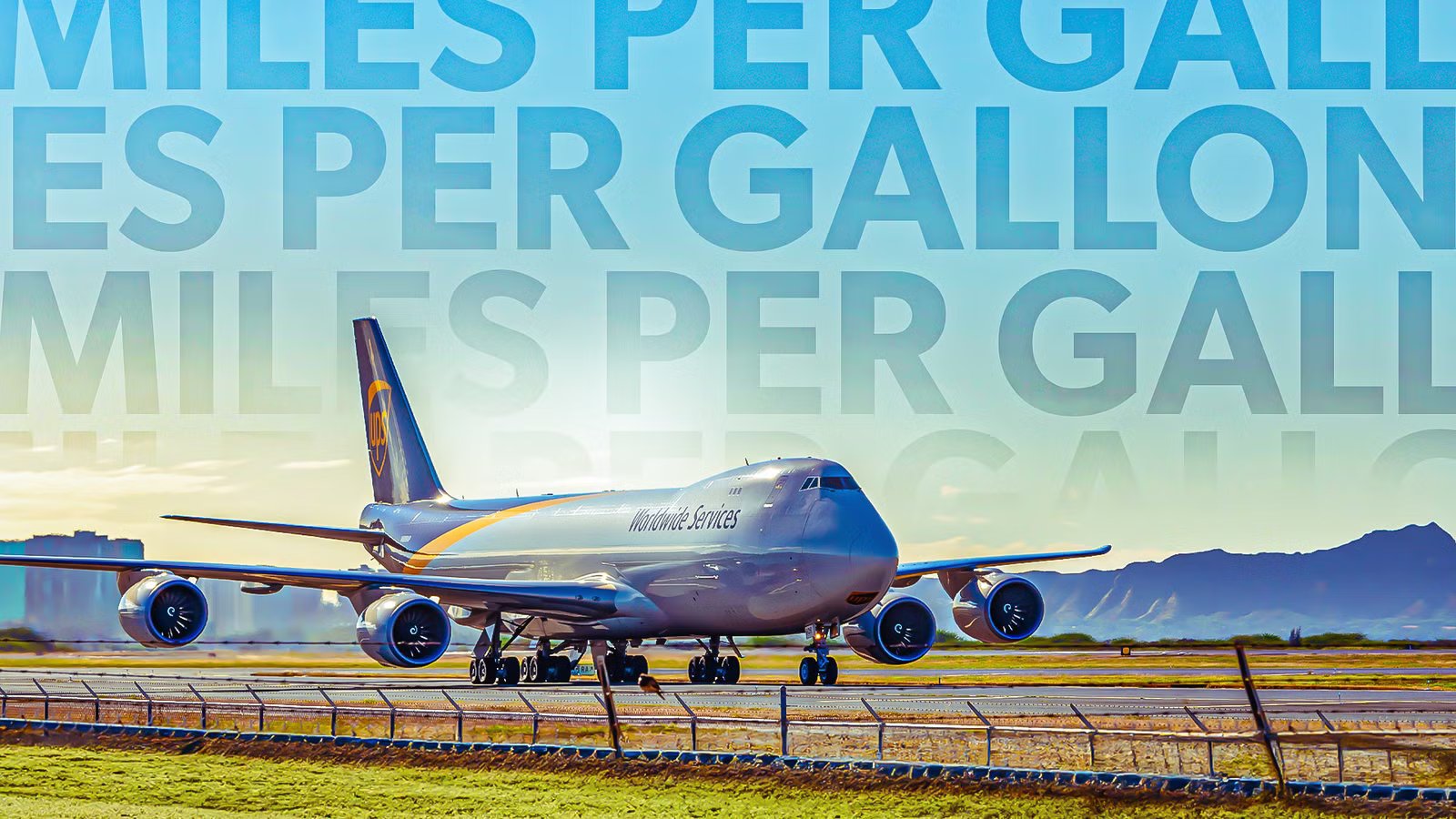
With its four engines, the Boeing 747 uses vast quantities of fuel, burning through 3,800 gallons every hour. This high fuel burn amounts to 0.9 gallons used every second and 0.19 miles per gallon (mpg). In this article, we will detail the Boeing 747’s mpg further, including the mpg per traveler, and how this compares to travel in a car and in modern airliners.
We will also delve into ongoing debates around sustainable aviation fuel to explore if aviation can be sustainable. After all, all airliners burn through staggering quantities of fuel.
The 747’s MPG

According to the BBC’s Future Planet, a cruising  Boeing 747 burns through 0.9 gallons (four liters) of fuel each second. This is equivalent to 3,500 gallons (13,250 liters) of fuel every hour. If a 747 is cruising at its standard cruising speed of around 580 mph (933 km/h), it is covering a mile every 6.2 seconds. Covering a mile requires 5.9 gallons of fuel. As a result, a cruising Boeing 747 can achieve just 0.18 miles per gallon. However, this is not the full picture, as a 747 carries far more people than most aircraft.
For example, Qantas’ 747-400s carried 364 passengers across Business, Premium Economy, and Economy. If we extrapolate this number of seats into the mpg that each passenger has, the data shows 65.5 mpg per passenger. According to calculatormpg.co.uk, the baseline for a good car mpg is 50. If a car is carrying two people, then the car is achieving 100 miles per gallon for each person. This suggests that flying on a 747 still uses substantially more fuel than a car carrying multiple people, but less than a car carrying one person.
The other difference to consider when comparing fuel consumption across modes of transport is that a 747 has to take off, which is not a concern for a car or train. Takeoff is the most fuel-intensive part of any flight as the jet has to get up to speed while it is at its heaviest, and then climb to cruising altitude. The exact fuel consumption during takeoff depends hugely on how close the aircraft is to its maximum takeoff weight (almost a million pounds). However, the general quantity of fuel needed is approximately 5,000 gallons (19,000 liters).
How Does a 747 Sustain This Consumption?

This consumption of fuel equates to a fuel burn of approximately 154,000 lbs (70,000 kg) for a flight from London to New York. To sustain such a high consumption, a 747 can carry a vast amount of fuel. The debut 747 could carry 48,400 gallons (183,000 liters) of fuel. Later variants increased this capacity to 63,034 gallons (238,610 liters) for the 747-8i Intercontinental.
This vast ocean of fuel is stored primarily in the aircraft’s wing. A 747 has two main fuel tanks in each wing, with further reserve fuel tanks in the wings’ outer sections and central wing tanks. It is common for airliners to store fuel in the wings to free up fuselage space for cargo storage.
The primary fuel tanks are usually filled first. Any further fuel needed for the flight is put into the central wing tank. Any final drops needed are pumped into the reserve tanks. Select 747 models can increase fuel capacity further by sealing off part of the horizontal stabilizer and using it as an additional auxiliary tank.
Cap Seal FAA Investigation

In recent years, the 747-400F’s fuel storage has come under FAA scrutiny due to improperly applied cap seals on some aircraft. Should these seals fail during a lightning strike or short circuit, it could allow arcing within the fuel tanks and cause an explosion. The FAA’s attention came following several fuel tank explosions on commercial aircraft in the late 1990s, which led to a 2001 review titled ‘Transport Airplane Fuel Tank System Design Review, Flammability Reduction, and Maintenance and Inspection Requirements.’
The document led to a range of safety recommendations, including those relating to cap seals. In June 2022, the FAA responded to reports that cap seals were not being applied properly during production of the 747-400F. A design change omitted the application of the cap seals on eight fasteners, distributed equally across both wings.
Aviation Fuel Concerns

At a surface level, the similar MPG per traveler between a 747 and a modern car would suggest a similar amount of environmental harm. Moreover, the US Energy Information Administration claims that jet fuel produces 21.1 lbs of CO2 per gallon, which is comparable to the 19.6 lbs of greenhouse gas produced from burning a gallon of gasoline. However, focusing on CO2 alone hides the unique environmental harm caused by burning aviation fuel at altitude.
The Intergovernmental Panel on Climate Change points to the effects of water vapor clouds that contain black carbon, nitrous oxide, and sulfur dioxide. Climate scientists use ‘radiative forcing’ as their measure for how environmentally harmful an activity is. A 2010 study by the University of Oslo’s International Institute for Applied Systems Analysis compared the radiative forcing of car and aircraft travel. The scientists concluded:
“Air travel results in a lower temperature change per passenger-kilometer than car travel on the long run; the integrated radiative forcing of air travel is on short- to medium time horizons much higher than for car travel. Per passenger-hour traveled however, aviation’s climate impact is a factor 6 to 47 higher than the impact from car travel.”
How Do Modern Airliners Compare?

One reason the 747 burns so much fuel and has a poor mpg, causing greater environmental harm, is that it’s an outdated airframe. This aircraft was first introduced in 1970, and the technology available 56 years ago was substantially less advanced than aircraft technology today. As a result, the 747 would be considered incredibly inefficient if it were produced today. Furthermore, modern airliners are far lighter than the 747, needing less fuel for takeoff.
21st-century widebody, and notably two-engine, aircraft are far more efficient due to modern technology. They burn less fuel. However, because they carry fewer passengers than the behemoth 747, they don’t necessarily have a better mpg per passenger. The Airbus A350 was introduced in 2015 with Qatar Airways, becoming the first Airbus aircraft constructed primarily with carbon-fibre-reinforced polymers.
Simple Flying reported that this aircraft burns 2,700 gallons per hour, or 0.75 gallons per second. With a cruising speed of 561 mph, the aircraft travels a mile every 6.4 seconds and has a cruising mpg of 0.208. Qantas’s upcoming A350-1000s will have 238 seats across four classes, yielding an mpg per passenger of 50. This is equivalent to a modern car with only the driver on board.
A Boeing 787 Dreamliner has also advanced the field of environmentally conscious aviation. The Dreamliner was first introduced in October 2011 with All Nippon Airways. This jetliner burns 2,900 gallons of fuel per hour, and its cruising speed is 561 mph. As a result, the aircraft burns 5.17 gallons per mile, yielding an mpg of 0.193. Meanwhile, a Qantas 787-9 Dreamliner has 236 seats across three classes, so each passenger gets 44.8 mpg during the cruise.
Could Sustainable Aviation Fuel Mitigate Environmental Harm?

We can see that even modern airliners consume vast quantities of fuel, causing significant environmental harm. Sustainable aviation fuel (SAF) could be a pathway to mitigate the harm of this enormous fuel consumption. SAF is defined as aviation fuel that is not derived from fossil fuels, but has near-identical performance characteristics. It can be mixed with conventional fuel, and aircraft don’t have to be re-engineered, and its development has come with a host of benefits and challenges.
IATA’s criteria for fuel to be considered sustainable are that it must reduce CO2 emissions across its lifecycle, not require excess freshwater, not compete with food production, and not cause deforestation. If SAF can be rolled out, it could transform the aviation sector’s sustainability. A ScienceDirect study based on the Carbon Offsetting and Reduction Scheme for International Aviation found that SAF could allow greenhouse gas emissions to decrease by up to 94%. Airbus puts this number closer to 80%.
SAF has begun to be seen in action within the commercial aviation sector. Virgin Atlantic operated the first 100% SAF flight in 2023, flying a Boeing 787-9 Dreamliner with Rolls-Royce Trent 1000 engines. Rolls-Royce has since claimed to be the only engine manufacturer to confirm that all its powerplants work with SAF.
However, SAF rollout has not yet been substantial, primarily due to economic challenges: SAF costs an average of $6 per gallon, while fossil-fuel-based jet fuel typically costs $2.29 per gallon (although it has been on the rise amid the 2026 Iran Crisis). The high cost is primarily due to low production rates, as just 33 million gallons of SAF were produced in the US in 2021. The US Department of Energy estimated in 2022 that SAF production would have to increase to 3 billion gallons annually.