dailynewsnblog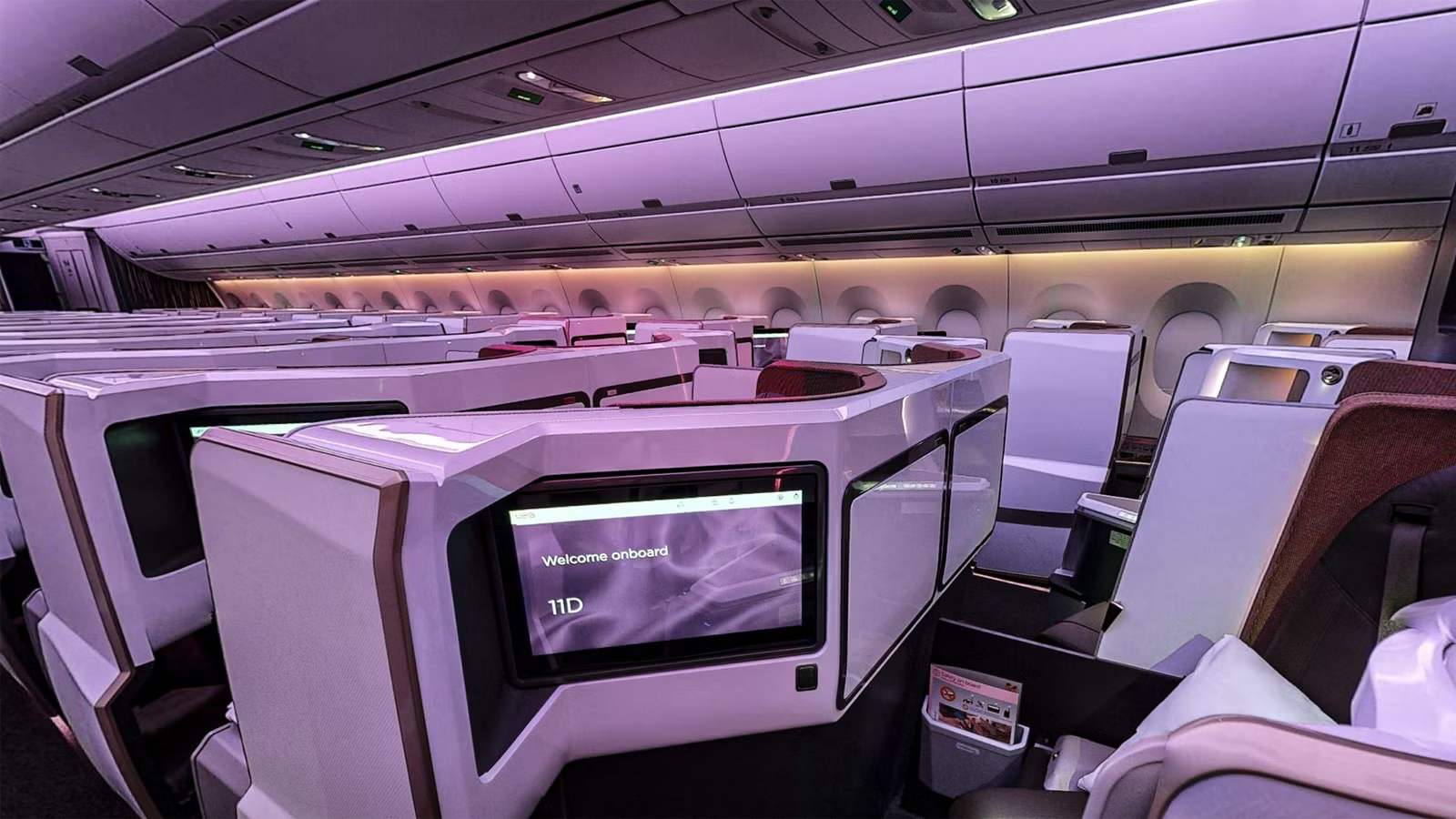
Airlines tend to prefer keeping all examples within a given fleet type more or less identical to reduce complexity and improve flexibility. Operating subfleets of the same type with multiple configurations is typically only done when an airline has a large fleet of these planes. Virgin Atlantic is a fairly small airline, with 43 aircraft in its fleet (per ch-aviation), including only 12 Airbus A350-1000s.
However, the airline operates two very different configurations on its A350-1000s. The first seven A350-1000s were delivered with 335 seats, including 44 Upper Class seats and 56 premium economy seats, which is fairly standard for a premium-configured A350-1000. The next five A350-1000s, however, feature just 16 Upper Class seats and 56 premium economy seats.
Having two subfleets in a fleet of 12 aircraft has the potential to be inefficient, and the dense layout of the later A350-1000s seems to be suboptimal considering the high demand for premium seats today. However, for Virgin Atlantic, this works well.
The Two Virgin Atlantic A350-1000 Subfleets

Virgin Atlantic’s standard A350-1000s are used to serve flagship destinations that justify the large premium cabins. In actuality, these are hardly the most premium A350-1000s in the world, as some airlines install close to 60 seats on these planes (including rival  British Airways), but these aircraft have more Upper Class seats than anything else in Virgin Atlantic’s fleet.
What’s more, the 56-seat premium economy cabin is one of the largest of any airline, and these A350-1000s also feature a large 235-seat economy cabin. The five newer A350-1000s feature the same seats as the first seven (using the Safran Cirrus NG for Upper Class, the Collins MiQ for premium economy, and the Recaro CL3710 for economy), but these planes feature just 16 Upper Class seats.
The premium economy cabin is the same size, and there are 90 additional economy seats, for a total of 325 economy seats. Meanwhile, these A350-1000s feature 397 seats across all cabins, one of the densest A350-1000 layouts in the world, especially for a full-service airline. In addition to the different configurations, Virgin Atlantic also installs different social areas for Upper Class on the two subfleets.
The standard A350-1000 features ‘The Loft’ located by the second set of exit doors between the Upper Class and premium economy cabins. Meanwhile, the high-density A350-1000s feature ‘The Booth’, located at the front of the Upper Class cabin on the left side. As the name suggests, The Booth consists of two seating benches facing one another with a table in the middle, resembling a booth.
The Deployment Of The A350-1000

For the 2026 summer season, Virgin Atlantic is deploying the 335-seat A350-1000 from London Heathrow to Atlanta, Los Angeles, New York JFK, and San Francisco, while also operating some frequencies to Delhi. Meanwhile, the 397-seat A350-1000 is most commonly scheduled from London Heathrow to Orlando, as well as from Edinburgh to Orlando, Manchester to Orlando, and Manchester to Las Vegas.
The 397-seat A350-1000 also operates some frequencies from London Heathrow to Delhi and, until recently, from Heathrow to Toronto. Virgin’s standard A350-1000s are being flown to major business hubs where demand for premium seats is high. The 44 Upper Class seats on Virgin Atlantic’s A350-1000s are arguably too few for some of the routes that they serve, which is why the carrier will soon begin taking delivery of Airbus A330-900s with 48 Upper Class seats.
The Airlines With The Densest A350-1000 Configurations | Business Class | Premium Economy | Economy | Total Seats |
|---|---|---|---|---|
French bee | N/A | 40 seats | 440 seats | 480 seats |
Air Caraïbes | N/A | 40 seats | 440 seats | 480 seats |
24 seats | 45 seats | 360 seats | 429 seats | |
Virgin Atlantic | 16 seats | 56 seats | 325 seats | 397 seats |
Ethiopian Airlines | 46 seats | N/A | 349 seats | 395 seats |
Qatar Airways | 24 seats | N/A | 371 seats | 395 seats |
Philippine Airlines | 42 seats | 24 seats | 316 seats | 382 seats |
The airline earns huge amounts of revenue from Upper Class. With its large premium economy and economy cabins, it can also capture demand from a wide range of customers. However, the 397-seat A350-1000s are predominantly flown to leisure destinations, with Orlando being their most visited destination.
The demand is massive but traditionally low-yielding, and most passengers prefer to book economy rather than premium seats. On an aircraft the size of an A350-1000, the 16-seat Upper Class cabin is essentially the bare minimum, while the economy cabin is where the money is made. Of course, to make money from low-yielding economy seats, the cabin needs to be massive.
Why A One-Size-Fits-All Solution Doesn’t Always Work

Airlines generally make their money from selling premium seats, which have much higher margins than economy tickets. While economy does bring in some money, largely due to the size of the cabin, the overall revenue generated from business and premium economy is generally higher than in economy on a widebody.
However, this only works when demand exists to fill the premium seats. Excessive capacity drops prices down, thereby destroying the economics of what’s meant to be an airline’s most profitable fare class. For destinations like Orlando or Las Vegas, travel demand is virtually limitless, but demand for business class is quite limited since budget-focused tourists usually focus on economy.
Using the 397-seat A350-1000 to a business hub like San Francisco would simply leave money on the table, but the same would be true if Virgin Atlantic flew the 335-seat A350 on its leisure-oriented routes. The two aircraft are designed for entirely different markets, and both are superior to the other for their intended missions. It may seem strange to dedicate a small subfleet just to leisure flights, but these destinations make up a sizable portion of Virgin Atlantic’s small network.
What’s more, Virgin Atlantic has generally struggled to compete against British Airways on many routes because it’s a much smaller airline with no short-haul network, but it’s quite strong on flights to leisure destinations in the US, with a larger presence and less competition. As a result, the routes operated by Virgin Atlantic’s 397-seat A350 can outperform the business-heavy routes flown by the 335-seat Airbus A350.
The Importance Of Premium Economy

While the 397-seat A350-1000 is designed to serve destinations like Orlando and Las Vegas, selling only 16 Upper Class seats isn’t ideal for overall revenue on a transatlantic widebody flight. However, the true moneymaker on this flight is the premium economy cabin, which features 56 seats (the same number as on the 335-seat configuration).
Virgin Atlantic has generally favored larger premium economy cabins compared to many other airlines, and it’s generally been quite successful for most carriers. Premium leisure has become highly prevalent in the aviation industry, but business class tickets remain expensive and highly elevated compared to economy.
Premium economy, meanwhile, still commands a sizable fare premium over economy, but the actual seats don’t take up nearly as much space as a business class seat. What’s more, it tends to have a very strong appeal to premium leisure travelers, even more so than business class, and this is particularly important for flights to vacation destinations. Several airlines have reported that premium economy is their most profitable cabin on a square-foot basis.
For Virgin Atlantic’s 397-seat A350s, the cabin is critical to earning real revenue on these routes, and it likely earns Virgin Atlantic more money than the other two cabins on these planes. Because of how space-efficient premium economy is, the carrier can also install even more economy seats, further lowering per-seat costs and creating one of the most cost-effective aircraft in the industry.
The Other End Of The Spectrum

Virgin Atlantic’s 397-seat A350s are extremely dense, while the large premium economy cabin significantly improves the economics of serving leisure destinations. Because these routes are extremely important to Virgin Atlantic, it’s crucial to optimize the plane, and they fly some of its strongest routes in terms of its market position. However, Virgin Atlantic also serves several major business hubs for which a 44-seat cabin (as found on the 335-seat A350) is needed, or not enough.
Virgin Atlantic’s upcoming Airbus A330-900s will feature 48 Upper Class seats, 56 premium economy seats, and 128 economy seats, for a total capacity of 232 passengers. This aircraft is specifically designed to serve markets like New York-JFK, which has nearly limitless demand, but also extremely strong premium demand. This new A330-900neo configuration will have relatively high per-seat costs, but the plane will generate a massive amount of revenue, making it extremely lucrative.
Aircraft | Upper Class | Premium Economy | Economy | Total Seats |
|---|---|---|---|---|
Airbus A330-300 | 31 seats | 48 seats | 185 seats | 264 seats |
Airbus A330-900neo | 32 seats | 46 seats | 184 seats | 262 seats |
Future A330-900neo | 48 seats | 56 seats | 128 seats | 232 seats |
Airbus A350-1000 | 44 seats | 56 seats | 235 seats | 335 seats |
16 seats | 56 seats | 325 seats | 397 seats | |
Boeing 787-9 | 31 seats | 35 seats | 192 seats | 258 seats |
Future 787-9 | 44 seats | 56 seats | 127 seats | 227 seats |
Virgin Atlantic’s standard A330-900 layout only has 32 Upper Class seats, which essentially leaves money on the table in these markets. What’s more, the airline will be reconfiguring its Boeing 787-9 Dreamliner fleet with 44 Upper Class seats, as opposed to the 31 you see today. For these markets, more premium revenue is crucial to the success of the route, and these planes will become increasingly dominant on the business routes, while the 397-seat A350 will remain the most effective weapon for leisure routes.
Catch what other trackers miss
Emergency squawks, holds, NOTAMs — live signals, no signup.
Open tracker
Catch what other trackers miss
Emergency squawks, holds, NOTAMs — live signals, no signup.
Open tracker

![American Airlines Launches 10 Nonstop Routes From New York-JFK To Europe [List & Map]](https://dailynewsnblog.com/wp-content/uploads/2026/09/aa.png)