dailynewsnblog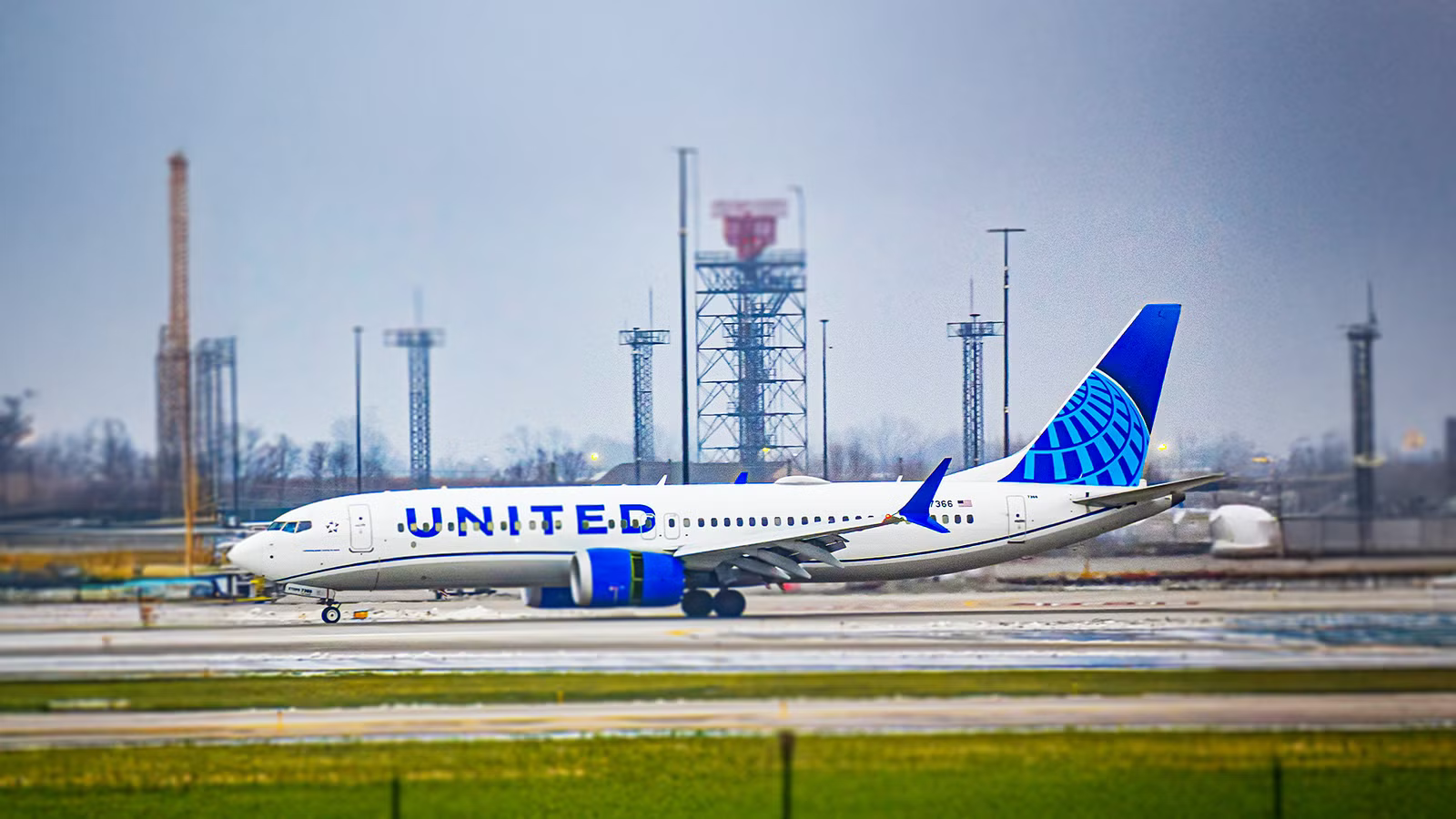
A 10-aircraft fleet within  United Airlines operates unlike almost anything else in the US carrier’s network. From Guam International Airport (GUM) United sends Boeing 737s across thousands of miles of the Pacific Ocean, connecting communities separated by vast stretches of water, where the next available transportation option may be hundreds of miles away. Now, those aircraft are being replaced by newer 737 MAX 8s — and the most peculiar feature of these aircraft is not the larger screens or faster WiFi, but a row of economy seats that can be collapsed to make room for a medical stretcher.
That unusual configuration points to a much bigger reason for the fleet change. United is modernizing a small fleet by putting an aircraft with substantially lower fuel burn, greater published range, and a flexible cabin into one of the most operationally unusual corners of its network. So why does the Guam operation need a 737 that can transform part of its passenger cabin into a medevac area, and why is United introducing the aircraft so rapidly across its most demanding Pacific routes?
United Is Rebuilding A 10-Aircraft Pacific Sub-Fleet

United’s Guam operation may be tiny compared with its mainland hubs, but its network is remarkably broad, and its importance is huge. According to United’s own description of the Guam operation, the carrier’s Guam-based narrowbody fleet serves 15 destinations, with up to 12 flights per day. Those flights include the unusual Island Hopper, which connects Guam and Hawaii through Chuuk, Pohnpei, Kosrae, Kwajalein and Majuro. United also operates up to 42 flights per week to Japan’s major cities, including  Tokyo Narita Airport(NRT),
  Tokyo Haneda Airport (HND), Osaka International Airport (KIX) and Nagoya Airport (NGO).
The fleet replacement is equally unusual because United is effectively maintaining a self-contained Pacific sub-fleet. The airline announced that it would replace its entire Guam-based fleet of 10 Boeing 737-800s with 10 Boeing 737 MAX 8s. In its March 2026 announcement, United said the first regularly scheduled MAX 8 flights from Guam would include Tokyo-Narita, and the aircraft would again operate unusual fifth-freedom flights such as Tokyo-Narita-Ulaanbaatar (UBN) and Tokyo-Narita-Koror (ROR). United’s fleet announcement initially targeted completion of the replacement by the end of 2026.
The timetable has subsequently become more complicated. AeroRoutes reported in June 2026 that United accelerated the Island Hopper, Palau, and Saipan routes to all-MAX 8 operation by early October 2026. The schedule called for Guam-Chuuk-Pohnpei-Kosrae-Kwajalein-Majuro-Honolulu service to transition from October 1, with other Island Hopper variants following on October 3 and October 7. Guam-Koror was scheduled to switch on September 30, while Saipan had already been moved to MAX 8 operation from July 19.
However, that acceleration does not mean every Guam route is moving at the same time. A later AeroRoutes schedule update still showed Guam-Nagoya, for example, switching to the MAX 8 in December, consistent with the remaining Guam routes originally scheduled for the end of the year.
Guam 737 fleet transition | Outgoing Boeing 737-800 | Incoming Boeing 737 MAX 8 |
Guam-based aircraft | 10 | 10 |
Planned role | Regional Pacific network | Regional Pacific network |
United two-class seating | 166 seats | 166 seats |
Boeing maximum seating | 189 | 210 |
United Guam configuration | 166 seats | Up to 166 seats, including up to 16 United First seats |
Published Boeing range | Up to 2,800 nautical miles (5,190 km) | Up to 3,500 nautical miles (6,480 km) |
Maximum takeoff weight | 174,200 lb (79,010 kg) | 182,200 lb (82,640 kg) |
Fuel-burn change | Baseline | About 14% lower per seat |
Engine | CFM56-7B | CFM LEAP-1B |
Medevac capability | Not highlighted in Guam configuration | Front economy rows can be collapsed for stretcher transport |
Source: Boeing
Meanwhile, the technical differences between the two aircraft are significant, as the table shows. However, United is not using the maximum seating capacity of a new aircraft in Guam. United says its Guam-based MAX 8s can seat up to 166 passengers, including up to 16 United First seats. The airline is maintaining a similar passenger capacity while adding an aircraft with a wider published operating envelope. And that matters because the aircraft are about to be deployed on some of the most demanding narrowbody routes in the United States’ Pacific network.
Why The Island Hopper Needs More Than A New Cabin

The Island Hopper is the clearest example of why United’s Guam fleet needs more capability than a conventional regional narrowbody operation. The service links Guam and Honolulu while making multiple stops across Micronesia and the Marshall Islands, including Chuuk, Pohnpei, Kosrae, Kwajalein, and Majuro. United describes the route as a unique part of its Guam network, while AeroRoutes’ June 2026 schedule filing details the different Island Hopper variants moving to MAX 8 operation in early October.
For passengers, the Island Hopper is remarkable because a single scheduled service can include several intermediate stops and take up most of a day. For United, the challenge starts before the aircraft leaves the gate. The 737 must carry enough fuel for each sector and maintain the necessary reserves while also transporting passengers, baggage, and cargo, all within strict weight limitations.
This is where the MAX 8’s efficiency becomes more important than its cabin. Boeing says the 737 MAX family provides a 20% reduction in fuel use and CO₂ emissions compared with the previous generation, while United’s own fleet equipment has highlighted the efficiency benefits of the MAX 8 over the 737-800. Lower fuel consumption does not automatically mean that every flight can carry more cargo, because payload depends on distance, weather, reserves, runway conditions, and other factors. But reducing the fuel required for a mission can potentially free weight that can instead be allocated to payload.
The range difference is also substantial. Boeing lists 3,500 nautical miles (6,480 km) for the 737-8 compared with 2,800 nautical miles (5,190 km) for the 737-800. That is a nominal difference of 700 nautical miles (1,290 km). It illustrates the larger performance envelope available to United. That extra margin helps because the Guam operation includes routes where the older 737-800’s payload capabilities could be constrained. The MAX 8’s lower fuel burn can reduce the fuel-weight penalty associated with longer sectors, potentially allowing United to make better use of the aircraft’s available payload.
The Island Hopper route is where the MAX 8’s invisible advantages may be the most useful. But passengers will still notice another major difference as soon as they take their seats.
The MAX 8 Brings United’s Modern Cabin To Guam

The operational improvement comes with a major cabin upgrade too. United says its Guam MAX 8s feature seatback entertainment at every seat, USB charging, Bluetooth connectivity, larger overhead bins, Wi-Fi and more extra-legroom seating.
The airline says the aircraft have 13-inch high-definition screens in United First and 10-inch HD screens in economy, with more than 1,400 on-demand entertainment selections. The system includes movies, television, international content, audio, podcasts, and games.
Bluetooth connectivity is another great improvement. Passengers can connect wireless headphones directly to the seatback entertainment system, while USB charging is available at every seat. Wi-Fi will also be available for purchase, with United planning to roll out Starlink across its fleet; the airline says Starlink access will eventually be free for MileagePlus customers on equipped aircraft.
The upgrade is particularly relevant on the Island Hopper because this is not a typical short-haul regional flight. A passenger can spend many hours aboard the aircraft while making several intermediate stops. Consequently, entertainment, charging, and connectivity become considerably more important than they would be on a short domestic service. Yet the cabin’s most unusual feature is something passengers may never notice unless they need it. United has designed the front economy area so that the seats can be collapsed to accommodate a medical stretcher.
Why A Row Of Economy Seats Can Become A Medevac Bay

The stretcher capability makes sense once you look at the map of the Pacific islands. United connects communities across Micronesia and the western Pacific, where medical facilities capable of handling serious cases may not be located on the same island as the patient. In such circumstances, transporting someone to a higher level of care can itself become a logistical challenge.
That is why the front rows of economy can be collapsed to accommodate a medical stretcher for patients requiring medevac transport. United included the same capability in its original March 2026 announcement of the Guam MAX 8 fleet, confirming that the feature is a deliberate part of the aircraft configuration.
The important point is that United has not converted the whole aircraft into dedicated air ambulances. They remain commercial 737 MAX 8s carrying up to 166 passengers in the Guam configuration. The stretcher capability allows the airline to repurpose part of the cabin when a medical evacuation is required.
That flexibility has a particular value in the Pacific. United already operates flights between communities that may require such transportation, so the airline does not need to position a separate specialized aircraft every time a patient needs to move to another location. A commercial aircraft can retain its normal revenue-producing role while also providing a medical-transport capability when necessary.
The configuration also demonstrates why the Guam operation cannot be understood purely as a conventional airline hub. United says more than 1,000 employees are based throughout Guam and Micronesia, and the carrier describes Guam as a gateway connecting communities across the Pacific and the United States. Aviation transportation plays a crucial role in a region where geography can make medical transportation, cargo movement, and passenger travel part of the same logistical system.
The Real Upgrade Is Happening In The Fuel Tanks

Boeing’s specifications list the 737-8’s maximum takeoff weight at 182,200 lb (82,640 kg), compared with 174,200 lb (79,010 kg) for the 737-800. The MAX uses CFM LEAP-1B engines, while the 737-800 uses CFM56-7B engines.
That combination of higher MTOW, greater range, and lower fuel consumption gives United additional flexibility in planning individual missions. An aircraft’s payload is not determined solely by the number of empty seats or the cubic meters of cargo space remaining. Fuel itself contributes significantly to takeoff weight, so reducing a mission’s fuel requirement can preserve more weight capacity for passengers, baggage, or cargo.
This is particularly relevant because the same 10 Guam-based aircraft must cover a broad spectrum of missions. The 15 destinations range from nearby Pacific islands to Japan and other Asian markets, while the Island Hopper adds a multi-stop transoceanic mission unlike almost anything else in United’s network. The MAX 8 consequently gives United one aircraft type capable of successfully handling a wide range of missions.
There is also a fleet-management benefit. The Boeing 737 MAX family maintains substantial commonality with the previous NG family, with faster training for pilots, flight attendants, mechanics, maintenance facilities, and other operational resources. For United, replacing the Guam 737-800s with MAX 8s brings the Pacific sub-fleet onto a newer generation of the same narrowbody family while expanding the operational margin available on difficult routes.
The Pacific Test For United’s New 737 MAX 8s

The importance of the Guam fleet renewal will become clearer once the transition is complete. United is effectively creating a standardized 10-aircraft MAX 8 operation around Guam, replacing the older 737-800s that have supported the carrier’s Pacific network for years. AeroRoutes reported that the Island Hopper, Palau, and Saipan services were being accelerated to MAX 8 operation in late September and early October, while several other Guam routes were initially scheduled for December.
That staggered rollout gives United an opportunity to introduce the aircraft where the network demands it most before completing the wider replacement. The Island Hopper’s conversion is particularly significant because it is one of the carrier’s most distinctive services, while the later changes will bring the new aircraft to routes linking Guam with major Asian markets. AeroRoutes’ subsequent schedule information continued to show December transitions for routes including Nagoya, Manila, Osaka-Kansai, Taipei and Tokyo-Haneda.
For Guam itself, the change also represents a broader modernization of United’s operation. The airline has been upgrading the airport experience alongside the aircraft, including new check-in kiosks that it says are up to 55% faster. United also highlights improvements ranging from the MAX 8 cabin to accessibility and connectivity, suggesting that the fleet replacement is part of a broader effort to enhance how the airline serves its Pacific hub.
The longer-term question is what United does with the additional capability once all 10 aircraft are established in Guam. The MAX 8 gives the carrier a modern, standardized platform for a network connecting major Asian destinations with some of the world’s most isolated communities, while its adaptable cabin accommodates unusual requirements as needed. If the new fleet performs as intended, Guam will remain a small operation on United’s fleet map—but one with an aircraft configuration shaped by the extraordinary demands of the Pacific.
Catch what other trackers miss
Emergency squawks, holds, NOTAMs — live signals, no signup.
Open tracker
Catch what other trackers miss
Emergency squawks, holds, NOTAMs — live signals, no signup.
Open tracker