dailynewsnblog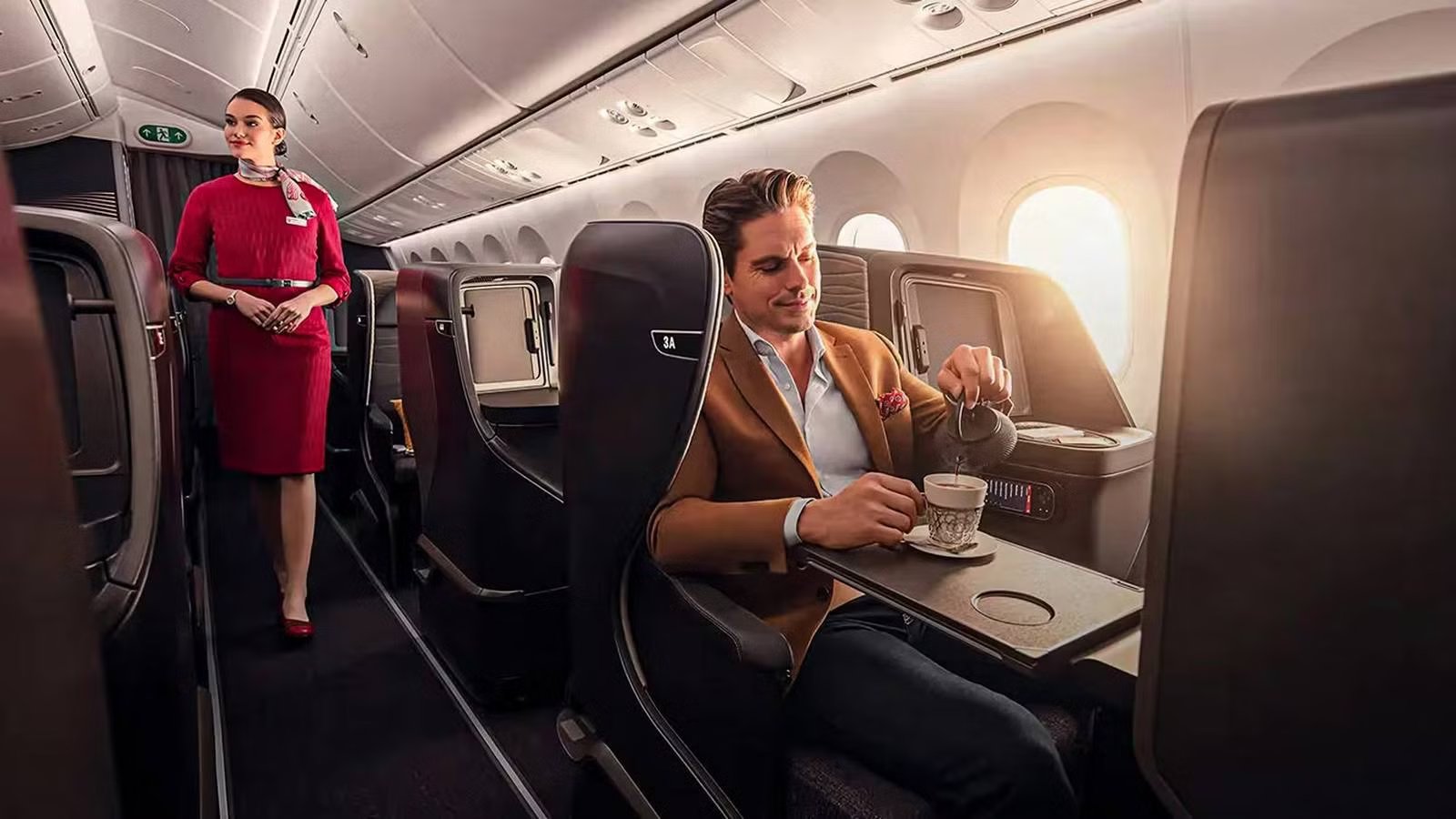
Long known for their open seating business class layout,  Turkish Airlines is set to make a major change to their business class product, in line with the latest industry trends. The latest update to their business-class hard product was in 2019, with a new seat on its Boeing 787 Dreamliner and Airbus A350 aircraft. These aircraft are currently configured in a 1-2-1 layout, with seats folding into full flat beds and a privacy screen between the middle seats. Meanwhile, its A330 is equipped with a 2-2-2 layout, with an even more open configuration and either lie-flat or reclining seats, depending on the configuration.
Turkish Airlines is shifting toward a suite-based, privacy-first cabin architecture, following a trend among its European and Middle Eastern competitors. The Istanbul-based airline is also evaluating its Economy product and potentially launching an all-new premium economy, according to Forbes. Although a premium economy product has not been officially announced, this move likely follows a surge in global premium leisure travel demand, particularly for premium economy offerings.
The Crystal Suite Program

According to Aviation Week, Turkish Airlines has announced the “Crystal Suite,” the formal name of the newest version of Turkish Airlines’ premium offering. The airline first announced the new suite in 2024, with installations projected to begin in early 2027. These suites will replace the current lie-flat seats on A350 and 777-300ER.
Turkish Airlines has reportedly developed the Crystal Suite in-house at TCI Aircraft Interiors, a subsidiary of the carrier. It describes the new seat manufacturing in more detail in a statement.
“The airline’s new seats have been developed by its subsidiary, TCI Aircraft Interiors, to create a bespoke product unique to the airline and features elements with plush leathers and fabrics all sourced from Türkiye to emphasize flag carrier’s roots.”
2026 management guidance confirms rollout beginning on newly delivered A350s in early 2027, followed by 777 refurbishment. The main component of the seat is privacy, as notably also pursued by Air France and  Lufthansa in their cabins. If privacy is the new baseline, what strategic shift is driving Turkish Airlines to redesign its long-haul cabins around segmentation rather than uniformity?
The Strategic Shift Toward Segmentation

Crystal is not an isolated product; it may be the first domino in a pattern of retrofits and upgrades to Turkish Airlines’ hard product, including the evaluation of premium economy returning in 2028. Turkish Airlines has an award-winning soft product and onboard dining.
By expanding on their business class’s overall comfort with new, private suites, the carrier is set to challenge Lufthansa,  Emirates,
  Air France, and
  Qatar Airways in the premium segment. While the airline is a main competitor to major European full-service carriers, its business model also competes directly with Middle Eastern carriers, where connections from Western Europe to regions like India, East Asia, and Africa are popular.
Turkish Airlines’ newly appointed CEO, Ahmet Olmuştur, said a premium-economy offering is under active discussion, though not in any official planning stages.
“We are also evaluating premium-economy for widebody aircraft starting in 2028, with around 8–9% of current economy capacity potentially allocated to the new cabin. Our research shows that around two thirds of the passengers on long-haul flights are willing to pay a premium for additional legroom and comfort.”
If segmentation is the strategy, how will Turkish Airlines implement it across its fleet, and what does that look like operationally? And in what timeframe might additional changes take place? This multi-year process must also consider other operational factors, such as maintenance planning, crew training, and aircraft route-assignment logic.
How Segmentation Shows Up In The Fleet

A350 deliveries with Crystal Suites, 777 refurbishment cycles, and the potential reintroduction of premium-economy on widebodies starting in 2028 are all the first components of Olmuştur’s vision for a hard product overhaul. This is a portion of an ambitious growth strategy: A 2033 target fleet of over 800 aircraft, annual revenues over $50 billion, and network expansion to 345 international destinations.
Turkish Airlines is already the number one international carrier by number of countries served, consistently targeting new routes to secondary cities such as  Minneapolis-St. Paul International Airport(MSP) or
  Philadelphia International Airport(PHL). Additionally, the new 300-aircraft delivery target reinforces its growth strategy and its ability to serve many destinations, including potential new long-and-thin additions with longer-range, lower-capacity aircraft.
The carrier leverages the 737 MAX and A321neo on many routes throughout Europe, Africa, and the Middle East, to lower-yield markets such as Bissau, Kinshasa, Turkistan, and Billund Airport (BLL). Bissau represents the classic low‑yield environment built around a small, economically limited market, where fares stay suppressed because premium demand barely exists. Kinshasa, by contrast, generates huge passenger volume but extremely price‑sensitive behavior, creating a different kind of low yield driven not by lack of demand but by the inability to monetize it. Turkistan’s challenge is more structural: traffic is pilgrimage‑based and highly seasonal, producing predictable peaks but little year‑round premium revenue. BLL sits at the opposite end of the spectrum, with steady tourism but short‑haul, leisure‑heavy traffic and minimal premium cabin demand, keeping yields modest despite strong brand recognition.
Once the airline commits to a segmented long‑haul cabin, the strategy introduces a new tension: segmentation doesn’t just reshape the cabin; it reshapes the economics of every long‑haul route. More cabin layers mean more complex revenue management, more differentiated fare buckets, and a sharper divide between high‑yield and low‑yield markets. The question becomes whether Turkish Airlines can sustain this multi‑tier structure across a network that includes both premium‑dense destinations and chronically low‑yield stations like the aforementioned examples, or whether segmentation will expose new operational and financial vulnerabilities.
Operational & Financial Implications

Turkish Airlines’ push toward a more segmented long‑haul cabin is directly tied to the carrier’s financial performance. The airline’s $2.2 billion profit from main operations in 2025 shows that yield protection is now central to its strategy, alongside its famously ambitious network growth. Cabin segmentation becomes the tool that lets the carrier turn cabin space into more predictable revenue, especially on long‑haul aircraft where cost exposure is highest.
Chairman Ahmet Bolat highlighted that the airline achieved its $2.2 billion operating profit despite global instability, the same pressures that later drove the suspension of 18 low‑yield routes, according to its 2025 earnings release. At the same time, it reported a 9.7% revenue increase, largely from premium cabin performance. This is the financial logic behind the Crystal Suite rollout on the A350 and the planned 777‑300ER retrofit.
The carrier will take on a slight structural shift as Crystal Suite retrofits and premium-economy plans progress. They will rely on segmentation to stabilize profit, reshape long‑haul cabin layouts, and create clearer product tiers for passengers. For the industry, Turkish Airlines is aiming to align more closely with premium products that offer maximum privacy: a physical door to enclose the business-class seat.
Looking Ahead With Turkish Airlines

The broader implication of Turkish Airlines’ Crystal Suite strategy is that the future of its long‑haul product will be decided not by branding or soft‑product differentiation, but by how effectively the airline can standardize and scale cabin segmentation across a fleet that now contains multiple cabin architectures. According to the carrier, the A350‑900 includes a wide cabin, high ceilings, optimized 2,600‑meter cabin pressure, and next‑generation Trent XWB engines that give it the physical platform to make segmentation economically meaningful.
The clearest test will come from the next wave of A350‑900 deliveries and cabin retrofits. The airline already operates over 30 A350‑900s as of early 2026, with documented deliveries continuing through 2026, including aircraft such as TC‑LHI (delivered December 30, 2025) and TC‑LHG (delivered September 17, 2025). According to Airfleets.net, these aircraft arrive with differing interiors. In the wake of sanctions against Russian Airlines such as  Aeroflot, Turkish Airlines has taken over pending A350 orders from the Russian flag carrier. Some are equipped with Stelia Symphony seats and others with Collins Aerospace Horizon suites featuring privacy doors and a hidden premium‑economy section.
Whether the carrier retrofits these aircraft into a unified, privacy‑first cabin or continues operating two materially different business‑class products will be the measurable indicator of whether segmentation becomes a coherent strategy or remains a patchwork of inherited configurations. Interestingly, AIN previously reported that Airbus once wanted to make the A350 production standard to boost delivery productivity and speed. However, with the rise in premium travel demand in markets such as North America and Europe, Airbus was not able to get its wish granted.
If Turkish Airlines consolidates around a single suite product with doors, the A350‑900 could become the aircraft that finally aligns its hard product with its high‑yield ambitions. However, if it continues flying mixed interiors, the A350 may instead become a case study in how rapid expansion complicates segmentation. Understandably, the carrier may opt to keep its A330 fleet configured differently, similar to Qatar Airways’ A330 fleet. Either way, the next published retrofit plan, or lack thereof, will be the moment to watch.
Catch what other trackers miss
Emergency squawks, holds, NOTAMs — live signals, no signup.
Open tracker
Catch what other trackers miss
Emergency squawks, holds, NOTAMs — live signals, no signup.
Open tracker