dailynewsnblog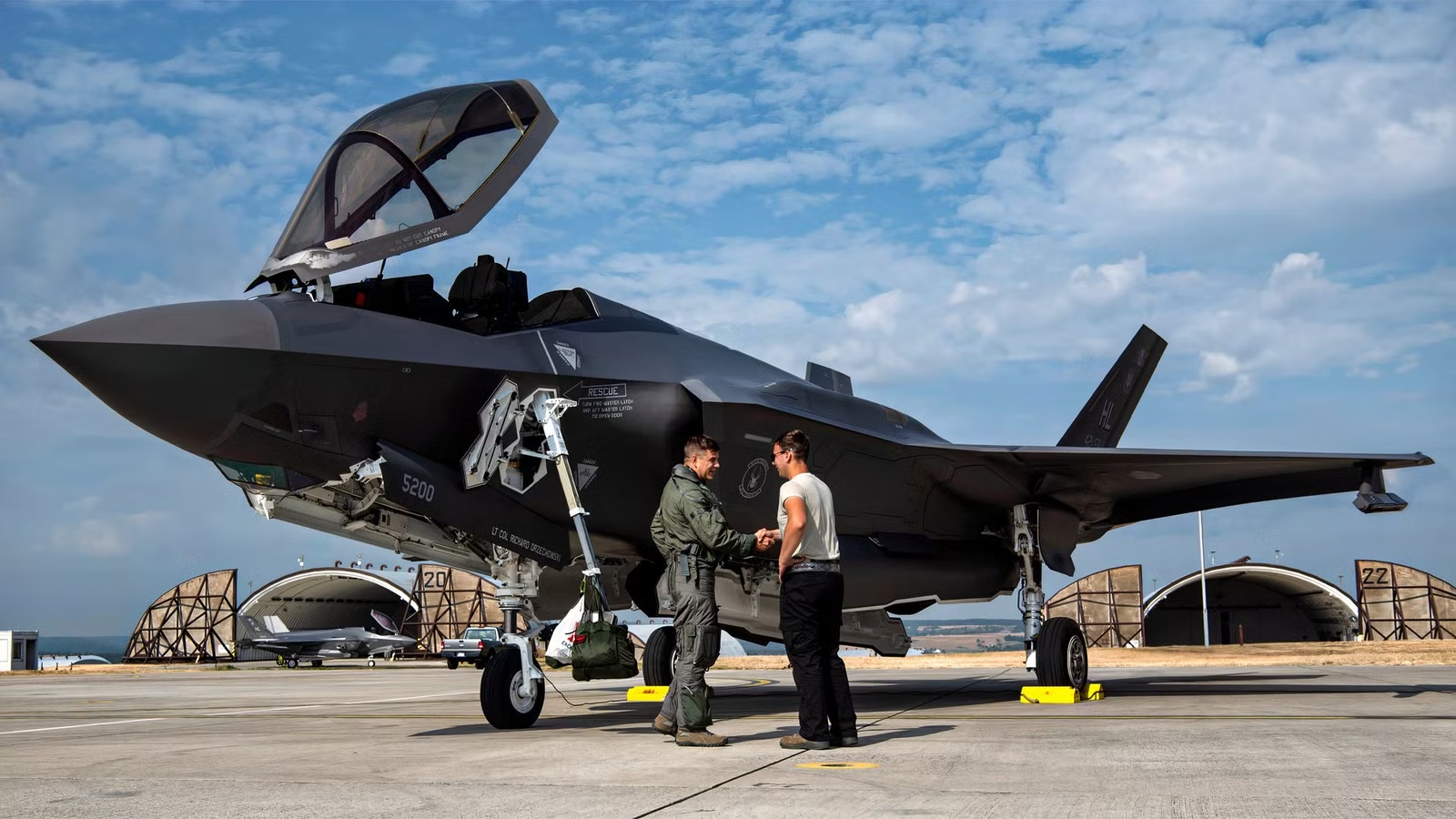
Germany is set to become the newest operator of the Lockheed Martin F-35A Lightning II. The move comes as the German Air Force’s fleet of Panavia Tornados approaches the end of its operational service life. A key consideration is that the aircraft currently provides Germany’s ability to deliver United States manufactured B61 nuclear bombs under NATO’s nuclear-sharing arrangements. The transition comes at a time when NATO is placing renewed emphasis on deterrence in response to Russia’s increasingly assertive posture and the deteriorating security environment in Europe.
To ensure the continuation of this mission, Berlin has ordered an initial batch of F-35As, largely because certifying the Eurofighter Typhoon for the nuclear role would likely have taken years. As a result, Germany is procuring both aircraft, with the F-35A assuming the strategic mission while the Eurofighter continues to fulfill conventional airpower roles across Europe.
Background: NATO & Nuclear Deterrence

During the Cold War, deterrence was a key objective of the North Atlantic Treaty Organization (NATO), as the Soviet Union possessed thousands of nuclear weapons and maintained a doctrine that envisioned the potential use of these weapons under certain circumstances, including first use. By the mid-1970s, Europe hosted more than 7,000 US nuclear weapons. However, since the Cold War’s end in 1991, there has been a considerable drawdown of these strategic weapons on the continent as a result of various arms control agreements and unilateral reductions.
Today, NATO’s nuclear deterrent capability includes approximately 100 B61 and B61-12 nuclear bombs (two can be seen in the image above), which are believed to be forward-deployed at bases in Belgium, Germany, Italy, the Netherlands, and possibly Turkey. These weapons are complemented by the independent nuclear arsenals of the United Kingdom (UK) and France. The UK is estimated to possess between 225 and 260 warheads, while France maintains approximately 290. Recent assessments suggest that France could modestly increase its stockpile as part of its ongoing nuclear modernization efforts. Together, these capabilities form the backbone of NATO’s strategic deterrence posture.
During a crisis, these weapons can be rapidly moved from secure underground storage vaults and loaded onto Belgian and Turkish F-16 aircraft (B61-certified), German and Italian Tornados (B61-certified), and US and Dutch F-35A aircraft (B61-12 certified). Belgium, Germany, and Italy are currently in the process of inducting the F-35A, which is certified to carry the upgraded B61-12 gravity bomb.
The renewed emphasis on NATO’s nuclear deterrence posture also comes amid Russia’s decision to deploy strategic weapons in Belarus, mirroring NATO’s forward deployment of US nuclear weapons in Europe. Additionally, Russia has deployed nuclear-capable Iskander-M ballistic missiles to the exclave of Kaliningrad, bordering Poland and Lithuania, since 2016. These developments all factor into Germany’s strategic deterrence calculations.
Enhancing Germany’s Nuclear Strike Option

At present, the German Air Force (Luftwaffe) is planning to reshape its nuclear strike capability. Currently, the Luftwaffe utilizes its 68 Tornado aircraft for, among other duties, the delivery of US B61 bombs under NATO’s nuclear-sharing arrangements. While the Tornado excels in areas such as low-level penetration, electronic warfare, and strike operations, its survivability has become an increasingly significant concern. Any potential strike mission deploying these weapons against a heavily defended adversary would require the aircraft to penetrate one of the world’s most sophisticated integrated air defense systems.
Berlin’s decision to purchase an initial batch of 35 F-35As in 2022, valued at approximately £6.2 billion ($8.4bn), reflects a recognition of the need to enhance the survivability of the nuclear strike mission. Another important factor, and perhaps the deciding one, was that certifying the Eurofighter Typhoon for a strategic mission would likely have taken years and required US approval. Consequently, the F-35A was regarded as the only practical option to replace the Tornado in the nuclear role before the aircraft’s planned retirement later this decade.
The F-35A possesses low-observable shaping, radar-absorbing materials, and internal weapons bays that enhance the aircraft’s ability to operate in contested airspace and, if necessary, deliver the B61-12 gravity bomb on a precision strike mission. The initial 35 F-35As are scheduled to be based at Büchel Air Base, where the US’ B61 bombs are believed to be stored under NATO’s nuclear-sharing arrangements.
While the first F-35As are slated for delivery in 2027, Der Spiegel reported, citing parliamentary sources, that a confidential submission had been presented to the Bundestag detailing a follow-on order for 15 additional aircraft, which would bring the total fleet to 50. According to Der Spiegel, planners in the Defence Ministry estimate the cost of the additional aircraft at around $2.7bn (€2.5bn).
If the follow-on order materializes, the Luftwaffe may have to establish an additional operating base for the F-35A fleet. The infrastructure upgrades at Büchel Air Base, undertaken in preparation for the arrival of the first 35 F-35As, have reportedly increased in cost from approximately $760 million (€700m) to around $2.7bn ( €2.5bn).
The Luftwaffe views an expanded F-35A fleet as essential to meeting NATO’s evolving defense and deterrence requirements amid growing concerns over Russia’s nuclear posture and its continued war against Ukraine. While nuclear deterrence will remain a key component of NATO’s strategy, Germany is also strengthening its conventional airpower capabilities.
The Eurofighter Typhoon Will Remain A Pillar Of German Defensive Strategy

As Germany prepares to receive its first F-35As, Berlin has also confirmed an order for an additional 20 Eurofighter Typhoons. As reported by Der Spiegel, this brings the country’s total commitment to the program to more than 160 aircraft. According to Eurofighter, these new-build aircraft, designated “Tranche 5,” are scheduled to enter service with the Luftwaffe between 2031 and 2034. They will replace the Tornado in its conventional strike and electronic warfare roles, while the F-35A assumes the nuclear mission. The Eurofighter is also expected to remain in Luftwaffe service into the 2060s.
According to Airbus, the company will manufacture the multirole fighters at its final assembly line in Manching, near Munich, Germany. Airbus states that it will “…equip the 20 Eurofighters with the latest sensors. This includes…the new E-Scan radar.” In parallel, Airbus will also enhance the German Eurofighter fleet’s electronic warfare capabilities by integrating the Arexis sensor suite, developed by Sweden’s Saab, into both existing and newly built aircraft.
With the conclusion of this latest contract, more than 740 Eurofighters have been ordered by Germany, the UK, Italy, Spain, Austria, Saudi Arabia, Oman, Kuwait, and Qatar. This makes the Typhoon the most successful European fighter program currently in production.
Strategically, the Eurofighter Typhoon is a cornerstone of European and NATO airpower. The aircraft supports missions such as Quick Reaction Alert (QRA), protecting more than 870,000 square miles (1.4 million square kilometers) of sovereign airspace across Germany, Italy, Spain, and the UK, helping safeguard approximately 257 million people.
These missions maintain aircraft on constant standby to intercept unidentified or potentially hostile aircraft approaching NATO airspace. This includes frequent intercepts of Russian military aircraft over the Baltic Sea, the North Sea, and, where applicable, the Black Sea region. Over the past two years, 80 percent of the operational air missions carried out by Eurofighter partner nations have involved the Typhoon. The aircraft also plays a key role in NATO’s Air Policing mission, helping to secure the alliance’s eastern flank.
A Dual Approach To Airpower

The purchase of both the Typhoon and F-35A represents a pragmatic approach to ensuring that the Luftwaffe can carry out two critically important missions. By formally entering the F-35 program, Germany can continue to meaningfully and effectively contribute to NATO’s nuclear deterrence posture. Further, in light of Russia’s nuclear posturing and continued war against Ukraine, deterrence remains a necessity. The Typhoon purchase demonstrates not only a commitment to conventional security missions over the skies of Europe, but also to the German defense industry, where Airbus alone supports approximately 25,000 jobs.
Germany’s modernization is also likely to influence procurement decisions elsewhere in Europe. As NATO continues to strengthen its deterrence posture, other member states will be watching closely to see how effectively the Luftwaffe integrates its F-35 and Eurofighter fleets. The F-35’s role as a hedge against potential delays to the Future Combat Air System (FCAS) program may also shape how European nations balance investment in next-generation fighter development with the need to maintain credible air combat capabilities in the near term.