dailynewsnblog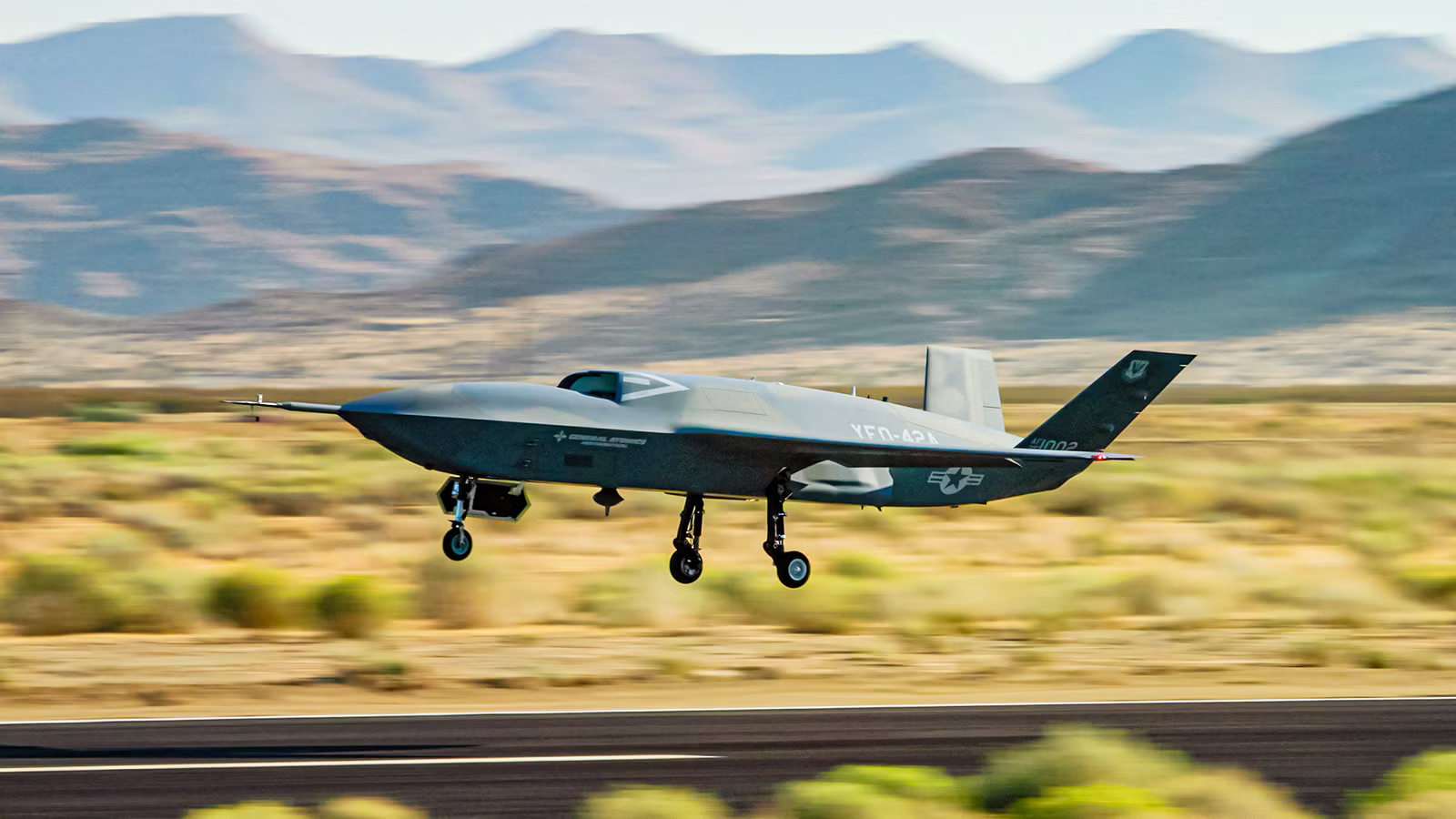
The US Air Force is pushing to rapidly launch its Loyal Wingman drones off the drawing board and into the air alongside crewed combat platforms. The Collaborative Combat Aircraft are being designed as low-cost support vehicles that will complement more capable planes like the Lockheed Martin F-35 Lightning II. As a function of providing the most adaptable, flexible mission capabilities possible, the USAF is pushing the next generation of drones to be deployable with absolute minimum ground support.
Extreme ruggedness and simplicity are vital to making the incoming CCAs force enhancers for the USAF as it reorganizes its fleet to better execute Agile Combat Employment. The Loyal Wingman drones will be expendable compared to a jet like the F-35, costing roughly one-third as much to produce, which will also allow large numbers to be deployed rapidly in any given theater. Building in independence from conventional airfield facilities will allow the USAF to set up a network of small, dispersed units at remote fields anywhere on the planet on short notice.
It’s unclear if either of the final two contenders for the USAF CCA program will be fully runway-independent like the US Marines’ Kratos XQ-58 Valkyrie, which can be rocket-launched from a trailer. What is certain is that the General Atomics FQ-42A Dark Merlin and Anurail FQ-44A Fury will need little more than a strip of flat earth and a data-link connection to join the fight.
Rapid Iteration To Dominate The Battlespace Of Tomorrow

The CCA program is one of the fastest-moving defense-industrial projects in recent history. The program has moved from concept to flight testing in less than two years. Although the USAF still refers to the program as a Pathfinder for acquisition transformation, it is also expected to yield combat-capable drones that it can mass-produce on a large scale. The Air Force aims to amass a vast armada of 1,000 or more Loyal Wingman drones of varying types, all with the same general capabilities.
Given the brief history and small scale the CCA initiative has so far experienced, simply taking the prototypes to different operating environments and evaluating performance is a valuable learning experience for the service. Along with the aircraft, human-machine teaming tactics and doctrine are still in their early stages of development. Every opportunity to perform hands-on exercises with live airframes produces a wealth of test data and valuable experience for the participating troops.
In late July, the USAF conducted its first major test outside a sterile environment with both the Dark Merlin and Fury drones. The multi-day exercise was overseen by the Experimental Operations Unit, which is responsible for developing CCA employment concepts. Additionally, members of the Air Force Operational Test and Evaluation Center observed the demo held at Creech Air Force Base in Nevada at the end of July, which was considered a resounding success by all parties.

Only weeks prior, both the FQ-42A and FQ-44A were on site at Creech AFB in Nevada to conduct an exercise demonstrating continuous improvement in the two drones’ ability to operate semi-autonomously from an austere site. The Air Force’s Experimental Operations Unit pushed the two Loyal Wingman drones hard during exercises to stimulate operational conditions in a wartime scenario.
Creech is a major hub for uncrewed aircraft operations in the Department of Defense. The base hosts many of the USAF’s remote pilot units, and its airspace is directly adjacent to the expansive Nevada Test and Training Range. The USAF released images showing both of the prototype CCAs conducting landings at Creech with inner air-to-air missiles and completing refueling ops.
Lt. Col. Matthew Jensen, EOU commander, praised the results of the demo held at Creech AFB.
“This exercise was about getting the systems into the hands of the warfighter. We are focused on operating CCA outside of a traditional test environment so we can continue to learn, inform, and rapidly iterate.”
The USAF declared the trials a success, with the two CCAs successfully generating multiple sorties and demonstrating extended range and reliability while integrating with crewed platforms in the air. Air & Space Forces magazine pointed out that representatives from the Royal Netherlands Air and Space Force were also present during the testing cycle at Creech as they had already signed on to procure examples for their own force.
Keeping The Human In The Loop Anywhere, Anytime

The mechanical simplicity, digital automation, and sheer ruggedness of the Dark Merlin and Fury are just one element of the entire ‘system of systems’ necessary to make CCAs fully operational for the Air Force’s vision of future ACE ops. Looking beyond the airframe itself, minimizing and consolidating ground support requirements is a primary area of focus. Directly related to this element of expeditionary deployment is the rapid setup of the remote piloting and control station needed for ground operators to fly the CCAs.
The US Air Force announced on August 13 that it had successfully completed prototype evaluations of the Portable Command and Control Enclave, or C2E, which will be able to control CCAs from austere or remote sites. The demonstration was hosted by the Ohio Air National Guard’s 178th Wing at Springfield Air National Guard Base, with the service declaring it a major milestone in the maturation of the technology for tactical control of the semi-autonomous Loyal Wingman drones.
Col. Eric Reagan, director of the Agile Development Office, was quoted as giving these remarks at Springfield ANG Base.
“Getting prototypes into the hands of our operational and acquisitions warfighters for a swift, combined evaluation is a direct embodiment of acquisition transformation. This partnership allows us to accelerate the fielding of the best-value capabilities to the Department of War.”
The brief announcement only stated that the Department of the Air Force was able to rapidly identify, test, and field crucial C2 capabilities in collaboration with leading industrial partners. The USAF press release did not identify exactly which contractors participated or the specific systems on exhibition. However, the Air Force stated that the next prototype phase would soon begin and would challenge vendors to refine and demonstrate more mature C2E combat cloud capabilities.
Training To Adapt And Overcome

The real-world testing cycles held at Creech were preceded by the first live-fire demonstrations in the history of the CCA program, roughly a week earlier, at Edwards AFB in California. During that evolution, the FQ-44A fired an AIM-120 long-range air-to-air missile at a simulated target over the Mojave Desert. Days later, former Air Force Secretary Frank Kendall told Air & Space Forces magazine that he expects the CCAs to make their debut at this year’s annual Red Flag exercise.
Red Flag is held at Nellis AFB, near Creech AFB and the NTTR, where follow-on tests were conducted after the live-fire demo at Edwards. The pattern clearly shows a ramp-up and anticipation of joining the large-scale simulated air war exercise conducted during the Red Flag drills. Kendall speculates that introducing the Loyal Wingman drones could produce “fascinating” results.
“I think that’s going to be fascinating when we start using CCAs at Red Flag. When the guys with the CCAs are beating the crap out of the guys without them, and not losing any manned fighters, that’s going to be pretty obvious, right?”
He went on to comment on how the drones protect crews and pilots.
“But they’re also protecting crewed fighters very, very effectively. When the CCAs get their missiles off and they kill a couple of the other guys’ aircraft, even if [the CCAs] die, they’ve really contributed a lot to the battle.”
The foreshadowing by the former Secretary is based on battle simulations that consistently showed a high victory rate for the force complemented with CCAs alongside its crewed aircraft. It is even possible that the Loyal Wingman drone not selected by the USAF for final consideration, the Boeing MQ-28 Ghost Bat, could make an appearance at Red Flag this year. Boeing’s defense division has begun producing them for the Royal Australian Air Force, meaning that they will still integrate with US forces during joint operations in the Pacific.
The Drones Descend On Red Flag

Introducing CCAs into this year’s Red Flag exercises represents a massive paradigm shift in modern military aviation history. It is the exact moment human-machine teaming transitions from an experimental concept into a scalable, high-end warfighting reality explicitly optimized for a peer conflict in the Pacific. The exercise will aim to demonstrate the Air Force’s target of fielding a massive, rapidly reproducible fleet to overwhelm peer air defenses, providing surge capacity that is impossible to achieve through crewed stealth platforms alone.
In the expansive Pacific, CCAs act as distributed sensor nodes flying hundreds of miles ahead of traditional aircraft. During Red Flag simulations, CCAs are deliberately sent into highly lethal Anti-Access/Area-Denial bubbles. Even when these uncrewed aircraft take heavy losses, they successfully draw enemy missile fire and clear paths for crewed jets, fundamentally altering the survival math of the entire air wing.
Red Flag pushes autonomy software to its absolute limit, evaluating how CCAs automatically execute a human pilot’s intent via secure, jam-resistant links when heavy electronic warfare completely severs traditional communications. The intensive training battery provides the ultimate stress test for deploying these systems away from large, vulnerable runways. CCAs require smaller logistical, maintenance, and fuel footprints, allowing the joint force to disperse them across remote island airstrips and complicate the adversary’s air warfare calculus.
Catch what other trackers miss
Emergency squawks, holds, NOTAMs — live signals, no signup.
Open tracker
Catch what other trackers miss
Emergency squawks, holds, NOTAMs — live signals, no signup.
Open tracker

![American Airlines Launches 21 Nonstop Routes From Philadelphia To Europe [List & Map]](https://dailynewsnblog.com/wp-content/uploads/2026/09/american_airlines_787_striking_1920x1080.jpg)