dailynewsnblog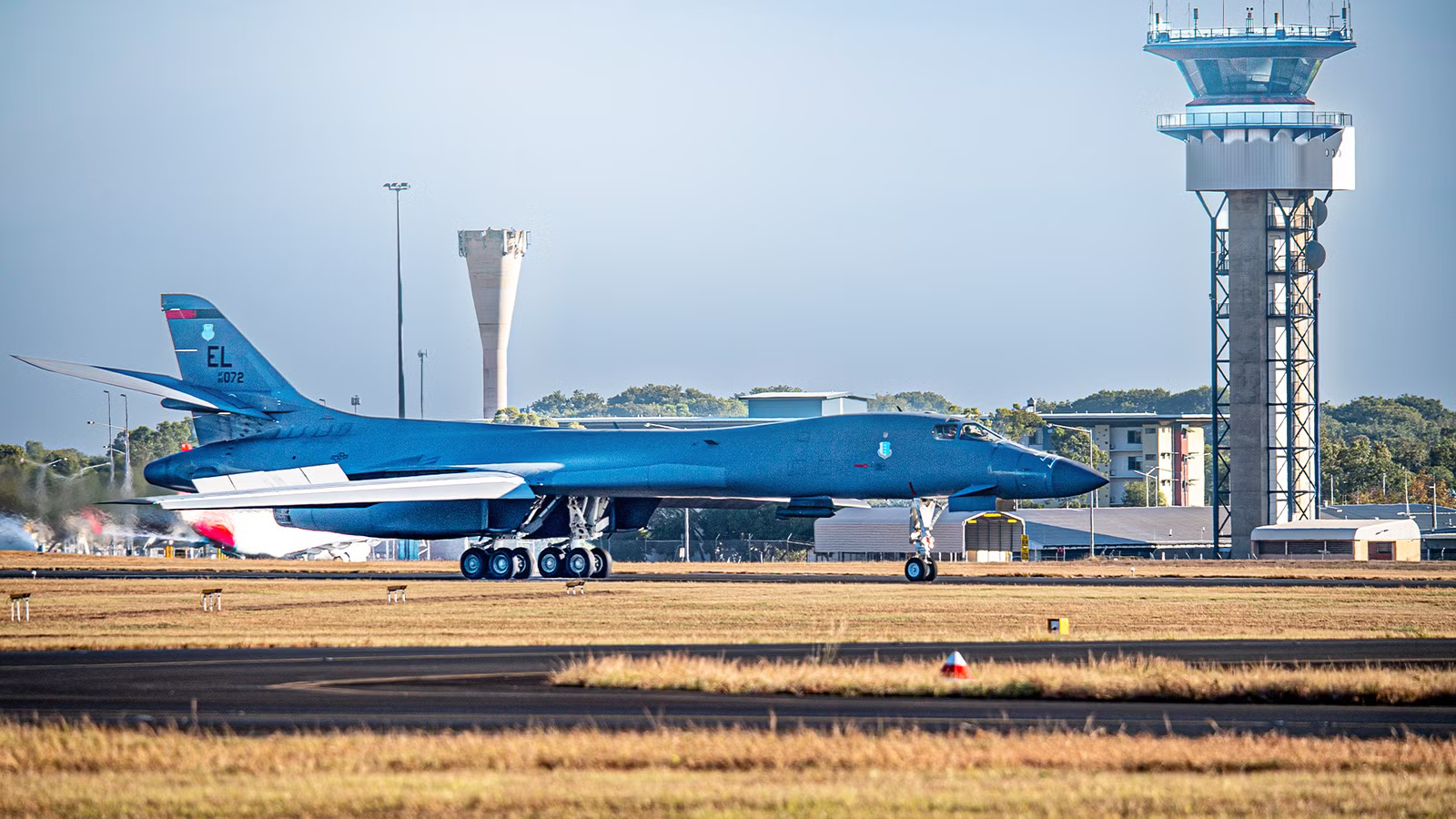
In May, one Rockwell B-1 Lancer left Wichita State University’s National Institute for Aviation Research with a new 33-foot section welded into its upper spine. The airframe overhaul was completed three months ahead of the one-year deadline the US Air Force had authorized for the job. The team behind it attributed much of the speed to the engineering aid provided by the jet’s ‘digital twin.’
The 3D model produced from detailed scans of the supersonic bomber was created in minute detail. This enabled engineers to design, sequence, and manufacture the aero structures for the Cold War-era bomber faster than anyone expected. Closing that gap between the OEM blueprints and the real-world condition of the airframe was as much the subject of the BackBONE Project as the repaired plane itself.
The twin itself was not built from Rockwell’s original 1980s engineering drawings. It was built by hauling mothballed B-1s out of the Arizona desert, cutting them apart bolt by bolt, and scanning every piece. Only by doing that, was the USAF able to revive one of its few remaining BONEs, as the B-1 is endearingly known in service. Building on the resounding success with the first example, the same technology is slated to make critical repairs to half of the active fleet.

The B-1B was designed for roughly 8,000 to 10,000 flight hours, a service life calculated around its original low-level, high-speed nuclear-penetration mission. Cracking on the fuselage’s dorsal and shoulder longerons, the load-bearing structural members running along the spine, have steadily emerged as potentially catastrophic fatigue symptoms.
The recently revived Lancer had been parked since September 2025 to undergo replacement of its Forward Intermediate Fuselage. That section of the B-1B’s upper spine sits just ahead of the wings. Before beginning its saga back to combat readiness, the bomber departed McConnell Air Force Base on May 11. Eight and a half months later, the joint Air Force-NIAR team had it back in airworthy condition.
Although it was the first fielded repair under the program, it is built to solve a fleet-wide point of failure before it grounds any of the precious few remaining aircraft. Boeing had already begun full-scale fatigue testing in 2012 with Tinker AFB’s Air Logistics Center. By 2021, Air & Space Forces Magazine reported, the program was well short of the target even after nearly a decade of running the tests and trials.
Physical ground fatigue testing was found to be primarily diagnostic rather than curative, leaving the growing fleet readiness problem without a viable maintenance solution. After reconsidering the fate of the B-1 fleet, the Air Force elected to switch gears. In 2020, Wichita State University’s NIAR was green-lit to move ahead with advanced digital engineering to craft high-fidelity digital twins of entire B-1 airframes. With the extension of the Lancer fleet’s service life to 2037 and potentially 2040, the revelation in BONE maintenance is needed now more than ever.
Why Blueprints Gave Way To A Boneyard Road Trip

Rockwell’s original engineering drawings describe the B-1B as designed, not as it exists after tens of thousands of flight hours of structural fatigue. Those same prints omit decades’ worth of prior repairs, as well as the manufacturing deviations carried from a production run that ended in 1988. NIAR’s engineers disassemble it down to individual fasteners, 3D-scan every component, and reconstruct the aircraft as a digital model precise enough to replace the missing fidelity in the original design data.
In 2020, NIAR pulled the first retired B-1 from the 309th Aerospace Maintenance and Regeneration Group boneyard at Davis-Monthan Air Force Base in Arizona, trucking the airframes roughly 1,000 miles to the university’s Park City, Kansas facility. Once an airframe arrives, it goes through what amounts to a destruction-to-creation pipeline. The payoff has scaled with the effort. NIAR has delivered more than 24,000 digital models by early 2024, according to Wichita State News.
Catch what other flight trackers miss
Emergency squawks, holds, NOTAMs — live signals, no signup.
Open tracker
Catch what other flight trackers miss
Emergency squawks, holds, NOTAMs — live signals, no signup.
Open tracker
Nearly half of the Air Force’s B-1 fleet will require the same major structural repair as tail number 86-0117, which departed McConnell AFB on May 11. The aero structure overhaul is critical for the safety of flight to keep the BONEs operationally effective until the new sixth-generation Northrop Grumman B-21 Raider arrives in numbers.
Half A Forty-Five-Jet Fleet Needs The Same Overall

In 2021, Air Force Global Strike Command digested 17 of the least serviceable B-1s. That purge shrank the fleet from 62 aircraft to 45. Today, that force is all that remain in flying condition. In order to sustain the AFGSC fleet level, Congress now treats that figure as a floor the service is required to sustain. Still, the wave of retirements was itself a readiness response.
America’s bomber fleet has been burdened for years by ‘vanishing vendor syndrome’ and a generally shrinking supply chain to support its geriatric flight line. One of the most startling headlines came in 2019 when the fleet endured what Air & Space Forces Magazine characterized as a fleet crisis.
The maintenance crunch that year left fewer than ten of the then-62 Lancers mission-capable at any given time. The primary cause of the grounded jets was cracking airframes, along with other maintenance issues combining to accrue more than 48 maintenance hours for every flight hour logged.
Retiring the worst airframes concentrated spare parts and maintenance effort on the remaining fleet and measurably improved mission-capable rates. It also means the Air Force has no slack left to simply retire jets that develop major aero structure cracking rather than fix them. Every one of the 45 aircraft is now ‘load-bearing,’ in the institutional sense.
A Retirement Date That Keeps Sliding To The Right

The B-1’s retirement horizon continues to move further out, making the BackBONE Project more urgent every time the sunset date is reset. Air & Space Forces Magazine previously listed a planned full replacement for the B-21 targeted for 2032. Aerospace Global News reported in mid-2026 that Air Force officials are now delaying B-1B retirements to at least 2037, while other defense observers speculate that that could be pushed out all the way to 2040.
At the same time, General Dale White reaffirmed that the first operational B-21s remain on track to arrive at Ellsworth AFB in 2027. A date supported by Northrop’s unusually exceptional execution at a time when many prime Defense contractors are consistently struggling. Boeing is notoriously years behind and billions over budget on the next-gen Air Force One, its jointly manufactured T-7A Red Hawk, and the KC-46A Pegasus tanker. Meanwhile, Lockheed Martin’s headline F-35 Lightning II continues to fail operational tests for software updates and jets have rolled off the assembly line lacking critical hardware like radar.
To expedite the bomber fleet recapitalization, a $4.5 billion agreement signed in February 2026 increased Northrop’s B-21 production capacity at Palmdale by 25%. Meanwhile, top brass at the Pentagon and even Navy Admiral Richard Correll of US Strategic Command have pushed for a program of at least 145 B-21s rather than the currently authorized 100.
Even if Capitol Hill authorizes the larger number of next-gen stealth bombers, production will stretch into the 2030s. The increased funding to ramp up low-rate initial production is hoped to prevent a capability gap for AFGSC, but either way, both the B-1 Lancer and legacy flying wing B-2 spirit will be pushed to serve longer.
An Aging Bomber Still Doing A Job Its Successor Was Built To Replace

The BONE’s continuously stretched service timeline is the gap the digital twin program is meant to fill. A B-21 fleet just beginning to arrive in 2027 does not immediately replace a 45-aircraft B-1B force. The next test of the BackBONE Project will not be whether NIAR’s digital twin can finish one aircraft ahead of schedule again, but whether it can do so consistently enough, across enough airframes, to keep America’s bomber fleet fully capable and mission-ready until the next generation can take up the mantle.
Still, none of the digital-engineering success obscures the airframe’s deeper limitations. Aside from the abuse that the jets have endured over thousands of intense maneuvering and supersonic flight profiles, they simply weren’t made for 21st-century air warfare. National Security Journal has reported that the B-1B’s speed and low-level penetration tactics designed to defeat Soviet air defenses cannot defeat modern, integrated networks.
Ultimately, only a stealth platform can fly into contested airspace on today’s battlefield. However, the B-1 carries a payload that exceeds the B-2, B-21, and even the Boeing B-52 Stratofortress in terms of sheer tonnage. With the addition of upgraded external pylons, it will be a valuable stopgap platform to haul massive standoff munitions like advanced cruise missiles and hypersonic munitions.
This is particularly valuable in the Pacific Theater, where the US military is re-optimizing its force structure to bolster its deterrence posture across the region. The BONE will never be able to do what the Raider can, but pioneering major overhauls will benefit the future fleet of stealthy jets when they too begin to show their age. In the meantime, the Lancer serves as a reliable missile truck and can even help prepare the advanced weapons that will be carried by its successor long after the last B-1 has touched down at the Boneyard.