dailynewsnblog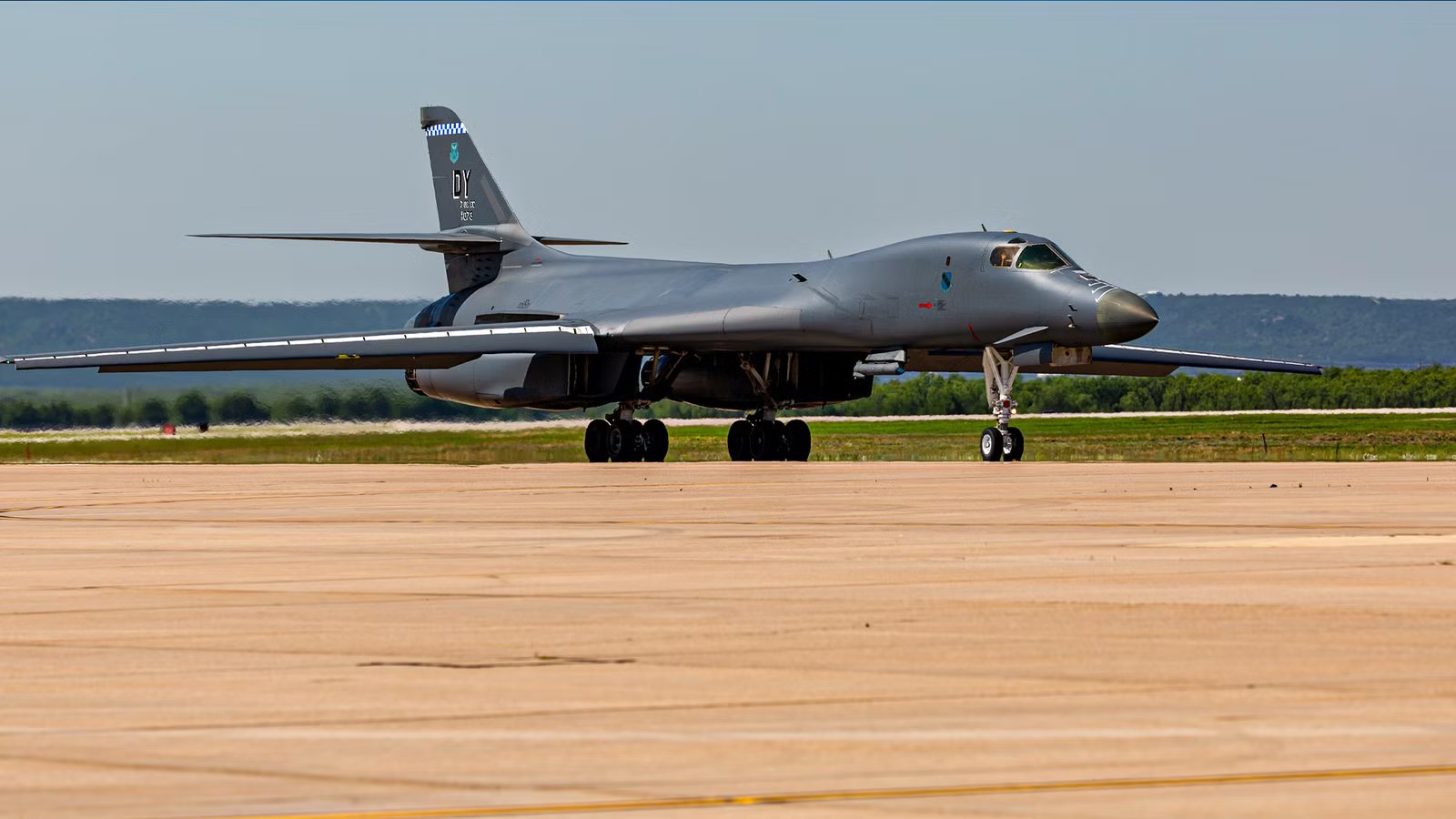
At the peak of Operation Epic Fury (around late March 2026), the US Air Force deployed around 15 B-1B Lancers and around six B-52H Stratofortresses at the UK’s RAF Fairford airbase. The initial wave of B-1Bs arrived on or after March 6, with B-52s arriving soon after. As of the time of writing (late July), a large share of the Air Force’s operational Rockwell B-1 Lancer fleet remains deployed at RAF Fairford.
The deployment offers insights, not only into the ongoing conflict with Iran, but also the vital role the United Kingdom plays in enabling the US to project air power into the Middle East and the wider role of the UK in the conflict. The presence of these bombers at Fairford has raised the specter of the conflict expanding out of the Middle East and towards Europe (however unlikely). Let’s examine why the US has deployed much of its Lancer fleet to the UK.
The US Air Force’s UK Bomber Bases

All of the US strategic bombers are permanently based in the United States mainland at Whiteman Air Force Base (Missouri), Minot Air Force Base (North Dakota), Ellsworth Air Force Base (South Dakota), Dyess Air Force Base (Texas), and Barksdale Air Force Base (Louisiana). While the US can conduct nonstop sorties anywhere in the world, it occasionally does so with its B-2s; this is terrible for sortie rates.
The US’s three main forward operating and rotational bases for its bombers are Andersen Air Force Base (Guam), RAF Fairford (United Kingdom), and Diego Garcia (British Indian Ocean Territory). These bases allow it to deploy its bombers much closer to the areas of interest, without being very forward deployed and vulnerable. Of these three bases, only RAF Fairford and Diego Garcia are within a reasonable distance of Iran. There are other bases, but these are either too far or too close.
Diego Garcia has traditionally occupied a favorable position: close enough to support operations in the Middle East while remaining beyond the practical reach of most Iranian strike capabilities. However, this appears to have changed. The base is now considered within range of some Iranian systems, and the US has elected to base its bombers at the more secure location of RAF Fairford in England.
12 B-1B Lancers At RAF Fairford In July

On July 25th, the OSINT flight tracking account Defence Geek posted on X (formerly Twitter) that “as it has been much requested over the last week, here’s the current list of US Air Force B-1B “Lancer” bombers stationed at RAF Fairford (EGVA).” Defence Geek then said that some of those Lancers had already flown earlier this week on combat sorties over Iran as part of CENTCOM.
He then wrote that “unlike at the start of the ceasefire, there are now no B-52H “Stratofortress” aircraft at the base – these all returned to CONUS along with rotating some of the original B-1Bs over May/June.” The update listed a total of 12 B-1B bombers based at RAF Fairford. The aircraft included the aircraft nicknamed Doolittle Raiders (registered 85-0060), Avenger (85-069), The Reluctant Dragon (86-103), Dragon Slayer (86-107), and others.
Most of these B-1Bs appear to have arrived at RAF Fairford during March, although three of them appear to have arrived in June. The United States Air Force has a mandated fleet by Congress of 46 B-1B bombers, although in practice the force has struggled to maintain this number with mishaps and other issues. The actual inventory is around 45. This means around a quarter of the fleet is at Fairford as of the time of writing.
The UK Was A De Facto Participant

While the United Kingdom is not an active participant in offensive operations against Iran, it is not a neutral passive party either. In the run-up to Operation Epic Fury, the UK denied the USAF use of its bases of RAF Fairford in England and Diego Garcia in the British Indian Ocean Territory for offensive bombing operations. Unlike Spain, the UK never closed its skies or otherwise denied the US use of its bases for refueling, cargo flights, ferry flights, and other missions.
That decision to specifically deny the use of its airbases to bombers was quickly overturned. During the campaign, the UK took part in defending its Middle Eastern allies from drone and missile strikes. It stationed Eurofighter Typhoons and other counter-drone systems in the Gulf, while its RAF Akrotiri base in Cyprus came under fire. The UK had F-35B fighters and other aircraft based there.
The UK was an active participant throughout the conflict and, as such, it has become a target of Iranian drones and missiles. Among other things, the UK’s RAF Lakenheath, RAF Mildenhall, RAF Fairford, and Diego Garcia are major bases for US fighter jets, bombers, refueling aircraft, and other aircraft and are vital to the USAF’s ability to project power in the Middle East. This makes them legitimate targets whether the RAF is engaged in offensive operations or not.
Iran Threatens RAF Fairford

In July, the Islamic Revolutionary Guard Corps threatened to attack RAF Fairford. It made the threats during a heating up of the conflict with the US and just after the new British Prime Minister, Andy Burnham, took office. Burnham agreed to continue former Prime Minister Sir Keir Starmer’s policy to allow Washington to use the bases for its Iran operations.
According to reporting by The Telegraph, the IRGC stated that “any base used for aggression against Iranian territory is a legitimate target for us.” It also claimed the US was “resorting to using B-1 aircraft flying from Fairford airbase in England” because its missile stockpiles had been depleted. Most of the bombs the B-1B and B-52H bombers appear to be using are stand-in munitions like the 2,000-lb GBU-31 JDAM. These are plentiful.
In response to the Iranian threats, the British Government stated it was “ready 24/7 to defend” Britain from any kind of attack. It pointed to a layered approach to air and missile defense provided by the Royal Navy, the British Army, and the Royal Air Force, equipped with “a range of advanced capabilities.” That said, British air defenses lack important systems like US Patriot or THAAD SAMs or even the Franco-Italian SAMP/T SAM.
The US Air Force Bomber Fleet

Currently, the Air Force is operating four types of bombers. These include around 76 (possibly 75 after a mishap) B-52 Stratofortresses, about 45 B-1B Lancers, 19 remaining B-2 Spirits, and at least two B-21 Raiders currently used for testing. The B-21 is expected to enter service in 2027 and is currently in low-rate production. The pair of testbed B-21s the Air Force is operating are believed to be very close to the serial production standard. These are expected to be brought into combat service.
The B-52 was originally developed in the 1950s and can be thought of as a transitional bomber between the designs and philosophy of WWII and the Cold War. America’s Air Force is working to re-engine and upgrade these 70-year-old bombers and keep them in service as complementary missile trucks to the B-21 Raider into the 2050s. The B-1B is a supersonic low-level bomber designed with a lower radar cross-section to bridge the gap between the B-52 and the B-2 Spirit
United States Air Force Rockwell B-1B Lancer bomber (per USAF) | |
|---|---|
First flew | 1974 (B-1A) |
Number built | 100 |
Number in service | 45 (46 mandated) |
Expected retirement date | 2037 |
Replacement | Northrop Grumman B-21 Raider |
The Air Force acquired 100 of the Lancers, with the latest batch of 16 bombers being retired in 2021. Some of these have been dragged out of retirement to keep the remaining fleet up to strength (46). After two mishaps, 19 of the 21 combat B-2s remain in service. During Operation Epic Fury, they appear to have flown their iconic nonstop missions from their home bases in the US and have not been deployed to Fairford.
The Future Of The B-1B Lancer

In the Fiscal 2025 budget documents, the plan was to begin retiring the Air Force’s remaining fleet of 46 B-1B Lancers in Fiscal 2028, with the type being phased out by around Fiscal 2032. This was to coincide with the new B-21 Raider entering service in Fiscal 2027 and with deliveries ramping up thereafter.
However, Fiscal 2027 budget documents show that these plans have since shifted, with the retirement date being pushed back by around five years. The last of the B-1Bs are now not expected to retire until Fiscal 2037. This will give the Air Force more time to mature the B-21 and to allow it to become available in larger numbers.
A downside is that it is becoming increasingly difficult to maintain these old variable-sweep low-flying bombers. Their airframes are wearing out, and the Air Force is struggling to keep its mandated 45 bombers in service. To keep these old and wary aircraft flying, current planning for the full Future Years Defense Program (FYDP, roughly FY 2027–2031) forecasts about $342 million in B-1 modernization investment.