dailynewsnblog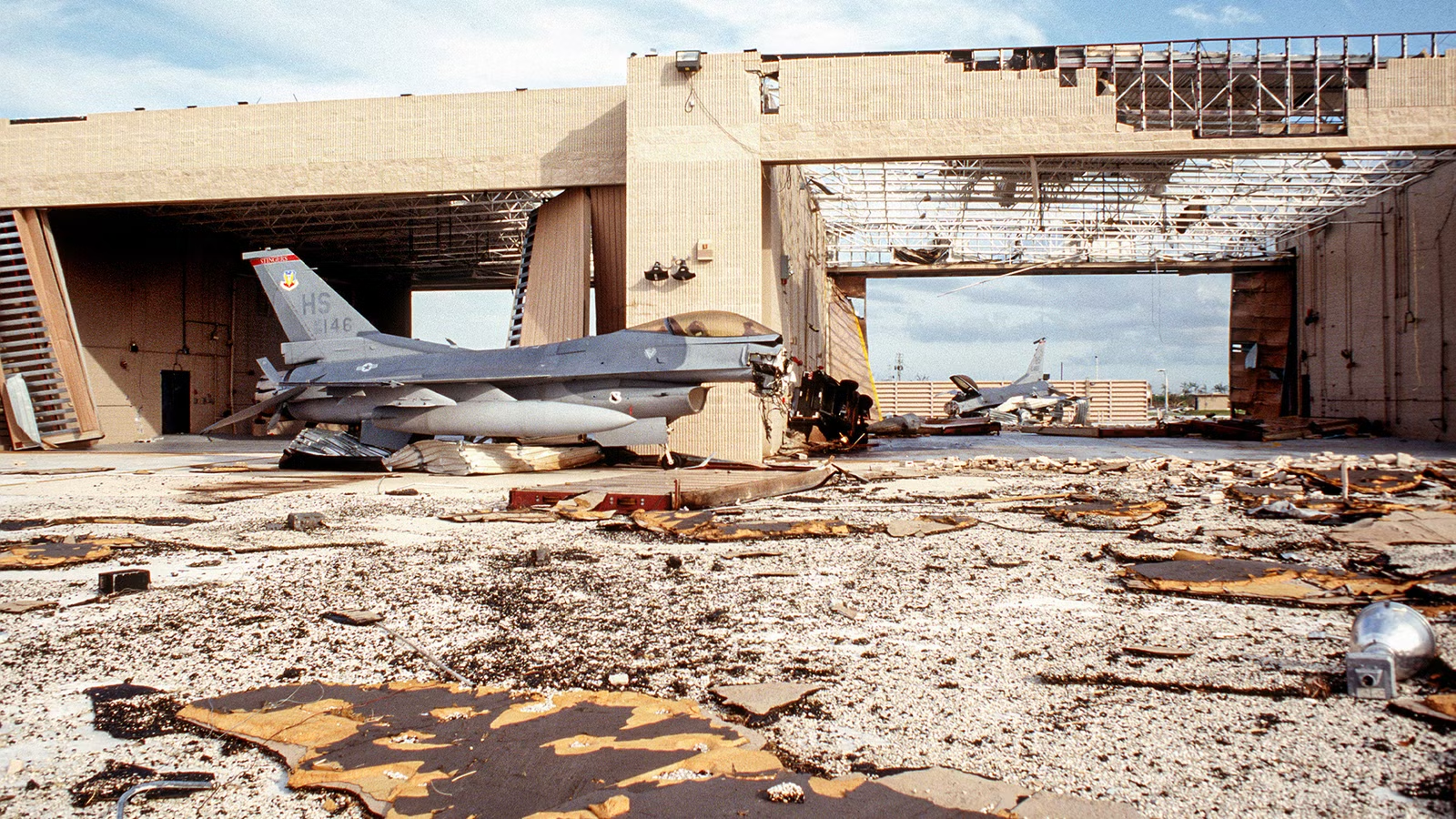
On May 8, the United States Air Force (USAF) announced that Homestead Air Reserve Base is a leading candidate to transition out of the General Dynamics F-16 Fighting Falcon to the new Lockheed Martin F-35 Lightning II. Leaving behind the legacy fourth-generation fighter, the 482nd Fighter Wing would be the next Air Reserve Component unit to continue the modernization of Reserve and Guard squadrons around the nation. However, there is a caveat that comes with selecting 482, which is the risk of hurricane damage to the aircraft and squadron facilities.
It is true that there are many Air Force and Navy F-35 jets in Florida at any given time, but Homestead Bay was severely damaged in 1992 during Hurricane Andrew. The Category 5 storm essentially leveled much of the facilities. While the new stealth fighters can be flown away to avoid the path of an incoming storm, the costly hangars, simulators, and classified maintenance depots cannot be so easily protected.
While the 482 has not been formally selected, it is still the top choice despite the additional cost that will come with infrastructure upgrades to protect the already expensive baseline requirements for the F-35. It’s not only new simulators and enhanced information technology infrastructure, but the classified nature of the internal components and munitions will require upgrades to virtually every part of the base. On top of that, the Pratt & Whitney F135 engine literally runs hotter and requires the runway and engine run-up areas to be strengthened as well.
The USAF Divests To Invest

As any good realtor would say, location is the first and last consideration when it comes to choosing real estate. The same is true for decisions made by the Department of Defense in many cases. Homestead is at one of the most valuable strategic points along the Gulf of Mexico, which not only allows for freedom of movement but also integration with other US Armed Forces service branches. It is also very close to Eglin AFB, which is one of the most important locations in the DOD for the development of aircraft and weapons, which helps facilitate training and logistics.
HARB makes joint operations with the Navy, Marines, or Army smoother and faster while also serving as a well-positioned launchpad for expeditionary deployments across the Atlantic or south of the Equator. In particular, Homestead is very valuable in supporting the US Southern Command. Bringing the latest and greatest air warfare technology to the 482 will significantly improve USAF and Joint Force operations in the Americas and as a part of the North American Aerospace Defense Command.
In recent history, 482 FW has actively contributed to air policing missions in Eastern Europe as a part of operations with the North Atlantic Treaty Organization. The Reserve Wing has also sent F-16 Vipers to support operations in the Middle East after the attacks on September 11. After the transition kicks off, it will take several years to achieve full F-35 combat capabilities and completely phase out the F-16.
Managing Climate Risk To Accomplish The Mission

The Center’s Armed Services Committee identified Homestead as one of the ten Air Force installations facing the greatest climate-related risks in a 2019 review. That assessment prompted a resilience review for all of Florida as a part of a Pentagon initiative to manage rising sea levels and storm surge that threaten base integrity across the state. Upgrading Homestead is less of an isolated, high-cost project and more of a piece in a larger puzzle.
HARB is just one of many such military sites, as Florida hosts one of the most dense military aerospace ecosystems in the entire world, holding 13 major military air bases operated by the Air Force, Navy, Marine Corps, Coast Guard, and Space Force. Continued investment in this apparatus of long-standing air bases is not only valuable for strategic reasons but also capitalizes on infrastructure that has existed for decades.
Still, many of the existing facilities are Cold War-era structures, or older, which are a mixed batch in terms of modern engineering properties and storm resilience features. To ride out a category 5 hurricane, the new F-35 hangars at Homestead will need to withstand continuous wind loads of over 150 mph. They will also need to have extremely heavy-duty, impact-rated polycarbonate or laminated glass in order to resist shattering when struck by flying debris.
One of the distinguishing design features of buildings made for these conditions is rounded edges or trapezoidal form factors in order to cut down on the aerodynamic pressure points. They will also be built with heavy-duty sealed metal roof panels and reinforced steel hangar doors. Meanwhile, the classified areas will need to have backup, independent power sources for climate control as well as storm-hardened utilities and underground fiber-optic lines.
One Team, One Fight At Homestead

As a part of the Air Force Reserve Command’s Tenth Air Force, the 482 FW shares HARB with the 367 Fighter Squadron, as well as the Special Operations Command South. Being co-located with an active-duty Air Force Fighter Squadron and a Special Warfare unit makes the investment in stealth fighters and infrastructure at HARB even more valuable for the Department of the Air Force.
Although no date has been set for the 367 FS to make the switch to the F-35 from its current F-16 fleet, the trend within the USAF suggests that it is likely to begin in the near future. This would make the resources at the facility currently planned to facilitate the 482 FW transition useful for the 367 FS in the future. Additionally, classified spaces and modernized facilities that can be shared with a SpecWar unit, SOCSOUTH, also yield a multipurpose value at HARB.
Ultimately, there is no way around the fact that it’s going to cost a great deal in extra funding in order to make HARB ready for the F-35 and also ready to withstand a future hurricane. Yet, its strategically crucial location, along with the other tenant commands, makes the investment in transitioning the 482 FW less of a sunk cost and more of a springboard. The most obvious case is when the 367 FS modernizes, but the presence of SOCSOUTH serves to further reinforce that argument.
The heavily shielded, top-secret digital spaces required to store and plan F-35 missions provide immediate modular value to SOCSOUTH, which is headquartered at HARB. These secure structures enhance high-priority, real-time intelligence sharing for elite commandos operating across the Caribbean and Latin America.
The Sunshine State’s Combined Arms Powerhouse

Eglin is one of the largest Air Force bases in the world by land area, including its massive test ranges over the Gulf of Mexico, but there are many other sprawling defense sites across Florida. Tyndall AFB is a major hub of training for F-35 and F-22 Raptor Fighter squadrons. Meanwhile, MacDill AFB is a key location for aerial refueling and SpecWar units. The 482 FW actually operated from MacDill for some time following the closure of Homestead for repairs after Hurricane Andrew in 1992.
Catch what other flight trackers miss
Emergency squawks, holds, NOTAMs — live signals, no signup.
Open tracker
Catch what other flight trackers miss
Emergency squawks, holds, NOTAMs — live signals, no signup.
Open tracker
The world’s second-largest operator of the F-35, the Department of the Navy, also maintains a massive air presence in the form of multiple naval air stations across the Sunshine State. US Navy and US Marine F-35s can be regularly found at NAS Pensacola, Jacksonville, or Key West for training and routine activities. Many of these planes cycle in and out of the state for training missions at one of the many test ranges which cover hundreds of thousands of square miles of airspace.
The Eastern Gulf testing and training range covers over 180,000 square miles (466,197 square km) of Pentagon-owned airspace. This vast expanse of dedicated military real estate extends from Key West up to the Panhandle. The massive range allows the different service branches of the DOD to conduct simultaneous exercises, when using from dogfighting to hypersonic weapons tests. The presence of multiple large-scale facilities of different forces also allows for joint service sea-air exercises and other combined arms tactics training.
Why The Pentagon Favors Florida’s Shores

Florida offers near-constant, year-round flying weather. This allows fighter wings to hit their required flight-hour training metrics much faster and with fewer weather cancellations than bases located in northern or landlocked states. The Department of the Air Force spends the extra funds to storm-proof and modernize Homestead because the base is anchored to a pre-existing multi-billion-dollar military ecosystem.
Homestead sits at the absolute southern tip of this network, acting as the guard post. Building new bases elsewhere in the country would cost hundreds of billions, but more importantly, no other region can legally clear 180,000 square miles (466,197 square km) of commercial airspace. Proactively spending to upgrade and harden Homestead preserves the strategic integrity of the entire Florida network, ensuring that the fifth-generation fleet can readily utilize the nation’s long-standing joint airspace for decades to come.
While bases in northern Florida focus on advanced development and heavy training, Homestead is positioned to directly deploy those highly trained assets into real-world combat environments across the Caribbean basin at a moment’s notice. A pilot stationed at Homestead can take off, instantly link with air-refueling tankers from MacDill, train over Navy airspace in Key West, and simulate electronic warfare threats alongside advanced fighters at Tyndall. Failing to update Homestead fractures this interconnected apparatus of airfields, equipment, and troops.