dailynewsnblog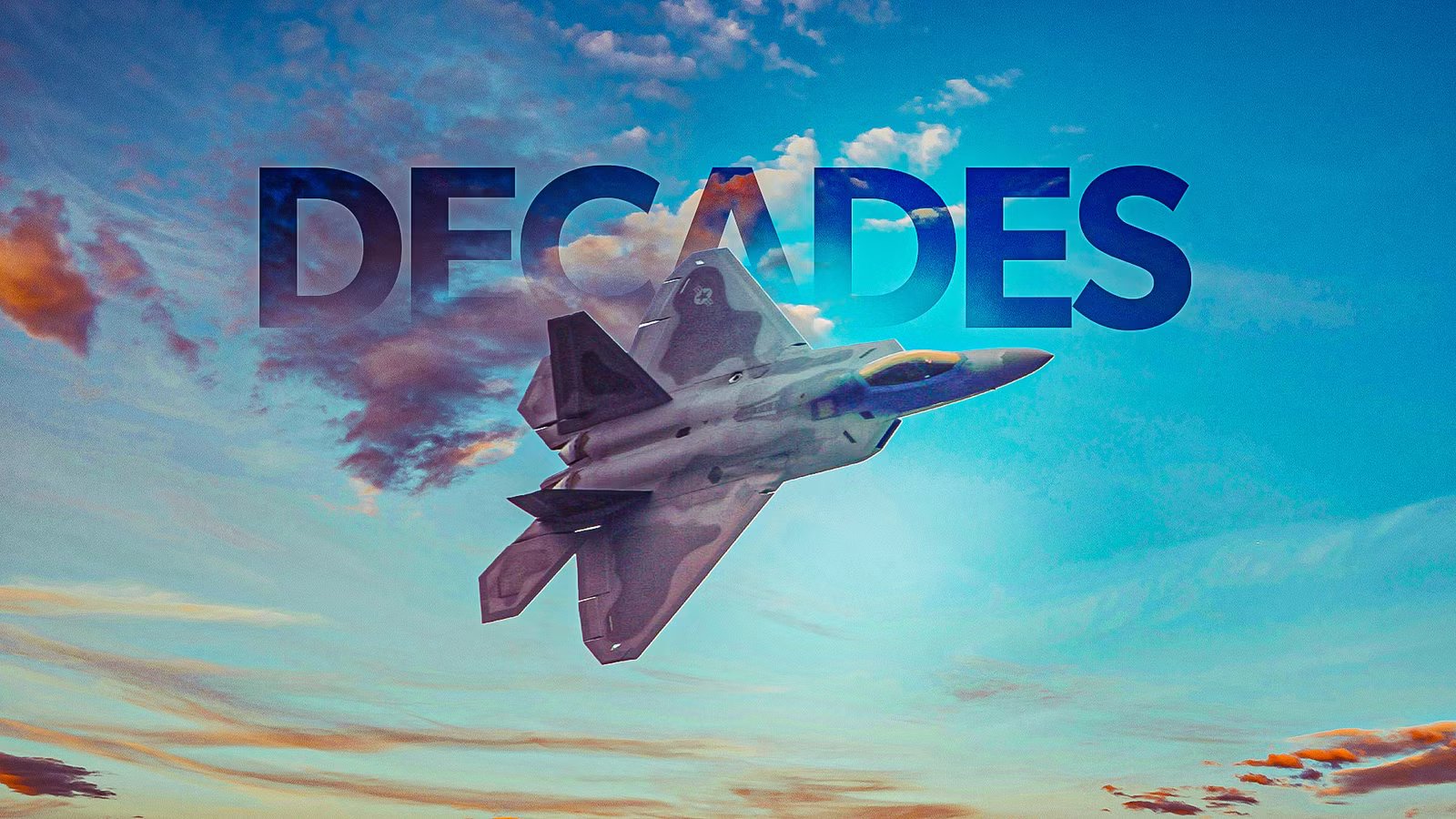
While some say that China is overtaking the United States in fighter jet technology, there is no indication that is an accurate reflection of reality. China has, indeed, narrowed the gap in many respects, both qualitatively and quantitatively. Very importantly, it has built a large number of fighter jets in recent years.
Chinese and US industry now produce a comparable number of fighter jets annually and together account for around 85% of annual output. However, narrowing the technological gap is not the same as overtaking. At the same time, over the last ten years, the US has pivoted from its counterinsurgency wars and is now focused on maintaining its technological advantage.
A major aspect that is beyond the scope of this article is the fact that the US and Chinese air forces are built to do very different things. The tailless fighter jets emerging in China are interesting and exotic, but reveal little about more important factors like sensor fusion.
The World’s First Fifth-Generation Fighter Jet

The United States brought the Lockheed Martin F-22 Raptor into service in 2005 as the world’s first fifth-generation fighter jet. The F-22 was built to dominate the skies against Soviet/Russian Su-27 and MiG-29 fighter jets and represented a generational leap over the F-15 that it was designed to place in the air superiority role.
While the concept of fighter jet generations was first suggested in the early 1990s by air historian Richard P Hallion, it was the F-22 that popularized the idea. The Air Force and contractors found it a useful way to explain to Congress and others how the Raptor represented a generational leap over the F-15 and why the enormous expense was justified.
Catch what other flight trackers miss
Emergency squawks, holds, NOTAMs — live signals, no signup.
Open tracker
Catch what other flight trackers miss
Emergency squawks, holds, NOTAMs — live signals, no signup.
Open tracker
The F-22 entered service in 2005, but the initial Air Force plan for 750 examples was eventually truncated to just 187 examples. The Air Force continued to develop the F-35, the world’s first true multirole fighter jet, which entered service in 2015. The 1990s to 2010s saw what was known as the ‘peace dividend.’
This was when Western countries slashed their military budgets and often redirected the money to social programs. This was less pronounced in the US than in Europe, but still, much of the US military spending became counterinsurgency. Some critics see the US as taking its eye off the ball, allowing China to narrow the technological gap in some high-end systems.
Fighter Jet ‘Generations’ Are Fuzzy & Politicized

When comparing the capabilities of fighter jets of opposing air forces, sorting them into generations: “4th-,” “4.5-“, “5th-“, and “6th-” is partially helpful, but also easily misleading and counterproductive. Aircraft do not neatly categorize into generations. They are incredibly complicated systems that exist in a much larger ecosystem that includes networking with ground-based radars, space-based assets, other fighter jets, and many other factors.
In a real-world conflict, the outcome of an air-to-air engagement can be better predicted by training, tactics, maintenance, pilot quality, electronic warfare, munitions, and overall system integration rather than pure aircraft specs. Importantly, there is no universal definition of what defines a ‘fifth-generation’, or any generation, fighter jet.
US fighter jets (Air Force, Navy, Marines) | Approximate quantity (per US Air Force) | Chinese fighter jets (PLA, PLANAF) | Quantity (per Rusi, end 2025) |
|---|---|---|---|
F-22 Raptor | 183 | J-10A/B/C | 550 |
F-35 Lightning II | Approx. 900 | J-16/D | 450 |
F-15 Eagle family | 330 | J-15/T/DH/DT | 80-100 |
F-16 Fighting Falcon | 760 | J-20/A/S | 320-350 |
F/A-18 Hornet/Super Hornet | 640 | ||
EA-18G Growler | 150 |
Aspects can also be uneven. For example, the Russian Su-57 may have a lower frontal radar cross-section, but the F-15EX may excel in other areas. In fact, the avionics, radar, networking, electronic warfare, and weapons of the F-15EX are now vastly superior compared to the fifth-generation concepts from the 1990s when the F-22 was in development.
‘Generational’ language is a useful shorthand and is used in serious analysis, but it is used somewhat loosely. The term remains popular for export sales, prestige, deterrence narratives, political messages, and defense budgets.
The Massive Information Bias

The United States and China are in a Great Power Competition, and with that comes political messaging. Importantly, these are very different countries with different requirements, different internal logics, and different ways of messaging. Compared to most countries, and especially China, the US is incredibly open about a massive range of defense-related topics.
The US releases precise inventories of most of its aircraft types, including openly published GAO reports on their readiness, delays, cost overruns, and failings. In this area, the US’s openness is immense and unthinkable in countries like China and Russia: it openly admits to many of its failings in procurement and readiness, and publishes audits on them.
However, China does not, beyond selective reporting on anti-corruption purges or similar. In fact, the number of aircraft of almost any type China has is a classified secret, meaning that lists of Chinese inventories are best guesses and estimates. China rarely acknowledges military aircraft mishaps, while the US does, and it publishes reports on the cause.
China will not acknowledge whether its fighter jets are combat-ready, while many Western air forces (like the RAF) do. With that being said, the US does have secretive ‘black box’ aircraft programs that it is secretive about, but these are mostly spy planes (e.g., MQ-180).
The Chinese narrative is that the country largely doesn’t make mistakes or have procurement debacles like the US. It partially achieves this by suppressing the information and then selectively parading and filming its gear operating perfectly.
China’s Current Optical Advantage

While the previous section is true, it comes with too many nuances to mention here. However, one of the most important qualifications of ‘sixth’ generation fighter jets is that the US has become more coy than China. The first demonstrators for the USAF’s NGAD program (now F-47) were first publicly confirmed to have flown in 2020.
Six years later, the contract has been awarded, and no public photo of the demonstrators has been released or leaked. Even the official partial renders of the F-47 are thought to contain misdirections, and the USAF has hinted at as much. By contrast, China has repeatedly flown its so-called J-36 and J-50 ‘sixth-generation’ demonstrators/prototypes in public since late 2024.
This is creating an information-biased narrative that China flew sixth-generation fighter jets before the US. It is possible that the narrative could be correct, as it is unclear when those aircraft first flew, and what qualifies as a sixth-generation fighter is debatable.
Another factor is that the US has been somewhat open about what capabilities it wants from its F-47 and F/A-XX next-generation fighters, but China has not. Instead, China has flown its tailless aircraft in public and let the media run wild with speculation and sensational headlines.
Sixth-Generation Fighters Are Defined By What’s Inside

Currently, what is known is that China flew exotic sixth-generation tailless fighter jets in public first, while the US still refuses to. At the same time, no one really even knows what a sixth-generation fighter jet is. There is some tendency in the media to look at China’s exotic new aircraft and conclude that they must be what sixth-generation jets are meant to be.
However, what truly defines a sixth-generation fighter jet is not its shape or flight performance. After all, the UK/Japan/Italian Tempest/GCAP fighter jet is being designed with large tail stabilizers. What is most important is the inside. If Second World War piston-engine fighters were flying tractors with machine guns, sixth-generation fighter jets are smartphones with missiles.
In 2024, Rusi’s Justin Bronks said, “…all that stuff [the internal unseen systems and integration of the plane] is where the US has had a crushing advantage over European producers for 20-30 years at least.” He added that:
“It’s comparatively easy to produce something that looks like a stealth fighter-ish thing that will fly. It is incredibly difficult and unbelievably expensive to sustain the production of a weapons system that works as a low-observable fighter (…) and also all the things you don’t see when you look at a plane. The integration between the weapons and the sensors (…) [and other integrations].”
What Japan’s Behavior Says About China

There is currently no indication that the United States is about to fall decades behind in fighter jet technology compared with China. At the same time, China is the only country that could realistically close the technological gap with the US. Russia is decades behind and seemingly falling further behind, despite its relentless propaganda messaging and Su-57s at air shows.
Europeans are able to build advanced fighter jets, but these are considered to be many years behind the United States. The European FCAS and GCAP programs could be more equivalent to a future F-35 Block 5 than the US’s upcoming F-47. The urgency with which the US is developing the F-47 points to both China narrowing the gap and the US’s intentions to technologically leapfrog to ensure it has an air superiority advantage into the 2040s and beyond.
However, while the US vs China debate may be full of political messaging, generating popular skepticism in both, another proxy for China’s fighter jet capabilities can be found in Japan. Japan currently operates F-16s (Mitsubishi F-2s), F-15s (F-15Js), and F-35s. It is known to want the next-generation Tempest/GCAP in service by 2035 to replace its F-16s.
This suggests that Japan has confidence that its F-16s, F-15s, and F-35s are able to provide the required area-denial and deterrence abilities against Chinese J-15s, J-20s, and J-35s until 2035 and that the GCAP will effectively counter the J-36. The GCAP is more of a multi-role fighter, while the F-47 is expected to be a much more specialized air dominance fighter.