dailynewsnblog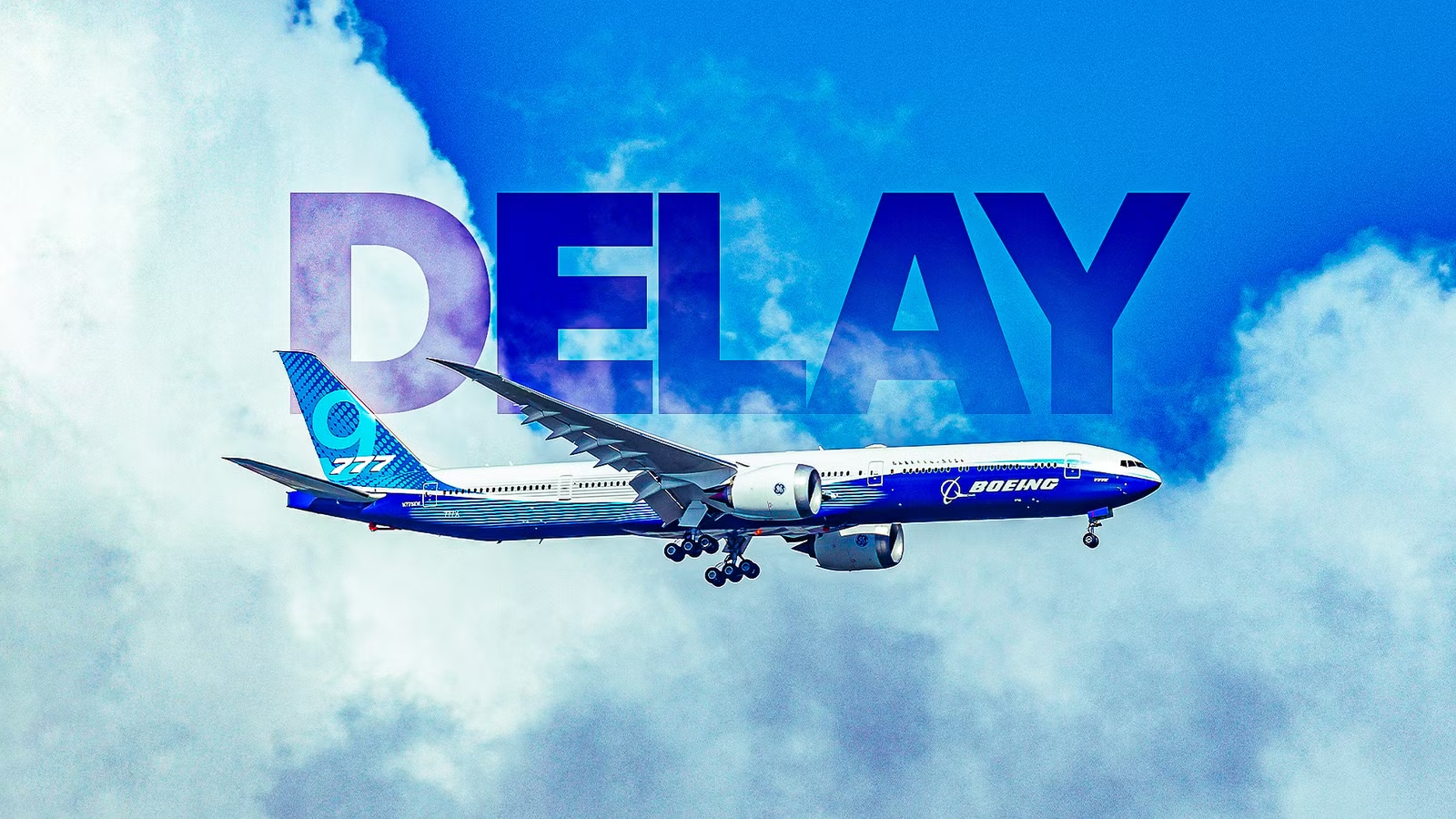
Few commercial aircraft programs have experienced a certification journey as prolonged as the Boeing 777X. Originally expected to enter airline service in 2020, the latest member of the 777 family is now scheduled to arrive in 2027, representing a delay of roughly seven years.
While certification setbacks are not unusual for new aircraft, the scale and financial impact of the 777X program have become remarkable even by aerospace industry standards. What makes the story especially striking is not simply the length of the delay, but its cost. Indeed, Boeing’s cumulative accounting charges tied to the program have now exceeded $15 billion, according to the company’s financial disclosures.
This figure is driven by certification delays, supply chain disruption, and customer compensation. That total is now broadly comparable to, and potentially exceeds, widely reported estimates for the development cost of the Airbus A350 family, highlighting just how expensive prolonged certification can become even for a derivative aircraft.
An Unexpectedly Expensive Program

When  Boeing officially launched the 777X, it appeared to represent a relatively straightforward evolution of one of the aviation industry’s most successful widebody families. Rather than designing an entirely new aircraft, Boeing chose to build upon the proven Boeing 777 platform while introducing significant improvements, including a new composite wing with folding wingtips, larger General Electric GE9X engines, updated avionics, and numerous aerodynamic refinements.
Derivative programs are typically intended to reduce both cost and risk compared to completely new aircraft, as much of the existing certification basis, manufacturing knowledge, and airline familiarity can usually be carried over. This allows manufacturers to deliver improved performance without absorbing the enormous expense associated with clean-sheet development.
The Boeing 777X certainly introduced substantial changes, particularly through its advanced wing design and powerful new engines, but it remained fundamentally an evolution of an established aircraft family. That made the expectation of a shorter development timeline seem reasonable when compared to all-new aircraft such as the Airbus A350.
Instead, the certification effort evolved into one of Boeing’s longest-running commercial aircraft development programs. The aircraft first flew in January 2020, yet certification has remained elusive as regulators required additional testing and validation before approving entry into service. While the aircraft itself has generally demonstrated impressive performance during flight testing, the process of satisfying regulators has proven significantly more demanding than originally anticipated.
Certification Challenges Have Increased The Financial Damage

Boeing, Simple Flying
The financial burden attached to the delays has accumulated through multiple factors rather than one dramatic event. Boeing has repeatedly recorded substantial accounting charges, often referred to as reach-forward losses, reflecting the higher expected costs of completing and delivering the program than previously forecast.
These charges have grown over several years as certification timelines extended, and the US manufacturer added another $4.9 billion pre-tax charge during the third quarter, pushing cumulative program charges beyond $15 billion. According to the company’s financial filings, those losses reflect the prolonged certification effort, higher production costs, supply chain challenges, and compensation arrangements with customers whose deliveries have slipped far beyond original expectations.
Several technical issues contributed to those delays. Engineers addressed cracked engine thrust links, additional flight control testing requirements, and the temporary suspension of flight testing following a cargo door failure during certification activities. None of these issues necessarily suggested a fundamentally flawed aircraft, but each required additional engineering analysis, testing, documentation, and regulatory review before the certification process could continue.
Modern aircraft certification has also become considerably more rigorous following heightened regulatory scrutiny across the aviation industry. Regulators such as the US Federal Aviation Administration (FAA) now demand more extensive evidence that aircraft systems perform exactly as intended under a wider range of operating conditions. As a result, even relatively isolated technical findings can have substantial consequences for development schedules.
Each month of delay also creates indirect costs. Manufacturing resources remain committed longer than expected, engineering teams continue working on a program that was supposed to be complete, suppliers require ongoing support, and aircraft built for customers cannot generate revenue until deliveries begin.
The Comparison With The Airbus A350 Is Difficult To Ignore

The headline comparison is striking because it places Boeing’s certification-related financial damage alongside the development cost of an entirely new competitor. Airbus has never published one definitive figure for developing the A350 program, but industry estimates generally place the investment somewhere around $15 billion, depending on exchange rates and methodology. These charges roughly match or potentially exceed some published estimates for what Airbus spent creating the A350.
What’s more, it built the entirely new carbon-fiber widebody family from the ground up. Importantly, these figures are not directly measuring the same thing. Boeing’s reported total reflects accounting charges associated with delays and future expected losses rather than the complete development investment in the aircraft itself, while A350 estimates refer to overall program development costs.
Even with that distinction, the comparison remains powerful, and the financial penalty generated largely by delayed certification has reached a level comparable with building an entirely new competing aircraft. Few aerospace programs illustrate the enormous economic consequences of schedule slippage more clearly.
The contrast also emphasizes the different expectations surrounding each aircraft. The A350 required Airbus to design an all-new fuselage structure, composite manufacturing processes, new systems architecture, and a completely fresh certification campaign. The Boeing 777X, despite incorporating major improvements, entered development with the advantages that normally accompany an established aircraft family, making the magnitude of the accumulated charges especially noteworthy.
Airlines Have Also Paid A Significant Price

While Boeing has absorbed billions of dollars in financial charges, airlines have experienced their own consequences from the repeated delivery delays. Fleet planning in commercial aviation depends upon aircraft arriving close to schedule, particularly for expensive long-haul operations where replacement aircraft may remain in service for decades.  Lufthansa provides one of the clearest examples.
The German airline originally expected the 777X to replace portions of its older long-haul fleet several years ago, but as certification continued slipping, Lufthansa was forced to extend the operational lives of both its Airbus A340 and Boeing 747 variants significantly longer than originally planned. Keeping older aircraft flying increases maintenance requirements, fuel consumption, and operational complexity while delaying expected efficiency improvements.
Other airlines faced similar planning challenges, and aircraft intended for retirement remained active because suitable replacements simply were not available. Route planning, crew scheduling, maintenance programs, and fleet modernization strategies all required repeated adjustment as delivery forecasts changed.
Perhaps the most visible commercial consequence came from Qantas and its ambitious Project Sunrise initiative. The Australian flag carrier selected the Airbus A350-1000 for its ultra-long-haul expansion plans, citing uncertainty surrounding the availability of the Boeing 777X. Although aircraft selection always involves numerous technical and commercial considerations, delivery certainty became an increasingly important factor as Boeing’s schedule continued slipping.
Airbus Has Benefited From The Extended Delay

Long certification delays rarely occur in isolation within competitive markets. While Boeing has worked toward certification, Airbus has enjoyed several years during which the A350-1000 has effectively occupied the market segment as the only available new-generation large widebody in production.
This timing advantage has allowed the European manufacturer to strengthen customer relationships while airlines seeking immediate fleet renewal increasingly looked toward aircraft that could actually be delivered. Some carriers that might otherwise have waited for the 777X instead made purchasing decisions based upon aircraft already available for service.
The competitive impact extends beyond individual sales campaigns, as every year an aircraft remains unavailable provides competitors additional opportunities to secure long-term fleet commitments, establish maintenance partnerships, and deepen operational familiarity with their own products. Widebody aircraft often remain in airline fleets for twenty years or longer, making each successful sale strategically valuable.
Although Boeing continues to possess a substantial order backlog for the 777X, prolonged delays inevitably affect customer confidence. Airlines generally understand that sophisticated aircraft development carries technical risk, yet repeated schedule revisions can still influence future procurement decisions. The market dynamics therefore extend beyond the accounting charges recorded by Boeing, and the consequences are difficult to quantify precisely but shape the long-term commercial landscape.
The Boeing 777X Remains Highly Capable

The certification challenges should not be interpreted as evidence that the Boeing 777X itself is an unsuccessful aircraft. On the contrary, the aircraft remains one of the most ambitious and capable twin-engine commercial aircraft ever developed. The Boeing 777-9 is the longest passenger twinjet ever built, combining increased passenger capacity with improved fuel efficiency through its advanced composite wing and General Electric GE9X engines.
Boeing designed the aircraft to deliver lower operating costs than previous large twin-engine aircraft while maintaining the range and payload capabilities expected by international airlines. Much of the program’s difficulty has centered on satisfying modern certification requirements rather than correcting a fundamentally deficient design.
Regulators have required additional validation, documentation, and testing before granting approval, reflecting an industry environment where oversight has become considerably stricter than when earlier members of the Boeing 777 family entered service. That distinction matters because certification delays and aircraft capability are not necessarily the same issue, and by most technical measures, the Boeing 777X promises to be an exceptionally capable long-haul aircraft once deliveries finally begin.
Simple Flying Quiz
Think you really know Boeing?
Answer 10 questions and put your knowledge to the test
Think you really know Boeing?
Answer 10 questions and put your knowledge to the test
Easy (15s)Medium (10s)Hard (5s)
The challenge has been navigating an increasingly demanding certification environment while absorbing the enormous financial consequences of every additional year spent waiting for regulatory approval. For Boeing, that prolonged process has transformed what began as a derivative evolution of a successful aircraft into one of the most expensive certification delays in commercial aviation history, with accounting charges alone reaching levels broadly comparable to the A350’s entire development.