dailynewsnblog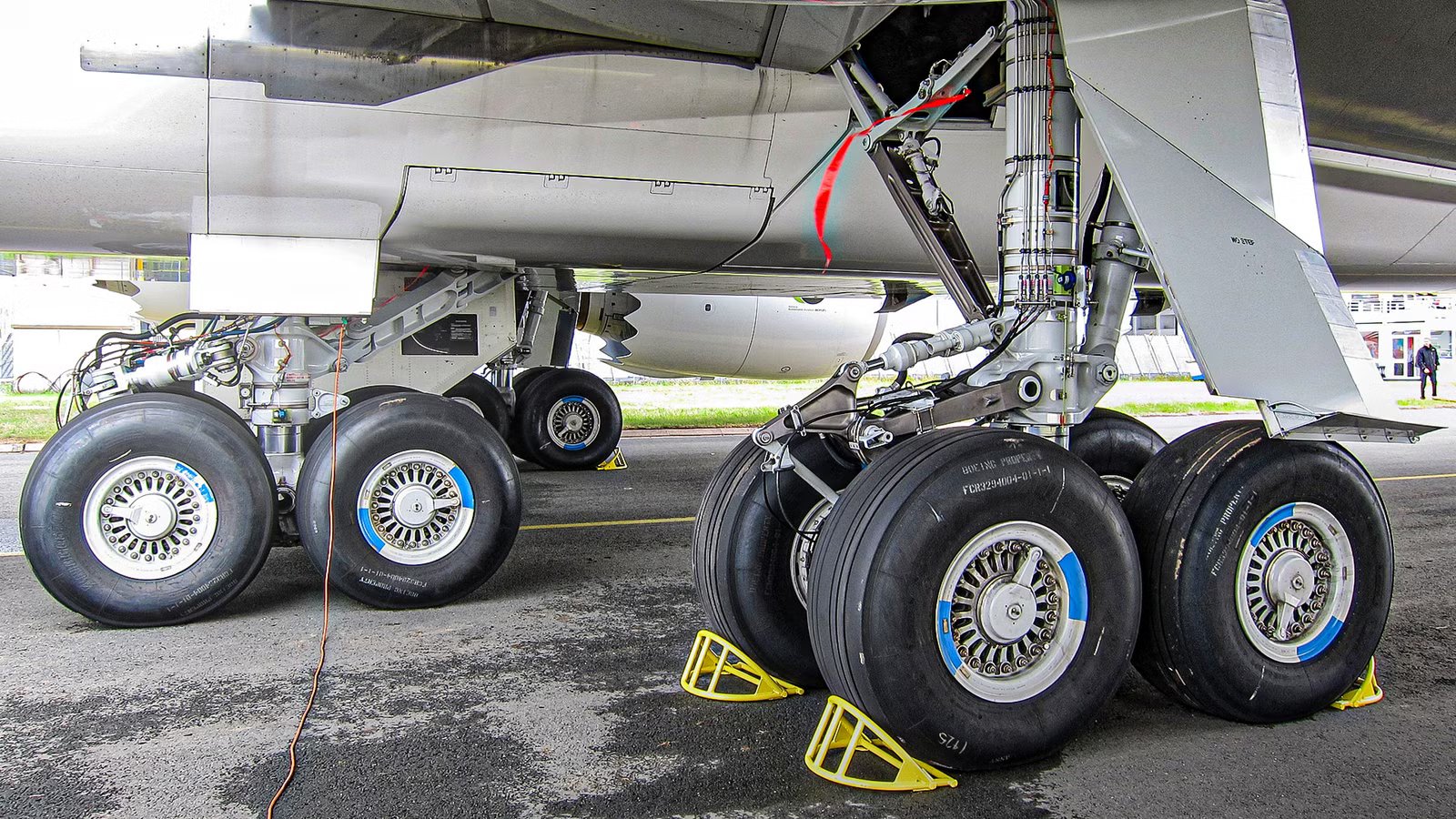
The Boeing 747-8 is one of the largest and heaviest commercial aircraft ever built, pushing the limits of modern aerospace engineering. With a maximum takeoff weight of nearly 987,000 lbs (447,000 kg), every aspect of its design must account for immense forces, especially during ground operations. Unlike in flight, where lift supports the aircraft, all of this weight must be borne by the landing gear on the ground.
This creates a significant engineering challenge: how to safely support and manage such a massive load without overstressing the aircraft or damaging airport infrastructure. One of the most visible solutions to this challenge is the aircraft’s use of 16 main landing gear tires. While it may seem excessive at first glance, this configuration is essential for distributing weight, absorbing landing forces, and ensuring safe operation under a wide range of conditions.
Each tire plays a critical role in balancing loads, reducing pressure on runways, and providing redundancy in case of failure. Together, they form a highly optimized system that allows the 747-8 to operate efficiently and safely across the global aviation network.
Extreme Aircraft Weight & Load Requirements

The 747-8 represents the upper extreme of commercial aviation in both size and weight, with a maximum takeoff weight of approximately 987,000 lbs (447,000 kg). This enormous figure includes the aircraft’s structure, fuel loads that can exceed 441,000 lbs (200,000 kg), and passengers and cargo. During ground operations, whether taxiing, taking off, or landing, this entire mass must be supported by the landing gear.
Unlike in flight, where aerodynamic lift carries most of the load, on the ground, all forces are transferred directly through the wheels onto the runway, creating one of the most demanding structural challenges in aircraft engineering. If engineers attempted to support this weight with fewer tires, each tire would be subjected to significantly higher loads, potentially exceeding its certified limits. Aircraft tires, while far stronger than automotive tires, are still constrained by material strength, heat tolerance, and performance limits.
A typical 747-8 tire is rated at around 50,000 lbs (22,700 kg). Without sufficient distribution, the load per tire would quickly surpass safe thresholds, increasing the risk of overheating, excessive wear, or even catastrophic failure during critical phases like landing rollout. At high speeds, a tire failure can create serious secondary risks, including damage from debris and reduced braking effectiveness.
By incorporating 16 main landing gear tires, the aircraft ensures that its weight is spread efficiently across multiple points of contact. This not only keeps each tire within safe operating margins but also accounts for dynamic forces such as braking loads, turning stresses, and uneven weight distribution caused by cargo placement.
Runway Load Distribution & Pavement Protection

One of the less obvious but critically important reasons for the large number of tires on the 747-8 lies in the need to protect airport infrastructure. Runways and taxiways are engineered surfaces designed to specific levels, defined through systems such as the Pavement Classification Number. Aircraft, in turn, are assigned an Aircraft Classification Number, which must be compatible with the runway’s PCN to avoid causing damage.
Because the 747-8 is so heavy, distributing its weight across more tires significantly reduces the force exerted on any single point of contact with the ground. Ground pressure is calculated as force divided by contact area. By increasing the number of tires, the total contact area between the aircraft and the runway increases, thereby reducing the pressure per unit area. This is essential for preventing structural damage to runways, such as cracking, rutting, or long-term fatigue.
Airports around the world vary widely in their pavement strength, and not all are designed to accommodate extremely high loads. Without sufficient wheels, the 747-8 would be restricted to only a handful of specially reinforced airports, severely limiting its operational flexibility and economic viability.
Furthermore, runway surface damage is not just a maintenance issue: rather, it can pose serious safety risks. Uneven surfaces, cracks, or damage to the pavement can affect aircraft during high-speed takeoffs and landings, potentially leading to instability or loss of control. This design consideration reflects a broader engineering philosophy in aviation: aircraft must be compatible not only with their own systems but also with the infrastructure they depend on.

Why Are Aircraft Tires Made Of Conductive Rubber?
The conductive rubber neutralizes electrical charge in aircraft tires.
Impact Forces During Landing

Landing represents one of the most mechanically stressful events in the lifecycle of an aircraft. As the aircraft descends toward the runway, it maintains a forward velocity typically between 140 and 160 knots (approximately 260 to 300 km/h). At the moment of touchdown, the vertical descent rate, though carefully controlled by pilots, still results in a significant force of kinetic energy into the landing gear system. This energy must be absorbed and dissipated rapidly to prevent structural damage to the aircraft.
The landing gear system achieves this through a combination of oleo-pneumatic shock absorbers and the tires themselves. The shock absorbers compress under load, converting kinetic energy into heat and reducing the force transmitted to the airframe. However, the tires also play a crucial role in this process. Each tire deforms upon contact with the runway, absorbing part of the impact energy and helping to smooth the transition from flight to ground.
In addition to vertical forces, the tires must also handle horizontal forces generated during braking and deceleration. Upon touchdown, the wheels accelerate from zero rotational speed to match the aircraft’s ground speed almost instantaneously, generating intense friction and heat. Having multiple tires allows these forces to be spread out, reducing wear and minimizing the risk of overheating or failure.
This is especially important during rejected takeoffs and emergency or overweight landings, where braking demands are even higher. The multi-tire configuration ensures that the landing gear system can handle these extreme conditions repeatedly without compromising safety or performance.
Redundancy & Safety Engineering

Safety is the cornerstone of aviation engineering, and redundancy is one of its most important principles. In the context of the Boeing 747-8, the use of 16 main landing gear tires provides a high degree of redundancy, ensuring that the aircraft can tolerate failures without catastrophic consequences. This is particularly important because tires are among the most heavily stressed components during ground operations and are therefore more susceptible to wear and damage.
If a single tire were to fail during landing or takeoff, the presence of multiple tires on the same bogie allows the load to be redistributed temporarily. This prevents immediate loss of control or structural failure, giving pilots time to safely bring the aircraft to a stop. Aircraft are designed to continue operating safely even with multiple tire failures, provided that the overall system remains within certain limits. This level of fault tolerance is essential for meeting stringent certification requirements set by aviation authorities.
Moreover, redundancy extends beyond individual tires to the overall landing gear configuration. The 747-8’s four main bogies are spaced strategically to provide balanced support across the aircraft’s length and width. This ensures that even if one gear assembly is compromised, the others can continue to support the aircraft. Such design considerations are the result of decades of engineering refinement and real-world operational experience, highlighting the importance of building systems that can handle not just ideal conditions but also unexpected failures.

Stopping Power: Boeing 777-9 Brakes Reach 2,500 Degrees In Critical Aborted Takeoff Test
The aircraft pushed the limits of its advanced braking system during a simulated maximum-weight, high-speed aborted takeoff.
Tire Engineering Limits & Performance Characteristics

Aircraft tires are among the most advanced and specialized types of tires in the world, designed to operate under conditions that would quickly destroy conventional tires. A typical  Boeing 747-8 tire is inflated to around 200 psi, which is significantly higher than the pressure used in automotive tires. This high pressure allows the tire to support heavy loads while maintaining structural integrity and minimizing deformation during high-speed stages.
Despite their strength, aircraft tires are subject to strict engineering limits. Factors such as heat buildup, material fatigue, and centrifugal forces all impose constraints on how large and how heavily loaded a tire can be. During landing, friction between the tire and the runway generates significant heat, which must be dissipated quickly to prevent damage. Additionally, as the tire spins up to high rotational speeds upon touchdown, it experiences enormous centrifugal forces that can stress the internal walls of the tire.
Because of these limitations, simply increasing the size or strength of individual tires is not a practical solution for handling greater loads. Instead, engineers opt for a multi-tire configuration, which allows the load to be shared across several components. This approach not only improves performance but also simplifies maintenance, as individual tires can be replaced as needed without affecting the entire system. It also provides flexibility in design, enabling manufacturers to optimize the landing gear for different aircraft variants.
Landing Gear Configuration & Structural Design

The landing gear system of the 747-8 is a highly refined piece of engineering, designed to balance strength, stability, and flexibility. It uses a quad-bogie layout, with two gear assemblies under the wings and two under the fuselage. This setup provides a stable base during ground operations and ensures loads are evenly distributed across the structure.
The gear is carefully positioned to match the aircraft’s shifting center of gravity, which changes with fuel and cargo. The body gear, near the centerline, supports the aircraft during rotation on takeoff and flare during landing, while the wing gear adds stability and load capacity, especially during taxiing and braking.
Beyond carrying weight, the system allows smooth ground handling across turns and uneven surfaces. Multiple wheels improve force distribution during maneuvering, reducing stress on components and improving control. Braking systems are built into the wheels, and having more wheels spreads braking forces more effectively, improving stopping performance and reducing wear. Overall, the 16-tire configuration is essential to the aircraft’s safe and efficient operation.