dailynewsnblog
Avgeeks and aviation journalists constantly talk about the end of the hub-and-spoke model. The advent of highly efficient twin-jet long-haul aircraft, like the Boeing 787 and Airbus A350, and the rapid rise in narrowbody range, through the Boeing 737 MAX and Airbus A321XLR, make point-to-point operations on thinner routes possible. Yet, for transatlantic aviation, the transition remains incomplete. Some European destinations have few or no direct transatlantic flights. Passengers for these cities still have to fly to an enormous hub like London Heathrow Airport (LHR) and then take a connecting flight to their final destination.
There are several reasons for the lack of transatlantic services to some major European destinations. You can discover them in the section below.
Viability Issues Prevent Transatlantic Services

The decision not to fly to major European cities is not a sign of preference, but of a lack of viability. Launching and sustaining a new transatlantic route requires a specific combination of demand, connecting traffic feed, airport infrastructure, slot availability, and aircraft economics. If a city catastrophically fails one of these tests, such as the inability to sustain large aircraft needed for transatlantic routes, the route will not be viable. Conversely, an airport may have fantastic infrastructure to handle widebody jets but not sufficient demand to fill them on transatlantic routes.
It is estimated that airlines need at least 200 passengers per day each way (PDEW) to sustain regular services on transatlantic city pairs. Some large cities can’t sustain this level of demand. Carriers instead choose to fly transatlantic via their major hubs and allow other carriers to offer passengers wishing to complete these niche trips connections. Cities with slightly higher demand, like Prague or Budapest, can often support a seasonal US route, bolstered by passengers seeking connections to other Central European destinations.
Budapest is the clearest example of such an airport. It hasn’t maintained nonstop service to the US since 2022, when LOT Polish ended its last transatlantic service.
Catch what other flight trackers miss
Emergency squawks, holds, NOTAMs — live signals, no signup.
Open tracker
Catch what other flight trackers miss
Emergency squawks, holds, NOTAMs — live signals, no signup.
Open tracker
American Airlines’ Latest Announcement Demonstrates Seasonal Transatlantic Services

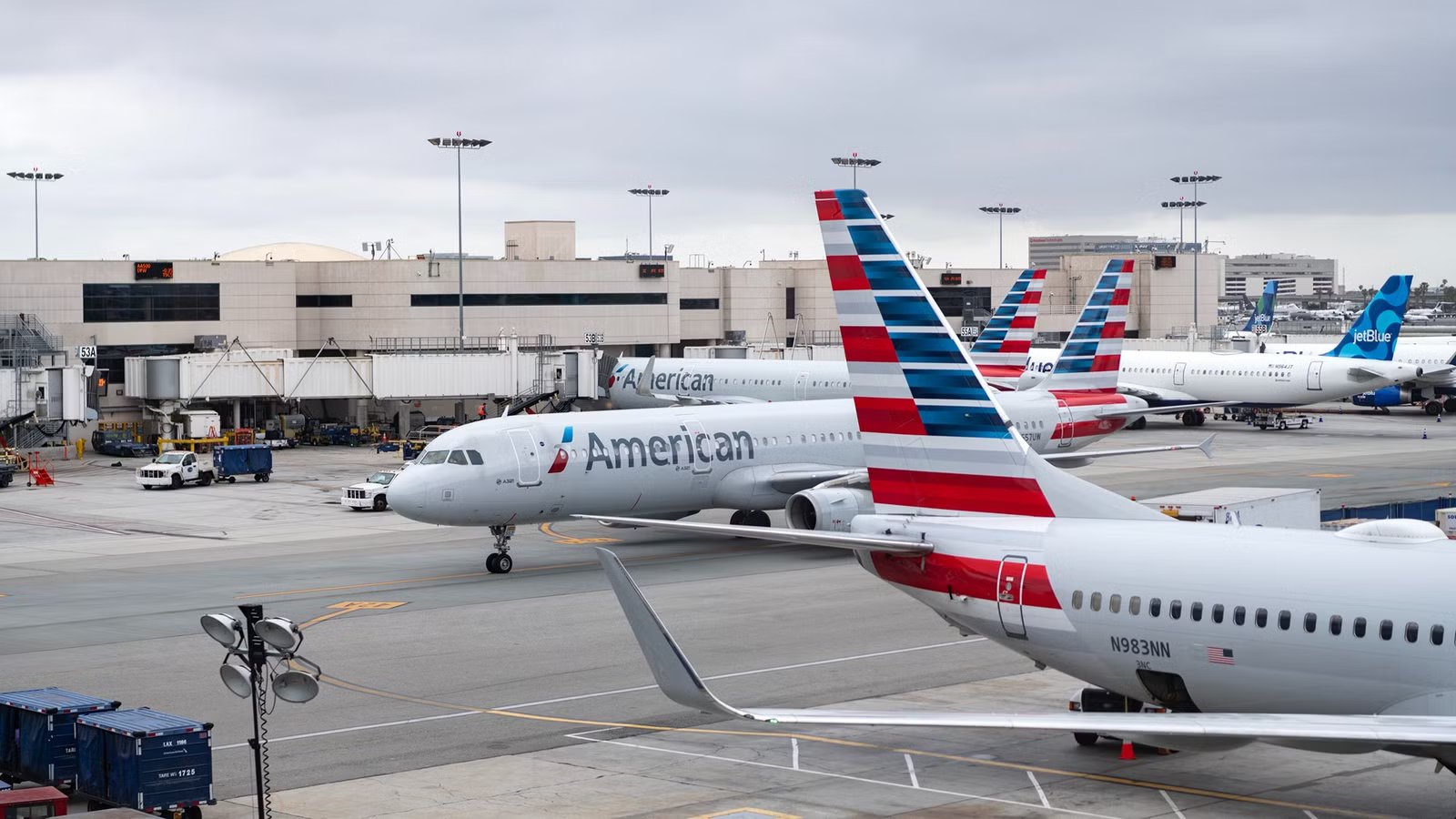
In May this year, American Airlines announced four new routes for the summer season that exemplify US carriers’ approach to barely viable transatlantic destinations. These routes were to Budapest and Prague from Philadelphia, and to Athens and Zurich from  Dallas/Fort Worth International Airport (DFW). The announcement was part of American Airlines’ record-breaking summer travel season, including 70 daily transatlantic flights. The Philadelphia flights use the airline’s Boeing 787-8, while the services from Dallas use a mix of Boeing 777-300ER and 777-200ER aircraft.
The table below shows American Airlines’ full widebody fleet that is available for transatlantic services, making use of American Airlines’ financial data:
Aircraft | In fleet | On order |
|---|---|---|
Boeing 777-200ER | 47 | None |
Boeing 777-300ER | 20 | None |
Boeing 787-8 | 37 | None |
Boeing 787-9 | 33 | 19 |
These routes are also part of a broader Philadelphia strategy, with the airline offering customers nonstop services to 19 destinations across the Atlantic during the summer, along with 120 destinations worldwide. American’s Vice President of PHL Operations, Cesar Marchese, said: “Bolstered by our redesigned schedule and powered by the dedication of our team, we’re ready to care for customers during a record summer at PHL — especially as the city hosts several major global events this year.”

Up To 70 Daily Flights: American Airlines Puts Pressure On Delta With 4 New European Routes
The airline is heating up its transatlantic competition with its legacy rival.
The Modern Narrowbody Aircraft Opening Up New Routes

Cases of major cities lacking transatlantic service will likely decline as long-range, highly efficient, and relatively high-capacity narrowbody aircraft become more prevalent. Jets like the 737 MAX have the capability to operate long-haul transatlantic routes, while their low operating costs reduce pressure for constant demand. Long-thin routes are becoming increasingly viable. One example is United’s restoration of its Newark to Glasgow flights following a six-year absence, which is United’s first route to the UK using the 737 MAX.
Karolien De Hertogh, Director of Sales UK and Ireland, United Airlines, said: “We are excited to return to Glasgow with the launch of our service to Newark/New York, further underlining the importance of Scotland within United’s global route network.”
The table below shows operational details for this seasonal service:
Flight | From | To | Depart | Arrive | Frequency | Dates of operation |
|---|---|---|---|---|---|---|
UA231 | GLA | EWR | 2:00 PM | 4:35 PM | Daily | May 9 – Oct 24 2026 |
UA230 | EWR | GLA | 10:15 PM | 10:10 AM+1 | Daily | May 8 – Oct 23 2026 |
Like the 737 MAX, the Airbus A321XLR will also offer an alternative to aging widebody jets. Simple Flying reader Daniel_Dair summarizes the aircraft’s potential perfectly in a comment on an article on new United Airlines long-haul routes: “A321XLR has a 200-seat capacity with a Business class & up to 244 in an all-economy format. It fits the bill in every respect… The operator seat per mile costs of the A321XLR are far less than the 767’s.” The aircraft has already opened up destinations such as Split, Bari and Santiago de Compostela, which are receiving their first-ever nonstop flights to the US in 2026.
More Routes Won’t Necessarily Mean A Better Flying Experience

In the years to come, passengers will be able to fly longer than ever on narrowbody aircraft. This will open up many more non-stop transatlantic flights. However, people who can take a more leisurely approach to flying may still opt for hub-and-spoke flying. This will particularly be the case for passengers hoping to fly in lie-flat business class, which remains a rarity on narrowbody aircraft.
Simple Flying’s Abid asked our readers and journalists this question in their thread ‘Transatlantic Flights On A Narrowbody! Would You Be Willing To Fly On It?’ Their conclusion was, “I personally think that any flight longer than four hours is more comfortable on a widebody aircraft, and therefore avoid a narrowbody flight across the Atlantic.”
The range of answers in the comments shows that airline passengers remain undecided, largely because few have had the opportunity to try it out. Many would deal with the discomfort if, as Jake Hardiman put it, “the price was right.” Others would be perfectly fine so long as Wi-Fi or some other form of in-flight entertainment was available. Meanwhile, OrangeCat was unequivocal in their opposition. They wrote, “Hard pass, the 1960s are long over… Leave the old 707s and DC-8s dead and buried. I don’t even want to do Miami or Boston to LA in one of these cramped tubes, regardless of the new jet smell.”
Some Cities That Previously Had Transatlantic Flights Are Getting Cut

Airlines are constantly reworking and optimizing their flight schedules. This could lead some European cities that previously had transatlantic services to lose them. Cirium data from April 2025 showed that four airlines had made plans to cut six transatlantic routes from their schedules.
The table below shows a full list of the services reported as being cut by Simple Flying’s Dillon Shah in an article published last spring. The frequencies stated apply to April 2025:
Airline | Origin (US) | Destination (Europe) | Weekly frequency | Reason for cut |
|---|---|---|---|---|
United Airlines | Newark | Tenerife South | 3 | Low demand |
Norse Atlantic | Miami | Oslo | 1 | Unclear, likely low demand |
Norse Atlantic | Miami | Berlin | 3 | Unclear, likely low demand |
Lufthansa | Minneapolis | Frankfurt | 3 | Switched to Discover Airlines |
Lufthansa | Miami | Munich | 6 | Summer seasonal |
Aer Lingus | Las Vegas | Dublin | 3 | Summer seasonal |
While most of these route alterations and cuts were strategic decisions made by some of the world’s largest airlines, the cuts by Norse Atlantic came as a result of broader operational difficulties. Dillon notes that their cut routes had unsustainable average loads of 78% for Berlin and 76% for Oslo in 2024. London Gatwick, which was on the cards for axing in winter 2025, recorded an even worse performance of 71%. This data shows that, even when flying to some of the world’s busiest airports, insurgent airlines can struggle in a crowded marketplace.

American Airlines Suspends 6 Transatlantic Routes This Winter
The news comes nearly a week after the airline confirmed to Simple Flying that it is adjusting its schedule on three other transatlantic routes.
Transatlantic Aviation Is Facing A Startling Decline

Many airlines will have to switch to modern narrowbodies or cut transatlantic services in the years to come due to an astonishing decline in demand. This is demonstrated by Airways Magazine’s comparison of transatlantic bookings in the summer of 2025 and 2024. The data showed bookings from the US to Europe were down 9.8%, with a greater decline from Europe to the US of 12%.
The decline has not been equal across all European destinations. Munich was worst hit with a 24% decline, followed by Amsterdam (22%), Rome (17%), Athens (19%), and Barcelona (16%). Paris saw no change. Meanwhile, only Lisbon showed positive direction of travel, with a 7% increase. Perhaps this data indicates waning demand for what has been Europe’s most popular summer destinations for decades. Less traditional destinations, covering much of Portugal, have experienced an impressive rise in popularity recently. Visitors rose to 32.5 million in 2025, a rise of 3% compared with 2024, according to reporting by deVere Portugal.
The change has been just as alarming for the US market. San Francisco was the hardest hit, with a 19% decline, followed by Washington, D.C. (17%), Los Angeles (6%), Houston (16%), and Atlanta (14%).