dailynewsnblog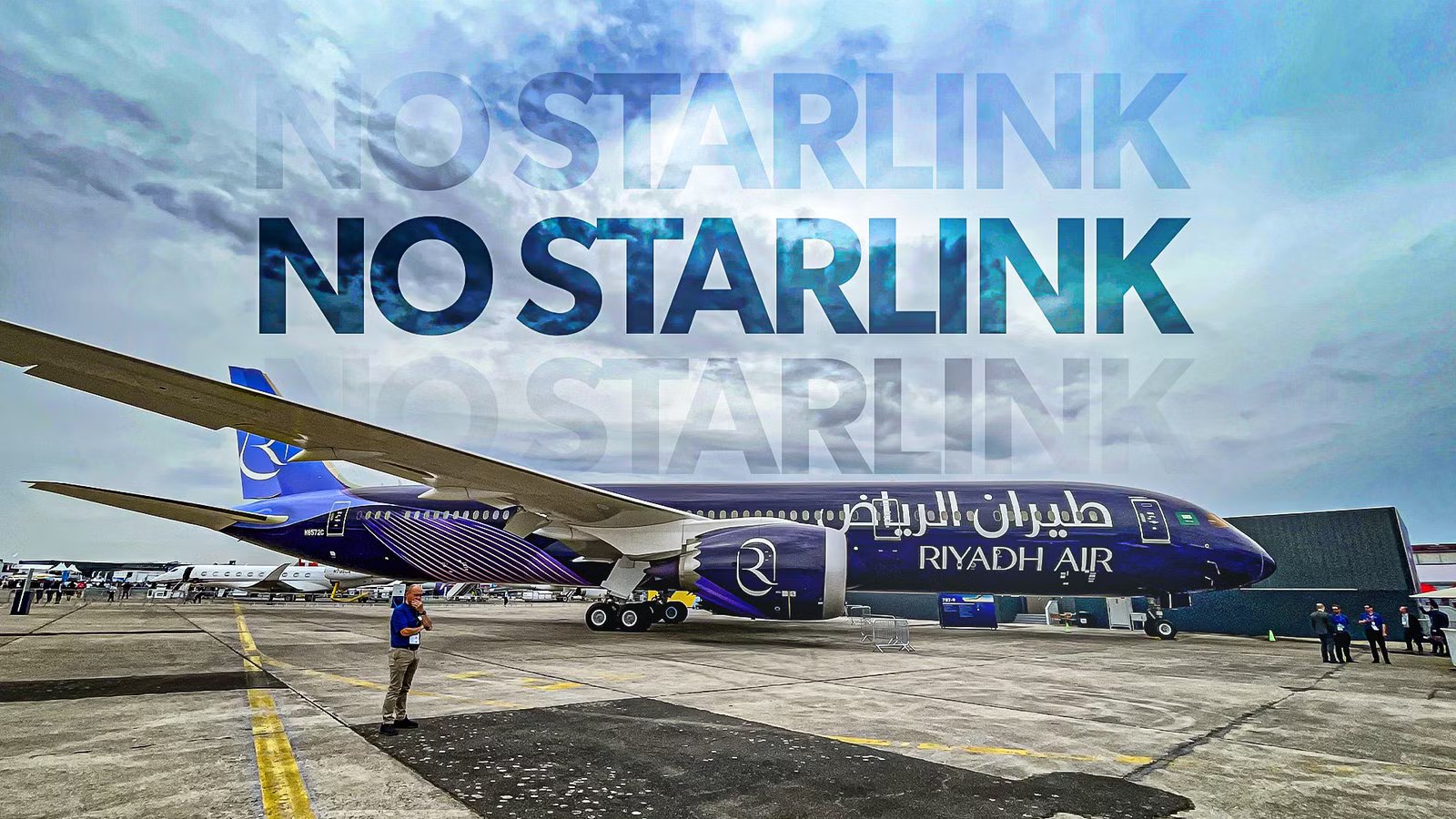
Saudi Arabia’s newest airline has finally arrived. On June 10, 2026,  Riyadh Air launched its first scheduled Boeing 787-9 Dreamliner service from Riyadh Airport (RUH) to
  London Heathrow Airport (LHR), marking one of the most anticipated airline debuts in decades. Yet amid all the attention surrounding its futuristic cabins, premium service ambitions, and Vision 2030 growth plans, one detail surprised many aviation observers: the airline’s flagship Dreamliners do not use Starlink WiFi. Instead, they rely on Viasat’s satellite connectivity platform.
The decision matters because Riyadh Air has positioned itself as a digitally native airline designed around technology, connectivity, and passenger experience. While competitors around the world are increasingly embracing SpaceX’s Starlink system, Riyadh Air’s brand-new Boeing 787-9 fleet launched with a more traditional satellite connectivity solution. The reason has less to do with airline preference and more to do with one of the aviation industry’s most complicated technical challenges: installing and certifying low-Earth-orbit antennas on composite-fuselage aircraft such as the Boeing 787 Dreamliner.
Riyadh Air’s Spectacular Launch Came With An Unexpected Connectivity Compromise

Riyadh Air’s inaugural commercial flight, RX401, departed Riyadh on June 10 and arrived at London Heathrow the same morning, officially launching scheduled Dreamliner operations for Saudi Arabia’s newest carrier. The milestone represented years of preparation and marked the beginning of an ambitious expansion plan targeting 100 destinations worldwide by 2030.
The airline’s debut product immediately attracted attention. Riyadh Air’s Boeing 787-9 business class features just 28 seats arranged in a spacious 1-2-1 configuration. Privacy walls reach approximately 52 inches in height, while passengers enjoy 22-inch 4K Panasonic OLED entertainment screens, among the largest in commercial aviation today. According to early passenger reviews on social media, the physical product compares favorably with those of many established premium airlines. And, as per reports from Head for Points, the airline has created one of the most visually impressive business-class cabins currently in service.
However, one aspect of the experience generated less enthusiasm. Despite the cutting-edge cabin design, passengers discovered that internet performance fell well short of the standards increasingly associated with Starlink-equipped aircraft. That contrast quickly became one of the most discussed aspects of the launch among aviation enthusiasts and frequent flyers.
The First Real-World WiFi Test Exposed The Performance Gap

The reality of Riyadh Air’s onboard internet became apparent during a first-hand review of the inaugural London flight. According to Head for Points, WiFi speeds measured approximately 2.7 Mbps, while latency reached roughly 750 milliseconds.
Those figures are not necessarily unusual for traditional geostationary satellite internet systems. However, they appear underwhelming in a market increasingly shaped by Starlink’s low-Earth-orbit architecture, which often delivers dramatically lower latency and significantly higher speeds.
The difference becomes particularly noticeable during modern online activities. Streaming video, video conferencing, cloud-based applications, and online gaming all benefit heavily from low latency. While a speed of 2.7 Mbps remains sufficient for messaging, email, and light browsing, passengers expecting a seamless ground-like internet experience may find it limiting.
Ironically, Riyadh Air is offering the service free to members of its Sfeer loyalty program, reflecting the airline’s desire to create a digitally connected travel experience. The challenge is that free connectivity only goes so far when passengers compare every in-flight internet experience against Starlink’s rapidly growing reputation. Riyadh Air announced its partnership with Viasat in 2025, specifically to provide complimentary connectivity to loyalty members across its Dreamliner fleet.
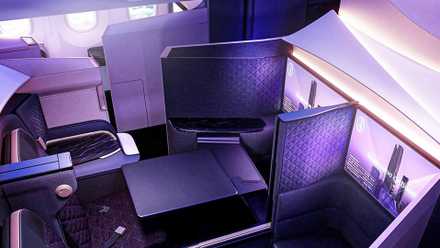
Luxurious, But No First Class: Inside This Start-Up Airline’s New Boeing 787-9 Cabin Configuration
Can a product with no first class truly be luxurious? Riyadh Air thinks so and is planning to take the world by storm.
The Boeing 787’s Composite Fuselage Creates A Hidden Starlink Obstacle

The obvious question is simple: why didn’t Riyadh Air simply install Starlink? The answer lies largely in the Boeing 787 itself. Unlike older widebody aircraft that use predominantly aluminum construction, the Dreamliner was designed around a carbon-fiber composite fuselage. Roughly half of the aircraft’s primary structure is made of composite materials, creating unique engineering considerations when airlines seek to add external equipment.
Starlink’s aviation system relies on phased-array antennas mounted on top of the aircraft. These antennas must be integrated into the airframe, connected to onboard systems, and certified for safe operation. While this process is relatively straightforward on some aircraft types, composite structures introduce additional complexity.
According to an analysis published by One Mile At A Time, certification and installation challenges on the Boeing 787 have become one of the primary reasons many Dreamliner operators have not yet adopted Starlink. Airlines, manufacturers, regulators, and equipment suppliers must work through extensive testing requirements before approving large-scale installations.
The issue is not that Starlink cannot work on the 787. Rather, obtaining certification and creating standardized installation procedures has proven slower than many airlines originally hoped. As a result, numerous Dreamliner operators continue relying on existing connectivity providers while waiting for certification pathways to mature. For example,  British Airways has also encountered similar issues with its Boeing 787 fleet, where installation delays meant only five aircraft were equipped with Starlink for the 2026 summer season.
This has created an unusual situation in which some older aircraft, like  Emirates’ metallic Boeing 777, can access next-generation internet technology more easily than some of the newest widebodies in service.
Other Airlines Are Encountering Similar Certification Challenges

Riyadh Air is far from the only carrier affected by these issues. Across the industry, airlines have expressed strong interest in Starlink because of its performance advantages, but implementation timelines remain heavily dependent on aircraft certification programs.
For example, airlines across Europe and the Middle East have explored Starlink deployments, while manufacturers and regulators continue working through certification requirements. Recent industry developments show increasing momentum, but the rollout remains uneven across aircraft types and operators. Reports indicate that even major global airlines are still evaluating implementation strategies and certification timelines for certain fleets, especially for carbon-fiber aircraft.
This explains why Riyadh Air’s choice of Viasat should not necessarily be viewed as a rejection of Starlink. Instead, it appears to represent the most practical solution available when the airline needed to launch commercial operations with in-flight internet.
After all, Riyadh Air could not delay its entire network rollout while waiting for certification processes beyond its control. The carrier needed a proven, certifiable connectivity platform that could be delivered alongside its first Dreamliners. Viasat offered a quick solution.
The result is a compromise many passengers may not notice immediately, but one that aviation enthusiasts quickly identified during the inaugural flights.
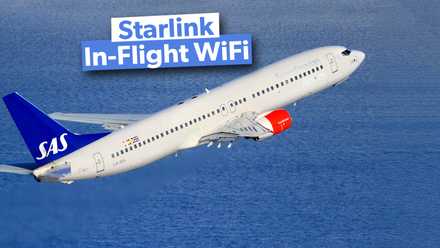
All The Airlines Installing Starlink WiFi & How Soon They’ll Go Live
Some aircraft already have the system up and running.
Riyadh Air’s Narrowbody Fleet Could Eventually Deliver The Connectivity Passengers Expect

Interestingly, Riyadh Air’s long-term connectivity strategy suggests that the airline understands the growing importance of high-speed internet.
The carrier has already signed a separate agreement with Neo Space Group (NSG) for connectivity services aboard its future Airbus A321neo fleet. According to AeroTime, the system is expected to deliver speeds of up to 300 Mbps, substantially higher than what many passengers currently experience on traditional satellite networks.
The contrast between the Dreamliner and A321neo plans highlights the broader transition occurring across commercial aviation. Airlines now view internet connectivity as a core product feature rather than an optional add-on. In many cases, passengers now evaluate in-flight WiFi with the same scrutiny once reserved for seat comfort, meals, and entertainment systems.
Riyadh Air Fleet Connectivity Overview
Fleet Type | Connectivity Provider | Advertised Capability |
Boeing 787-9 Dreamliner | Viasat | Free connectivity for Sfeer members |
Airbus A321neo | Neo Space Group | Up to 300 Mbps |
Future Fleet Expansion | To be determined | Potential for next-generation solutions |
The airline’s broader fleet plan remains enormous. Riyadh Air currently has 39 confirmed Boeing 787-9 Dreamliners on order, with 33 additional aircraft expected to follow. That gives the carrier a potential Dreamliner fleet of 72 aircraft, making connectivity decisions increasingly important as the airline scales globally.
The WiFi Story Reveals How Ambitious Riyadh Air’s Challenge Really Is

The Riyadh Air ambition extends beyond internet speeds. This airline is attempting something the aviation industry rarely sees: building a global airline from scratch in the modern era, in an extremely saturated market.
Chief Executive Tony Douglas has repeatedly described the carrier as one of the largest airline startups in aviation history. Supported by Saudi Arabia’s Vision 2030 initiative, Riyadh Air aims to transform Riyadh into a major global aviation hub, connecting more than 100 destinations by the end of the decade. A new airport, King Salman International Airport, is being built there to handle over 180 million passengers a year.
That ambition creates enormous expectations. Every aspect of the airline’s product, from cabin design to digital services, is scrutinized more intensely than it might be at an established carrier. Consequently, the gap between Riyadh Air’s stunning onboard hardware and its relatively modest WiFi performance became a major talking point immediately after launch. But the reality is that Riyadh Air’s connectivity limitations are not primarily due to poor planning or cost-cutting. They stem from the complex intersection of aircraft certification, satellite technology, and composite-airframe engineering.
In many ways, the airline has become emblematic of a broader challenge in the aviation industry. The technology exists to provide near-ground-quality internet at 40,000 feet. Many passengers expect it. Airlines want to offer it. But certification processes and aircraft-specific engineering constraints often move far more slowly than consumer technology trends.
For now, Riyadh Air passengers will enjoy one of the industry’s most visually impressive new cabins while connecting through Viasat. The irony is difficult to ignore: the world’s most ambitious airline startup launched with a business-class suite that feels straight out of the future, but its internet performance can feel rooted in the past.