dailynewsnblog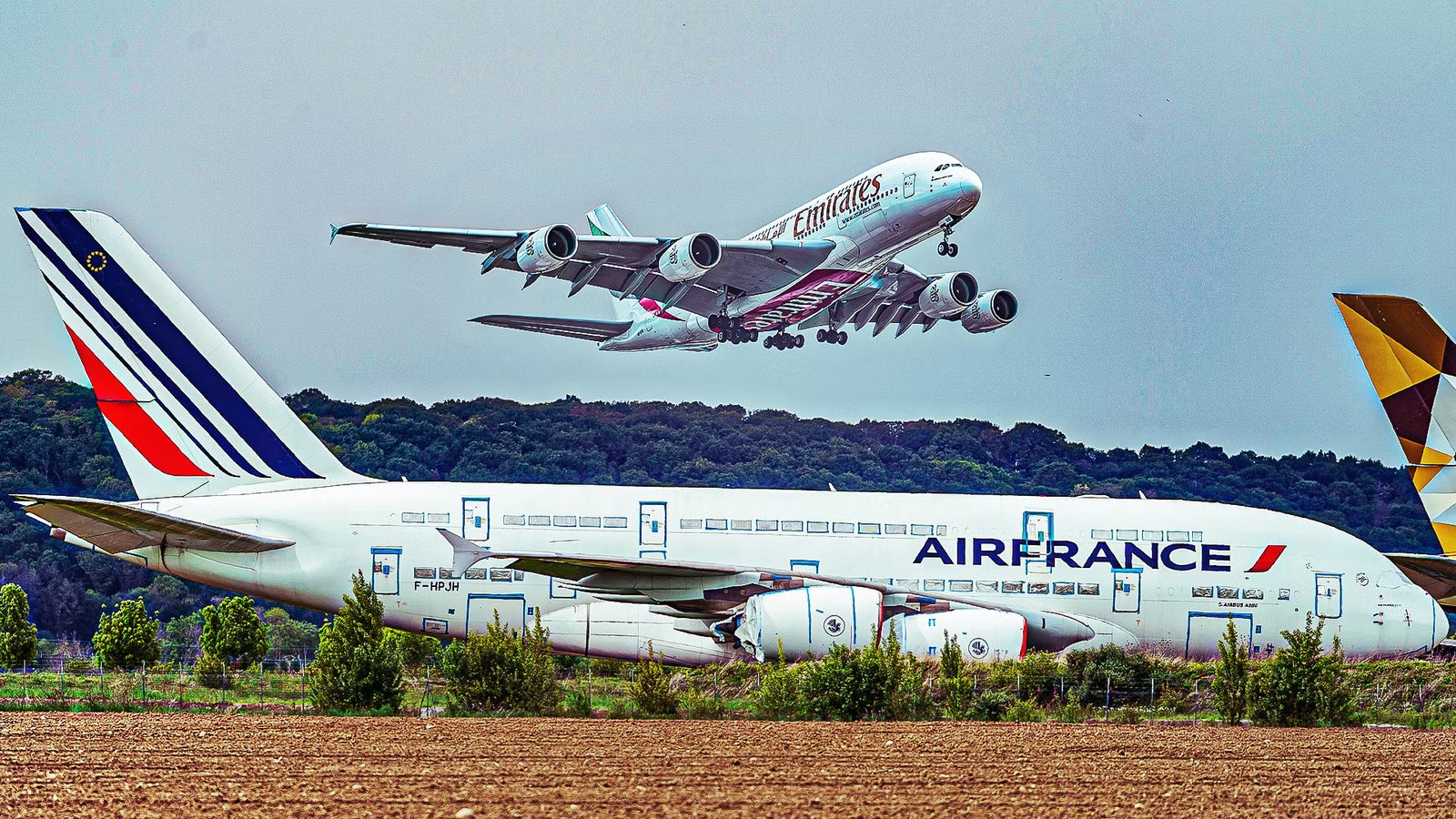
 Emirates operates approximately 118 Airbus A380s, more than every other A380 operator in the world combined. The airline plans to keep the type flying until at least 2040. But the A380 has been out of production since 2021; the pool of new replacement parts is shrinking, and Boeing’s 777X delays have forced Emirates to fly its oldest A380S longer than originally planned. Each additional year of service generates demand for engines, landing gear, and components that are increasingly difficult to source from the manufacturer.
Emirates’ solution is to buy retired A380s from other operators and dismantle them. A complete A380 can be acquired on the secondary market for $25-60 million. The four engines can generate millions more in recovered value. For an airline operating a fleet this large with no replacement aircraft arriving on schedule, retired A380s are worth more as a source of parts for the flying fleet than as aircraft anyone would want to operate again.
Emirates Is Buying Retired A380s To Take Them Apart

Emirates is retiring older A380s and acquiring end-of-lease aircraft from other operators not to fly them but to dismantle them.
“They are under retirement because we’ve got a major overhaul coming up and it’s best to take the old aircraft out, they’re all written down, and take the gear off them rather than buy a $25 million main landing gear,” Emirates President Tim Clark explained in 2023, according to One Mile At A Time. “I need two, possibly three, to meet that requirement.”
The airline has determined that buying a complete aircraft on the secondary market and stripping it for parts is cheaper than purchasing individual components new from the manufacturer. The math is straightforward. A retired A380 can be acquired on the secondary market for between $25 million and $60 million depending on age and condition. A single new main landing gear set costs approximately $25 million. The four Rolls-Royce Trent 900 engines on the same aircraft can each lease for up to $480,000 per month or sell for several million dollars apiece. The avionics, flight control actuators, hydraulic systems, auxiliary power unit, and hundreds of other rotable components add further recoverable value. An airline that buys a retired A380 for $30 million and harvests the landing gear, engines, and major components recovers more value in parts than it paid for the whole aircraft.
Clark acknowledged that there is no meaningful secondhand market for the A380 as a flying aircraft.
“Clearly, the demand in the secondhand market isn’t there. So when we’ve got the life out of the aircraft that we had planned, we’re indifferent to what happens to them in the sense that we don’t have any value left in them and we don’t have to take any write-downs.”
For Emirates, A380s that have reached the end of their useful flying life have a second career as parts donors for aircraft still in service. Dubai World Central, Emirates’ secondary airport facility, is effectively becoming a parts department for the active fleet.
What An A380 Is Worth Whole vs What It Is Worth In Pieces

The gap between what an A380 costs to buy new and what it sells for on the secondary market is larger than on any other commercial aircraft type in recent history. Singapore Airlines took delivery of the first A380 in 2007 under a sale-leaseback arrangement valued at approximately $197 million. Airbus’ final list price for the A380 before it ended production was approximately $445 million. In 2026, second-hand A380s trade in a range of $25 million to $60 million depending on airframe age, engine hours, and maintenance status. Most transactions cluster between $25 million and $35 million. An aircraft that cost nearly $200 million to acquire new 15 years ago now sells for roughly one sixth of that figure.
The parts inside that aircraft tell a different story. The four Trent 900 or Engine Alliance GP7200 engines are the single most valuable component, with each engine capable of generating up to $480,000 per month in lease income or selling outright for several million dollars. A set of four engines on a single airframe can therefore generate close to $2 million per month in lease revenue or a total sale value exceeding $15-20 million. The main landing gear, which weighs about 12,000 lb (5,443 kg) per set, costs about $25 millionnew from the manufacturer. Engine overhauls run $3-5 million per engine. Avionics, flight control actuators, hydraulic pumps, and environmental control system components each have individual market values that add up across the hundreds of line-replaceable units on the aircraft.
When the recoverable parts value of a retired A380 exceeds its market value as a complete flying aircraft, the economics favor teardown over resale. For most A380s older than 15 years, that threshold has already been crossed. An airline or parts supplier that acquires a retired A380 at $30 million and recovers $40-50 million in usable components through a managed teardown generates a return that no buyer operating the aircraft as a passenger jet could match, because the operating costs of flying a 15-year-old four-engine widebody on revenue service would consume whatever margin the low acquisition price created.
How Emirates Built The World’s Largest A380 Fleet

Emirates announced its first A380 order at the 2000 Farnborough Air Show, committing to seven aircraft before the type had flown. Emirates placed additional orders at the 2001 Dubai Air Show, just six weeks after September 11, and continued in batches over the next 15 years. Emirates ultimately ordered 123 A380s, accounting for roughly half of all A380s ever built. The final delivery, registered A6-EVS, arrived in December 2021. No other airline ordered even a third as many. The A380 program’s survival through the 2010s was directly tied to Emirates’ continued commitment. In January 2018, Emirates placed a $16 billion order for 36 additional aircraft after the program had gone two years without a new order, a deal that Airbus acknowledged was necessary to keep the production line open.
Catch what other flight trackers miss
Emergency squawks, holds, NOTAMs — live signals, no signup.
Open tracker
Catch what other flight trackers miss
Emergency squawks, holds, NOTAMs — live signals, no signup.
Open tracker
The A380 fits Emirates’ network in a way it does not fit most other airlines.  Dubai International Airport (DXB) sits within an eight-hour flight radius of more than five billion people. Emirates built its business model around connecting passengers through DXB between city pairs that lack sufficient direct demand to support nonstop service, aggregating traffic from dozens of origins and destinations through a single hub. The A380’s 484 to 615-seat capacity, depending on configuration, allows Emirates to carry the volume of connecting passengers that this model produces on trunk routes where demand justifies the aircraft’s size. Emirates currently operates approximately 118 A380s to destinations across six continents, with the type serving as the backbone of its long-haul network on routes including Dubai to London, Sydney, Los Angeles, and Bangkok.
Emirates President Tim Clark stated in 2023 that the airline plans to operate its A380 fleet until at least 2040. The oldest airframes are approaching 18 years old, and the youngest are under five. That age spread means the fleet will reach major overhaul milestones at staggered intervals over the next decade, creating a continuous and growing demand for replacement parts including engines, landing gear, and high-value rotable components. The parts must come from somewhere, and with the A380 out of production since 2021, the pool of available new components is finite and shrinking. Retired A380s are the most practical source.
The 777X Delay That Extended The A380’s Life And Created The Parts Problem

Emirates holds one of the world’s largest Boeing 777X orders, with commitments covering both the 777-9 passenger variant and the 777-8F freighter. The 777X was supposed to begin arriving in Emirates’ fleet years ago and was expected to gradually take over routes from the oldest A380s as they reached retirement age. Boeing’s certification delays, which have pushed the 777X program back by more than six years from its original entry-into-service target, have forced Emirates to extend the operational life of A380 airframes that were not planned to fly this long.
The Aviation Week fleet forecast, published in late 2024, noted the connection directly. An industry analyst observed that “Emirates is interesting because they are buying some aircraft that are at the end of their lease to dismantle them themselves and to feed the rest of the fleet. They’re not going to receive the 777X for any time soon, so they need to extend that A380 fleet.” They went on to explain how the program may not have ceased as early as it did.
“It’s a bit of a shame because if we’d known about this delay at the beginning, maybe the A380 might not have been stopped, but that’s history now,” the analyst reportedly said.
The implication is that the 777X delays have created a demand for A380 flying life that the production line, had it still been open, could have helped fill with new aircraft.
Instead, Emirates is extending the existing fleet through heavy maintenance and parts harvesting from retired airframes. The airline reportedly spent about $600 million reactivating 20 A380s stored during the pandemic, averaging about $30 million per aircraft. Each aircraft that remains in service beyond its originally planned retirement age generates additional demand for replacement parts, including engines approaching overhaul intervals, landing gear sets nearing life limits, and rotable components that wear with each flight cycle. With no new A380s available from Airbus and no 777X deliveries to reduce the fleet’s workload, the parts demand grows each year the A380 remains Emirates’ primary long-haul aircraft. The retired airframes that Emirates is acquiring and dismantling are feeding that demand.
The Teardown Industry Building Around The A380

The A380 teardown industry has grown from a niche operation into an essential part of the supply chain, keeping approximately 170-190 superjumbos flying worldwide. In April 2025, Airbus selected Florida-based VAS Aero Services to manage the dismantling of three retired A380s in partnership with Tarmac Aerosave at its facility in Tarbes, France. The three airframes were ex-Lufthansa MSN 61 and MSN 66 and ex-Malaysia Airlines MSN 84, all parked in 2020 and never returned to service. This was VAS Aero Services’ 13th dedicated A380 teardown project, as the company helped scrap the first A380 in 2018.
The teardown process recovers over 90% of the aircraft’s total mass. The team removes, inspects, documents, and enters engines, landing gear, avionics, flight control actuators, hydraulic systems, and environmental control components into the used serviceable material supply chain. The remaining airframe structure is separated by material type. Aluminum alloys are melted down for reuse. Carbon fiber reinforced polymer and GLARE composite sections from the A380’s upper fuselage, wing, and tail surfaces are processed through specialized recycling streams. The global aircraft dismantling and recycling market reached $9.67 billion in 2026 and is projected to grow to $15.64 billion by 2034 at a 6.2% compound annual growth rate. Engine USM alone accounted for 40% of the aftermarket parts market in 2025, reflecting the high cost of engine overhauls and the strong demand for serviceable engine components across all aircraft types.