dailynewsnblog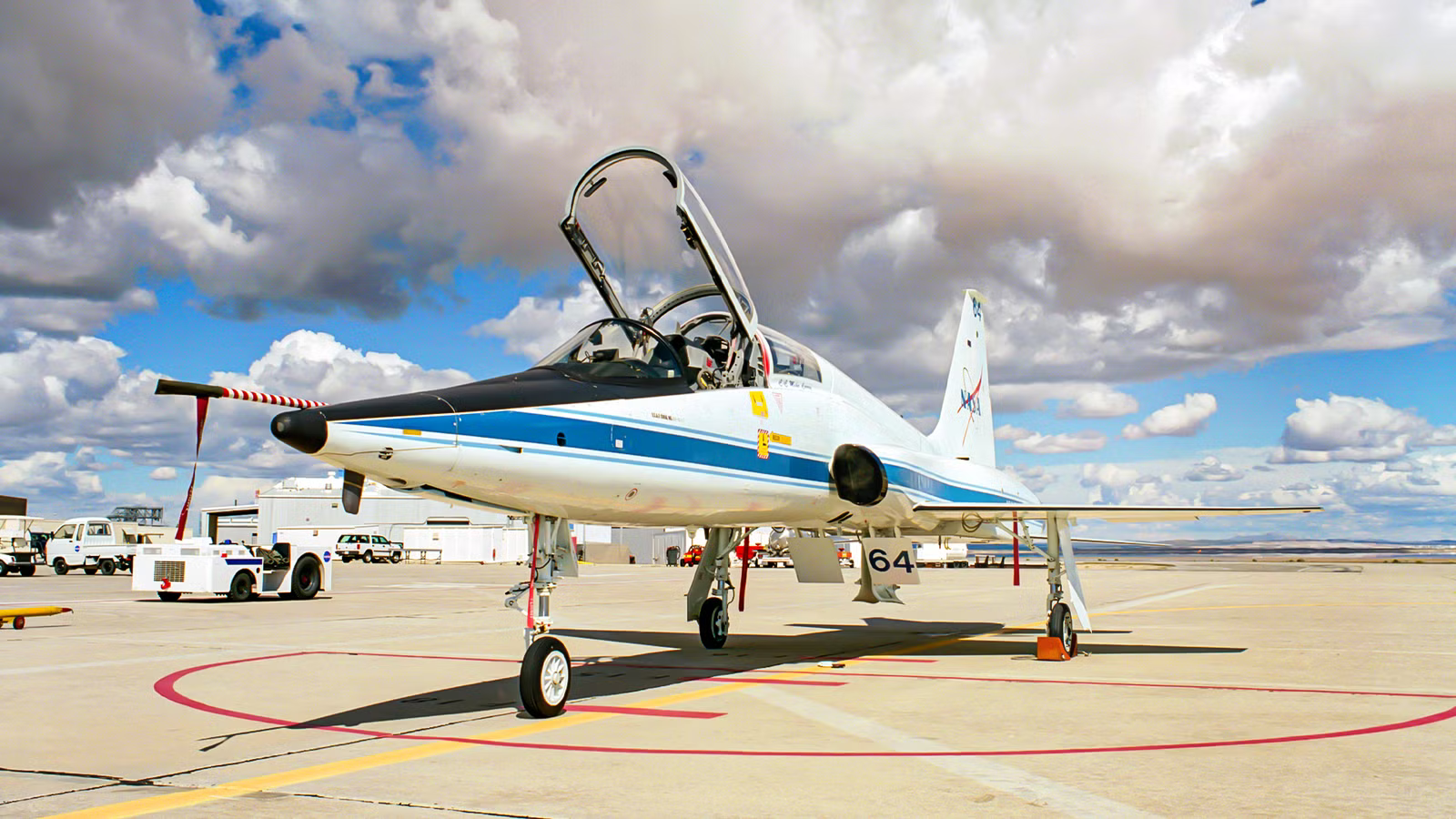
The Northrop T-38N Talon has been a staple of NASA’s astronaut program since 1964. The fleet of 25 lightweight, supersonic jets fulfills numerous missions as a chase plane, training tool for spacecraft pilots, and flying testbed. Yet, the years are catching up to the venerable fighter as its support network teeters on the edge of final collapse. NASA has been pushed into the move by the US Air Force’s transition away from its own T-38s into the new  Boeing-Saab T-7A Red Hawk.
NASA has not had to seriously shop for a new astronaut trainer since Lyndon Johnson was president. That changed on August 27, when Johnson Space Center quietly posted a market-research notice asking the industry what a modern jet had, with a broad list of parameters. It is true that the T-7 has a strong case to win the NASA award, but it is also made for a different mission.
The Air Force is phasing out the T-38 not only because its airframes and engines are simply reaching the end of their serviceable lives, but also because it is no longer a suitable training platform for fifth-generation fighter jets. The opposite is true for NASA, as the complexity of the ‘stick and rudder skills’ required to operate the Talon is precisely what makes it valuable as an astronaut training platform. That begs the question of what kind of jet will replace such an iconic platform.
A Fleet Running Out Of Support

The T-38N is a NASA-specific variant, distinct from the Air Force’s T-38A/B/C models and the handful of T-38Cs flown by the US Naval Test Pilot School, but all of them trace back to a design that first entered Air Force service in 1961, three years before the Air Force bailed the first Talons to NASA for Gemini-era training. The replacement will be judged primarily based on how well it can succeed the T-38 in the mission of astronaut Spaceflight Readiness Training, or SFRT.
With the Air Force planning to retire its own T-38 fleet between 2030 and 2035 in favor of the T-7, sustaining a boutique fleet of NASA-only Talons becomes far more difficult. There is simply no way around the vacuum that will follow once the Air Force walks away from it entirely. The USAF’s larger fleet has driven parts availability, depot maintenance, and engineering support for the type for sixty years. That is also reflected in the notice’s caveat that it is not a fleet-buy solicitation.
NASA said it wants to run a limited-scope evaluation program using a small number of modern aircraft first. The agency intends to fly them within Johnson Space Center to test compatibility, logistics, cost, and training impact, before committing. That caution points to the divergence from the USAF requirements. Although the T-38 has been very successful in its service to NASA, the jet was essentially dumped on them, whereas now the agency has the opportunity to choose an airframe tailored to its current and future specifications.
Why A Trainer Needs To Break The Sound Barrier

Former shuttle pilot Terry Virts has said the T-38 amounted to the most important training astronauts did, precisely because it was real flying rather than a simulator. Cockpit errors have consequences a simulation cannot replicate. Canadian Space Agency astronaut Jeremy Hansen, who later flew Artemis II, made the same point at Ellington Field.
The jet’s value is that, unlike any simulator, it can genuinely kill you, and managing that real risk prepares a crew to manage the real risk of a spacecraft. The T-38 can reach an altitude of 30,000 feet (9,000 meters) and its top speed within a minute of takeoff, subjecting a two-person crew to forces exceeding 5 Gs, the same kind of rapid-onset load astronauts experience during ascent and reentry.
The T-38 is powered by two afterburning General Electric J85 turbojets and can reach roughly Mach 1.6 above 40,000 feet. That performance envelope is deliberately punishing, not incidental. The aircraft’s low lift-to-drag ratio has historically made it useful preparation for flying other planes that glide poorly by design.
The goal is not simply to modernize avionics, but to replace the Talon with another unforgiving, high-performance fighter that forces fast, high-stakes decision-making. The premier case in point is the Space Shuttle. The iconic orbiter’s glide ratio was so steep that pilots described it as flying like a rock. That is the design bar any successor has to clear.
T-7A: The Red Hawk Problem

The Air Force’s chosen T-38 successor, the Boeing-Saab T-7A Red Hawk, is the obvious candidate for NASA to piggyback on, and the JSC notice explicitly frames the Air Force’s move to the Red Hawk as the reason NASA’s own sustainment picture is deteriorating. But the program has been a case study in how not to deliver an airplane on schedule.
Air Education and Training Command’s Milestone C decision, clearing the way for low-rate initial production, was not approved until April 23, more than a year and a half later than originally planned, and it came bundled with a $219 million contract for just the first 14 aircraft, according to the Air Force’s own public affairs office.
A subsequent Government Accountability Office weapon-systems assessment found that the Air Force’s full-rate production decision, once targeted for January 2027, had slipped again to January 2029. GAO auditors attributed the delay to extra engineering analysis, shortages of maintenance personnel and spare parts limiting the number of flyable test jets, and software finalization that keeps running long.
No Option To Buy Even With NASA Approval

The Pentagon’s Office of the Director of Test and Evaluation found that the T-7A’s emergency escape system, Collins Aerospace ACES 5 ejection seats, did not meet minimum safety requirements in 2024. Similarly, environmental testing at the McKinley Climatic Laboratory also turned up problems serious enough to require a second round of testing. Those setbacks, along with earlier wing-rock and flight-control software issues, have cost Boeing roughly $1.8 billion in program losses on a fixed-price development contract.
Catch what other flight trackers miss
Emergency squawks, holds, NOTAMs — live signals, no signup.
Open tracker
Catch what other flight trackers miss
Emergency squawks, holds, NOTAMs — live signals, no signup.
Open tracker
The GAO also warned that because production and testing now overlap for years, a practice it terms concurrency, any problem discovered in flight tests through 2028 could leave the Air Force owning a ramp of jets requiring retrofit. Those are bad omens for a plane meant to eventually replace some 476 Air Force T-38Cs in a program of record worth about $28 million per tail.
So, with the Air Force’s own initial operational capability target now pushed from October 2025 to August 2027, and full-rate production years away, NASA joining the T-7A program in the near term looks close to impossible. That is precisely why Johnson Space Center’s notice plainly opens the field to alternative planemakers by explicitly freeing industry responses from restrictions on any specific aircraft design or heritage.

Money, not just hardware, is the other half of the equation. From a financial and logistical standpoint, NASA’s decision to keep the T-38 for six decades is a masterclass in aggressive cost-saving. NASA is a space agency with a notoriously tight budget, and developing or buying a dedicated fleet of custom jets would have cost billions. By keeping the T-38, NASA let the US Air Force bear almost all the financial weight of keeping the aircraft alive.
The JSC notice asked industry specifically about lease, lease-to-own, and barter arrangements. The terms derived from what it called limited upfront procurement funding. That funding posture echoes how NASA acquired its original Talons in the 1960s. It also raises the possibility NASA could again strike a new inter-agency arrangement, potentially with a different military branch altogether. That follows the long-running program doctrine of keeping costs as low as possible, which is why the T-38 has been retained for seven decades.
NASA has continued to fly the T-38 for more than 60 years because it is a highly effective, cost-efficient tool for spaceflight training. With just 25 to 32 T-38s, if NASA had been the only agency flying them, custom manufacturing parts for such a small fleet would have been overwhelmingly expensive. Still, NASA didn’t leave the planes stuck in the 1960s. Over the years, they modified their custom fleet with modern glass cockpits and engine upgrades to keep them safe and capable.
A Training Pipeline That Cannot Wait

The NASA calendar is only getting busier as the initiative to replace the T-38 kicks off. Artemis II carried NASA astronauts Reid Wiseman, Victor Glover, and Christina Koch, along with Canadian astronaut Jeremy Hansen, around the Moon and back after launching April 1. They were the first crewed lunar mission in more than five decades.
Artemis III is slated for 2027 as a low-Earth-orbit test of the human landing system. Artemis IV is currently scheduled for 2028. According to Inverse, the mission is set to return astronauts to the lunar surface for the first time since Apollo 17 in 1972.
Every crew needs SFRT proficiency in the interim, and nothing in NASA’s public timeline suggests demand will taper off as landing missions resume. If anything, a growing pool of active flight-eligible astronauts training for moon missions argues for more T-38 flying hours, not fewer.