dailynewsnblog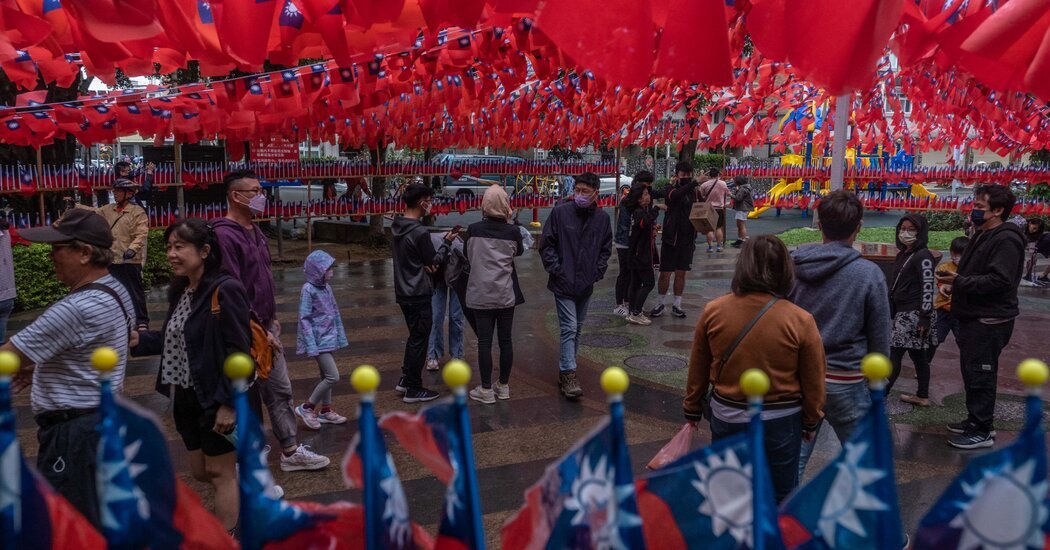
When President Trump meets his Chinese counterpart, Xi Jinping, Taiwan is almost certainly going to come up. And few issues in diplomacy are more complicated than the status of the self-governing island that China claims as its own.
Ahead of the summit, White House officials rejected speculation that Mr. Trump could set U.S. policy on Taiwan on a new course during this trip. But even seemingly slight changes in wording can count, especially if they are uttered by an American president in Beijing.
Will Mr. Trump, with his improvisational style, say he opposes Taiwanese independence, or something similar?
After 1949, the Nationalist Party that formerly ruled China retreated to Taiwan from the advancing Communist Party forces. In the 1970s, President Richard M. Nixon began establishing ties with Mao Zedong’s government in Beijing, and in early 1979 Washington broke off diplomatic ties with Taiwan and shifted recognition to Beijing.
Taiwan’s status in U.S. policy has since rested on nuanced formulae. The United States continues to give political and military support to the island democracy, but does not treat it as a full-fledged country. For example, the U.S. office in Taipei may look like an embassy, but is instead called the American Institute in Taiwan.
As part of this arrangement, American presidents have long said they “do not support” Taiwanese independence. Taiwan is not seeking to declare formal independence but those words were developed to reassure Beijing.
Mr. Trump may repeat them, or — some Chinese policy advisers hope — he might say that he “opposes” independence for Taiwan. “Oppose” may not sound very different from “not support,” but in Taiwan policy, the nuance matters.
“If you say that the United States opposes Taiwan independence, it puts all the onus on Taiwan really as being the responsible party in this conflict, which is not the case,” Nicholas Burns, the U.S. ambassador to Beijing under President Joseph R. Biden Jr., said in an interview with Foreign Affairs. Such a shift in words, he said, “would send shock waves, obviously through the Taiwan leadership, but also to our close allies in the region.”
Officials in Beijing also like to declare, or suggest, that foreign leaders support the “one China principle” — that is, the view that Taiwan is a part of China, and the Communist Party-led government in Beijing is the sole legitimate authority over that one country.
But the United States upholds a “one China policy” — not principle. That, too, is an important distinction. Under that policy, Washington acknowledges China’s claim on Taiwan, but does not endorse the claim, leaving the status of the island undetermined.