dailynewsnblog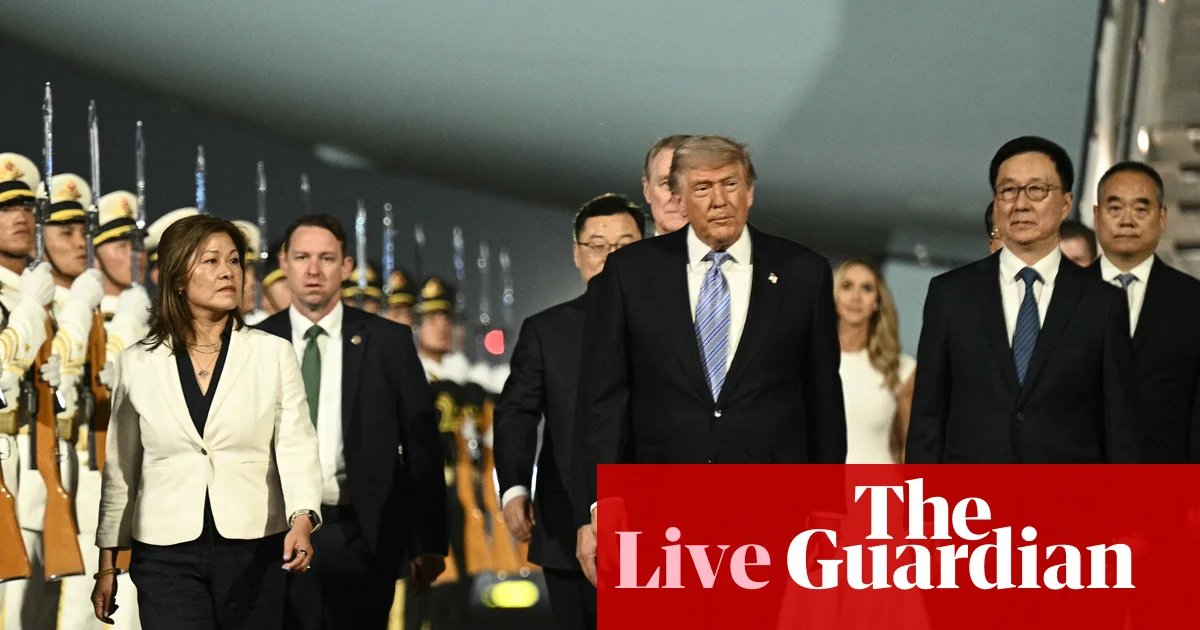
Key events

David Smith
Greetings from Beijing, where I awoke to CNN coverage of Chinese social media mocking Donald Trump and America as a fading superpower.
CNN noted that China’s tough internet censors had evidently allowed these comments to appear. But then my TV suddenly “lost signal”, which felt suspicious, though the coverage soon resumed.
Outside a lift on the 10th floor of the press hotel I bumped into Jacqui Heinrich, senior White House correspondent of the conservative Fox News channel. She had travelled with Trump on the long Air Force One flight but noted that, unusually, he did not come to the press cabin to “gaggle” with reporters.
Perhaps he was having too much fun with Elon Musk? Or maybe White House chief of staff Susie Wiles had intervened to make sure he didn’t make flip comment about Taiwan?
Here are some pictures of Donald Trump’s welcome in China after touching down aboard Air Force One at Beijing capital international airport on Wednesday night.
The president is also travelling with a large contingent of business leaders that reportedly includes:
Elon Musk, Tesla CEO and Space X CTO
Jensen Huang, Nvidia CEO
Tim Cook, Apple CEO
Kelly Ortberg, Boeing CEO
Dina Powell McCormick, Meta president and vice chairman
Larry Fink, Blackrock chairman and CEO
Other banking, finance and tech executives
So who else travelled with Trump on Air Force One to China? According to a partial list provided by the White House: US secretary of state Marco Rubio, defence secretary Pete Hegseth and senior adviser Stephen Miller.
Also onboard were Eric and Lara Trump, plus an array of White House advisers, strategists, speech writers and communications executives.
One of Trump’s pressing concerns as he visits Beijing is how to find a way to reopen the strait of Hormuz, through which half of China’s crude oil passes.
China has been more insulated from the energy shock than other Asian countries, thanks to its diversified energy mix and large stockpiles. But the risk of a global recession – which the International Monetary Fund has warned is a possible outcome of the Iran war – is a bigger threat to China’s economy.
About a fifth of China’s GDP comes from exports. If the rest of the world is no longer able to spend money on goods, China will suffer.
There’s speculation Trump could use the summit to seek Beijing’s help to end the war with China-allied Iran. But the US president told reporters before departing the White House on Tuesday:
I don’t think we need any help with Iran. We’ll win it one way or the other – peacefully or otherwise.”
Trump also sought to play down divisions with Beijing, saying Xi had been “relatively good” during the crisis.
The Guardian’s senior China correspondent, Amy Hawkins, has examined the biggest questions hanging over the Trump-Xi talks, which begin later today.
The Trump-Xi summit will span two days. It was originally scheduled for late March or early April but was delayed due to the Iran war.
Now that Trump is in China, here are some of the hazards the US president faces.
Welcome
Donald Trump’s state visit to China this week is the first by a US president in nearly a decade and comes amid a time of geopolitical upheaval, a Middle East war with no end in sight and a sometimes rocky relationship between the world’s two major superpowers.
Aside from discussions about Iran, Trump and Chinese leader Xi Jinping are expected to discuss trade and tariffs, Taiwan and AI.
Stay with us as we cover this high-stakes visit. It’s approaching 8.10am in Beijing.