dailynewsnblog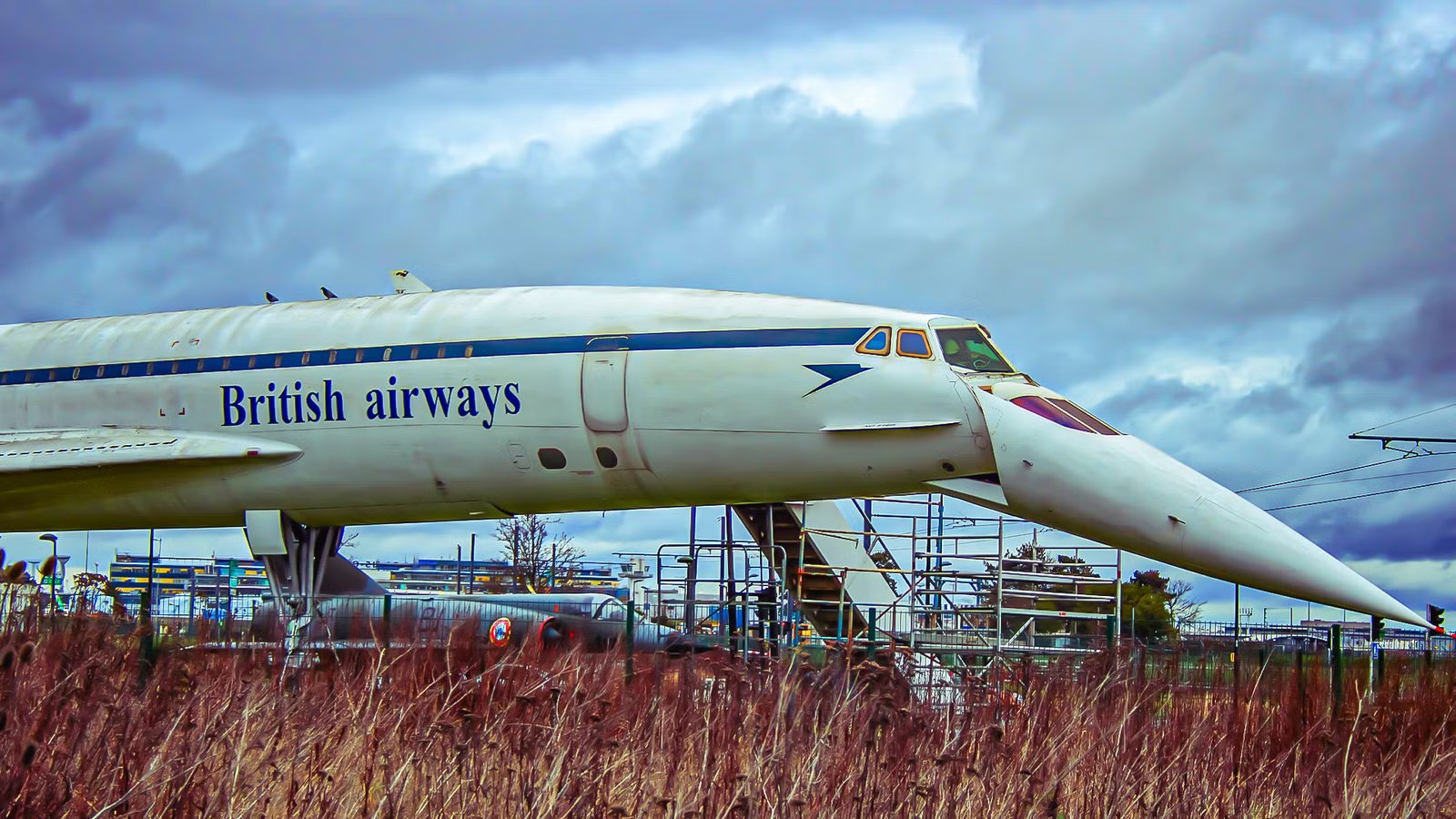
The iconic profile of Concorde tilting its slender nose downward during final approach remains one of the most enduring symbols of twentieth-century aviation triumph. Yet, as a new generation of aerospace firms works to revive commercial supersonic travel, that famous articulating silhouette is noticeably absent from modern blueprints. What was once celebrated as a brilliant stroke of Anglo-French engineering is now viewed by contemporary aircraft designers as an unnecessary mechanical liability. This guide examines the aerodynamic necessity that drove the creation of Concorde’s drooping nose, the severe weight and maintenance penalties it imposed on operators, and why modern technology ensures that a moving nose assembly will never fly on a commercial jetliner again.
High-speed efficiency demands a long, pointed nose cone to pierce supersonic shockwaves cleanly, but this geometry creates a critical visibility hazard during the slow-speed phases of flight. When landing, a delta-wing aircraft must pitch upward at an extreme angle of attack to generate sufficient lift, completely obscuring the runway from the cockpit’s forward windows.
All In The Wing Profile

The root of the visibility crisis that plagued Concorde lies entirely in the unique aerodynamic profile of the slender delta wing. Unlike conventional swept wings found on standard commercial airliners, a delta wing does not utilize traditional trailing-edge flaps or leading-edge slats to generate extra lift at lower speeds. Instead, it relies on a fluid-dynamics phenomenon known as vortex lift, which requires the aircraft to maintain an incredibly high nose-up attitude during takeoff and final approach. As a result, a fixed supersonic nose cone would completely block the flight crew’s view of the runway during the most critical phases of low-speed flight.
To solve this geometric obstacle without compromising supersonic efficiency, engineers at Marshall of Cambridge developed an articulating nose assembly hinged directly to the forward pressure bulkhead. This system allowed the entire nose and its protective thermal visor to alter its physical geometry depending on the specific phase of flight. The nose operated in four distinct configurations: fully up with the visor raised during high-speed cruise and parking; visor down with the nose up for ground pushback; visor down with the nose lowered to five degrees for taxiing, takeoff, and the initial climb; and finally, visor down with the nose dropped to its maximum deflection of 12.5 degrees during final approach.
This mechanical adaptability was highly praised during the early era of supersonic testing, yet it represented a massive structural compromise. The design required cutting a significant structural break into the forward fuselage, demanding heavy reinforcement around the hinge points to withstand the immense aerodynamic forces encountered at Mach 2.02. Furthermore, the steep 12.5-degree drop position altered the aerodynamic handling characteristics of the aircraft at low speeds, introducing pitching moments that flight crews had to actively counteract. Marshall of Cambridge successfully proved that a mechanical nose could be the middle ground between supersonic streamline efficiency and low-speed visibility, but they also inadvertently demonstrated the extreme weight and engineering penalties that would eventually discourage future aerospace designers from ever replicating the concept.
Catch what other flight trackers miss
Emergency squawks, holds, NOTAMs — live signals, no signup.
Open tracker
Catch what other flight trackers miss
Emergency squawks, holds, NOTAMs — live signals, no signup.
Open tracker
High Speeds Will Always Wear The Aircraft Down

Operating Concorde’s articulating nose required a heavy, high-pressure hydromechanical network that added massive structural weight to the aircraft. The system relied on specialized selector valves, mechanical uplocks, and dedicated hydraulic actuators pressurized to 3,000 psi (206.8 bar). Primary operations utilized the main green hydraulic circuit, while a secondary yellow circuit remained continuously on standby to guarantee deployment.
The system also managed a heavy, heat-resistant glass visor designed to shield the cockpit windshield panels from extreme kinetic friction. At cruise speeds of Mach 2.02, atmospheric friction drove nose temperatures above 260°F (127°C), necessitating an intricate electrical de-icing and structural cooling framework. If both high-pressure hydraulic lines suffered a total failure, pilots had to engage a manual emergency free-fall mechanism that allowed gravity to drop the nose and visor into place.
It led to an intricate web of moving parts, which created intense line-maintenance overhead and frequent component fatigue issues for early operators. Every flight cycle subjected the moving seals, high-pressure hoses, and locking hooks to severe thermal shock and structural vibration, leading to fluid leaks and extended inspection times. In today’s world, where airlines are always prioritizing quick gate turnarounds, this level of mechanical vulnerability is completely unacceptable.
The Industry Moved On Already

Modern aerospace certification frameworks make the inclusion of a movable nose assembly virtually impossible for contemporary aircraft developers. Regulatory bodies enforce strict survivability and structural integrity mandates that heavily penalize complex, articulating load-bearing components. Introducing a major structural break at the front of a jet creates a primary fatigue point that requires extensive, cost-prohibitive testing to pass modern bird-strike and fuselage pressurization failure requirements.
The sheer weight penalty of twentieth-century mechanical solutions directly undermines the economic viability of modern supersonic flight. Every pound of hydraulic plumbing, heavy actuator brackets, and redundant locking systems reduces the payload capacity or fuel range of the aircraft. By eliminating these moving parts entirely, engineers can optimize the aerodynamic profile of the forward fuselage while trimming over 2,000 pounds (907 kilograms) from the structure, and crucially, putting more paying passengers inside.
The focus on simplicity reflects a broader trend across the aviation industry toward reducing line-maintenance overhead, moving to outsourcing options. Airlines demand aircraft that can maintain high daily utilization rates with minimal time spent in the hangar. A complex hydromechanical nose would introduce dozens of potential failure modes, driving up scheduled inspection frequencies and risking costly dispatch delays that modern commercial carriers simply cannot tolerate.
The Current State Of Supersonic Travel

Leaving behind those heavy hydromechanical components has found its ultimate replacement in the field of high-definition optoelectronics. Instead of altering the physical structure of the airframe to achieve runway visibility, modern designers are completely bypassing the mechanical weight of a moving nose by relying on an array of external sensors, which allows modern supersonic aircraft to maintain a fixed, perfectly optimized aerodynamic profile throughout all phases of flight.
Boom Supersonic’s XB-1 demonstrator and forthcoming Overture airliner showcase this electronic evolution by replacing the movable nose assembly entirely with a flight vision system. Engineers are integrating nose-mounted cameras that stream real-time, high-resolution footage directly into augmented reality displays worn by the flight crew. Integrating this technology allows pilots to look through the solid composite nose structure during high-angle-of-attack approaches, providing an uncompromised field of view without structural penalties.
Substituting heavy hydraulic plumbing with lightweight data cables, Boom trims significant weight from the forward fuselage while also eliminating a primary mechanical failure point. The flight deck transforms from a traditional window-dependent cockpit into an augmented reality workspace where synthetic vision overlays critical flight telemetry onto real-world terrain. In short, there is no need for the technology of the past, as new solutions are completely viable.
No Windshield At All?

Achieving supersonic speeds is something that has always been tested in the aerospace industry, with a variety of different designs and concepts, very different from that of the original Concorde design. NASA’s experimental X-59 quiet supersonic research aircraft, for example, eliminates the front windshield entirely to maintain a continuous, drag-reducing nose cone. It is most definitely a radical design choice that isolates the flight crew from direct forward visibility, leading engineers to pioneer an alternative system that satisfies strict regulatory safety standards.
To compensate for the total removal of external visibility, NASA developed the eXternal Visibility System, an integrated setup featuring a forward-facing 4K camera paired with an ultra-high-definition display screen. The screen sits directly in front of the pilots, serving as a virtual windshield that replicates human visual acuity with exceptional clarity. The system works by combining live camera feeds with advanced terrain databases to ensure that the flight crew retains complete situational awareness during low-speed, high-pitch approaches.
By proving that an optoelectronic windshield meets strict see-and-avoid requirements, the X-59 establishes a vital legal and technical precedent for future commercial supersonic designs. It demonstrates that a solid, windowless composite structure is structurally superior and aerodynamically cleaner than any articulating alternative. Of course, it remains to be seen whether this will become widespread adoption, but if it does, then it closes the book on mechanical droop noses. It would bring in a future where glass and cameras permanently replace heavy hydraulics.
The Legacy Lives On

The ultimate decision to abandon articulating nose assemblies rests on the cold calculations of airline operating economics and fleet maintenance schedules. Major commercial carriers have already placed conditional pre-orders for modern supersonic airliners, and their business models leave zero room for temperamental mechanical subsystems. In a highly competitive global market, the success of a supersonic fleet depends on maximizing daily utilization rates and minimizing turnaround times at the gate.
Eliminating a complex hydromechanical nose removes a significant line-maintenance liability, allowing airlines to avoid the frequent inspections and component overhauls that burdened Concorde operations. A digital vision system can be continually monitored via software diagnostics, turning a potentially costly mechanical delay into a routine sensor calibration or component swap. Crucially, the structural predictability translates directly into lower insurance premiums, predictable maintenance costs, and stable dispatch reliability.
The aviation industry is edging ever closer to the commercial deployment of these advanced jets, and so, the legacy of Concorde’s drooping nose is still seen as an extraordinary milestone of physical engineering. However, the future belongs to the invisible efficiency of optoelectronics and synthetic flight decks. Trading heavy hydraulics for digital clarity, the next generation of supersonic aircraft will conquer the visibility challenges of high-speed flight while protecting the tight economic margins that keep modern airlines profitable.