dailynewsnblog
The headline figure attached to CFM International’s RISE program is easy to understand; more than 20% lower fuel burn than today’s best narrowbody engines would represent one of the largest efficiency improvements seen in commercial aviation for decades. In an industry facing mounting pressure to cut emissions without sacrificing growth, that number alone explains why airlines, manufacturers, and regulators are paying close attention to the project.
However, the real challenge facing CFM International is whether modern technology can finally overcome the problems that doomed the last major attempt at open-rotor propulsion in the 1980s. The General Electric GE36 demonstrator proved that dramatic efficiency gains were possible.
However, noise concerns, certification difficulties, and public acceptance issues ultimately prevented the concept from entering airline service. Four decades later, the RISE program is attempting to answer the same questions with vastly more advanced tools, materials, and testing methods.
The Efficiency Argument For Open-Fan Propulsion

The attraction of open-fan technology has always been rooted in physics. Modern turbofan engines have become remarkably efficient by increasing bypass ratio, which measures the amount of air flowing around the engine core compared with the air passing through it. Larger bypass ratios generally produce better fuel efficiency because they accelerate a larger volume of air by a smaller amount.
Today’s most advanced narrowbody engines operate with bypass ratios around 15:1. The RISE architecture is targeting a bypass ratio approaching 60:1, a figure that would have been almost unimaginable for a conventional ducted turbofan. By removing the surrounding nacelle and allowing a much larger fan diameter without the weight penalties associated with an enormous engine casing, CFM believes it can unlock efficiency improvements exceeding 20%.
That promise explains why the engine manufacturer continues to invest heavily in the technology despite the engineering risks. The RISE program is not currently a certified production engine but rather a technology demonstrator intended to validate concepts that could power a new generation of aircraft in the second half of the 2030s.
The effort also includes compatibility with 100% Sustainable Aviation Fuel and potential hybrid-electric assistance, making it part of a broader strategy aimed at reducing aviation’s environmental footprint. Full-scale ground testing is scheduled for early 2027, while flight testing aboard an Airbus A380 test aircraft is planned for 2029. These milestones are intended to determine whether open-fan propulsion can move from an intriguing concept to a commercially viable reality.
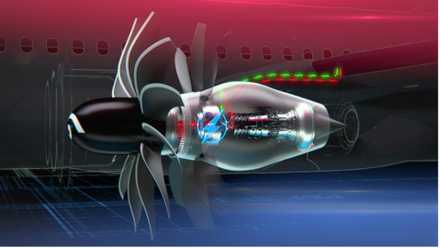
The Open Fan Revolution: Why Airbus Is Stripping The Cowling Off
The open-fan revolution takes flight, but will it overcome safety and perception hurdles?
The Ghost Of The General Electric E36

The challenge is that aviation has already traveled down this road once before. During the 1980s, General Electric’s GE36 unducted fan program generated enormous excitement, and like today’s open-fan concepts, it promised significant fuel savings at a time when airlines were highly sensitive to operating costs. Technically, the program achieved many of its goals: demonstrator aircraft flew successfully, and engineers proved that open-rotor propulsion could deliver impressive efficiency advantages.
However, performance alone was not enough, and the engine generated noise levels that were difficult to reconcile with increasingly strict airport regulations and community expectations. While fuel savings attracted airlines, the acoustic signature created concerns that were harder to dismiss. The timing also worked against the concept, as fuel prices softened compared with the levels that had driven earlier interest, reducing the urgency of adopting a radical new engine architecture.
At the same time, conventional turbofan technology continued improving, narrowing the efficiency gap while avoiding many of the operational and certification complications associated with exposed rotor systems. As a result, the General Electric GE36 became one of aviation’s most famous technological dead ends. The lesson was clear – efficiency advantages alone would never guarantee success if passengers, airport communities, regulators, and airlines viewed the noise and safety trade-offs as unacceptable.
Why Noise Remains The Central Battle

For all the discussion surrounding fuel efficiency, today’s engineers appear acutely aware that acoustics may determine the fate of the entire open-fan concept. Safran, one of CFM’s parent companies, has repeatedly emphasized that acoustics sits at the center of current development work. The challenge is fundamentally difficult because an open fan lacks many of the noise-mitigation benefits provided by a turbofan nacelle.
The duct surrounding a conventional fan does more than guide airflow: it also helps contain and manage sound. Removing that structure delivers efficiency gains, but it also exposes rotating blades directly to the surrounding environment. As a result, much of the current RISE testing effort focuses on understanding how aerodynamic performance and acoustic performance interact.
Engineers have already accumulated more than 400 hours of wind-tunnel testing using scale demonstrators, examining installed engine configurations, and validating sophisticated numerical simulations. These campaigns are intended to ensure that future open-fan designs can satisfy stringent community noise requirements while preserving their efficiency advantage.
The aviation industry already knows that open rotors can save fuel. However, what remains uncertain is whether they can do so quietly enough to earn public acceptance in an era when airport noise remains one of the most politically sensitive issues facing aviation.
Why Might The World’s Largest Aircraft Engine Have Boeing Worried?
Boeing and others are taking note as Rolls-Royce works with Airbus to develop the next-generation long-range jet engine.
Supercomputers, Composites & Forty Years Of Progress

The strongest argument in favor of RISE succeeding where the General Electric GE36 failed is that today’s engineers possess tools their predecessors could only dream about. Modern computer capabilities allow designers to analyze airflow, vibration, structural loads, and noise generation with extraordinary precision before engines are ever built.
GE Aerospace has highlighted the use of advanced computing resources, including some of the world’s most powerful supercomputers, to optimize blade shapes for both aerodynamic efficiency and acoustic performance. Instead of relying primarily on physical testing and iterative redesigns, engineers can evaluate countless design variations in virtual environments and identify promising solutions much earlier in the development process.
Materials technology has advanced just as dramatically. Safran’s latest composite blade designs stretch beyond 5.2 feet in length while benefiting from decades of experience gained through composite fan-blade production on modern commercial engines. Recent testing campaigns have included extensive ingestion, endurance, aerodynamic, and acoustic evaluations aimed at validating both performance and durability.
More than 175 large-scale blade tests have already been completed as engineers refine the architecture. The result is an open-fan design that looks superficially similar to concepts explored in the 1980s but is fundamentally different in terms of analytical sophistication. The question is whether these advances are sufficient to overcome challenges that proved insurmountable four decades ago.
Safety & Containment Remain Difficult Questions

Noise is not the only ghost haunting open-fan development, and the absence of a surrounding nacelle also creates difficult certification questions regarding blade containment and failure scenarios. In a conventional geared turbofan, the engine casing is designed to contain a failed fan blade, preventing high-energy debris from escaping the engine. Open-fan architectures remove that protective structure.
As a result, engineers must demonstrate through design, testing, and analysis that blade failures remain extraordinarily unlikely and that any potential consequences can be managed safely. Competitor engine manufacturers have been quick to point out these challenges, and both Pratt & Whitney and Rolls-Royce have publicly questioned whether open-fan configurations can overcome the aerodynamic integration and safety hurdles associated with exposed rotating hardware.
Beyond containment concerns, there are also questions regarding wake interaction with advanced wing designs and the impact of large rotating blades on future aircraft configurations. Still, CFM International clearly believes these issues are solvable.
Indeed, the manufacturer has completed hundreds of tests across multiple technology areas, involving more than 2,000 engineers and numerous research partners. Nevertheless, certification authorities will demand evidence rather than optimism, and every efficiency benefit offered by the architecture must ultimately be balanced against the industry’s uncompromising safety requirements.

Why Some Carriers Are Stripping Perfectly Good Airbus A321neos For Parts
The Pratt & Whitney GTF engine crisis has created a bizarre market reality: airlines are paying to have perfectly good aircraft dismantled.
Singapore May Provide The Ultimate Test

Perhaps the most revealing aspect of the RISE program is that it extends beyond laboratories, wind tunnels, and flight-test aircraft. Airbus, CFM, and partners in Singapore are developing what is described as the world’s first airport testbed dedicated to evaluating next-generation propulsion technologies, including open-fan concepts. This initiative recognizes an important reality that even if engineers solve the technical challenges, the engine must still function successfully in the real world.
Ground crews must also be able to work safely around it, maintenance procedures must prove practical, and airports must understand how noise propagates across actual operating environments rather than controlled test facilities. Most importantly, nearby communities must be willing to accept the technology. The General Electric GE36’s experience demonstrated that technical success alone does not guarantee commercial adoption.
Airlines operate within a complex ecosystem that includes regulators, airport operators, local residents, and passengers. If any one of those groups views the technology as problematic, widespread adoption becomes far more difficult. The Singapore testbed, therefore, represents more than another engineering milestone.
Rather, it is an attempt to answer the broader question that has lingered since the 1980s. Specifically, can an open-fan engine deliver transformational efficiency improvements while remaining quiet, safe, practical, and acceptable to the people who will ultimately live and work around it? Until that question is answered, the acoustic and containment ghosts of the General Electric GE36 will continue to hover over every ambitious promise attached to the RISE program.