dailynewsnblog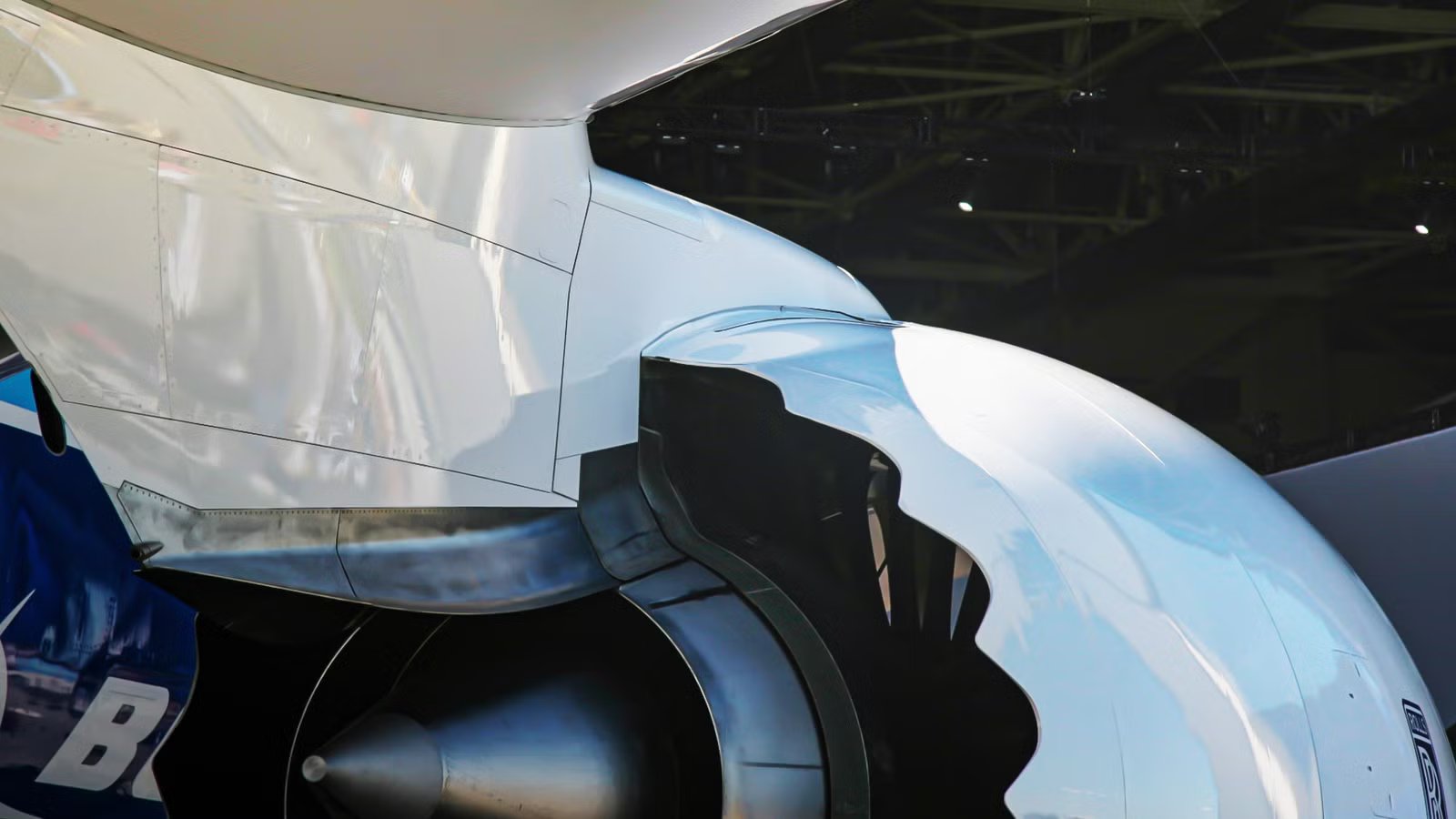
Not all next-generation technologies are enduring. Some are more transitional in character. For years, NASA worked on sawtooth edges on aero engines to reduce noise. Boeing took this technology and developed it for its cleansheet Boeing 787. Some of the technology used to develop the Dreamliner was also used to update the Boeing 747 (747-8), Boeing 737 (MAX), and Boeing 777 (777X).
The Boeing 747-8 uses a variant of the Dreamliner’s GEnx and was a key reason why Boeing was able to affordably upgrade the Boeing 747-400. Even though the upcoming 777X uses a large amount of Dreamliner innovations (e.g., increased composite materials, dimming windows), it has moved past the Boeing 787’s engine chevrons. Here is why Boeing is already moving on from chevrons, why Airbus simply skipped them, and why they are not likely to return.
NASA Developed The Chevrons

As with a large amount of aerospace technology, chevrons were tested and developed by NASA. In 2025, NASA published an article entitled “NASA’s Chevron Technology Quiets the Skies.” NASA started flight testing these experimental jagged-edged nozzle engines in 2001 with a modified Learjet 25. It describes the innovation as “groundbreaking” and an important step toward lowering noise levels for communities.
This built on accumulated knowledge NASA had from the military sector. It writes, “NASA researchers discovered that the military’s use of rectangular notches, or tabs, along an engine nozzle’s exit – to help disguise a jet fighter’s infrared signature – could also reduce engine noise by helping mix the hot air from the engine core and the cooler air blowing through the engine fan.”
In the 1990s, a NASA researcher called Dennis Huff found that serrated or sawtooth shapes offered promise in reducing noise. NASA contracted General Electric and Pratt & Whitney to develop various chevron designs for NASA to experiment with. NASA records that its early tests found: “the chevron nozzle had a negligible 0.25% reduction of thrust. It was a major development for jet noise research.” It describes the noise decrease as analogous to the difference between running two lawnmowers and one.
Pre-777X Conventional Wisdom On Chevrons

Eight years ago, popular aviation YouTube channel host Petter Hörnfeldt uploaded a video entitled Keeping MAX quiet – Chevrons onto his channel, Mentour Pilot. In the video, he explained why Boeing had chosen to put chevrons on the engines of its Boeing 737 MAX, Boeing 747-8, and Boeing 787. He said, “They further reduce the noise of the engine by controlling the vortexes that are being created from both the engine exhausts, but also the bypass air.” He explained chevrons create very small vortices themselves that help create a boundary layer that can reduce takeoff noise by up to six decibels.
This is enough to have a big impact on noise regulations around some airports and flight paths in some cities. Making the engines quieter also allows for some of the insulation to be removed from the aircraft. The insulation is reasonably heavy, and it allows the aircraft to lose a small amount of its weight and so reduce its drag by a very small margin. This can make up for the loss of thrust caused by the chevrons.
He explained that chevrons come with some disadvantages. While they may look more aerodynamic, they are not; instead, they are less aerodynamic. They have the effect of reducing the thrust of the engine by a small amount, with some estimates putting the number at around 0.5% of the thrust lost. By creating mini-vortices, they take away some energy from the thing, creating the main vortex.
The Boeing 777X Lacks Chevrons

Petter Hörnfeldt ended the video implying that the chevrons represented an advancement for Boeing aircraft. A takeaway is that they are net-beneficial, and they would be expected to appear on subsequent aircraft. However, Airbus did not include them on its new aircraft (e.g., the A330neo), and in 2019 Boeing rolled out its Boeing 777X without them.
Early renders of the Boeing 777X often featured chevrons, and it was thought that they represented a new standard in commercial passenger engines. It is also noteworthy that Airbus’ A320neo and A350 were built without them. This suggests that Airbus may have never agreed with Boeing that they were worth the trade-off. The same goes for the A220 (Bombardier CSeries), Embraer E-Jet, Russian MC-21, and COMAC C919.
Boeing was alone with the chevrons, and it appears it is abandoning them with the 777X. While GE Aerospace does not publicly provide an explanation for why it dropped the chevrons, it is plausible that the new extra-high bypass engines are quiet enough to meet current and future noise regulations and that the GE9X engines will have a better fuel burn without them. Notably, there have been improvements to fan blade aerodynamics, allowing composite fans to have lower tip speeds.
Turning To Other Techniques

Chevrons were always primarily a way to reduce noise, while having the added benefit of reducing some weight from surplus insulation. But that is a goal that can be solved in more than one way. Rolls-Royce and Pratt & Whitney elected to pursue different noise-reduction strategies that would provide a similar result with fewer penalties.
These companies chose to rely on improved acoustic liners inside the nacelle, redesigned fan blades, better outlet guide vanes, a smoother exhaust flow, optimized fan pressure ratios, and nacelle shaping. For GE Aerospace, it appears it judged the chevrons unnecessary partially due to the GE9X’s enormous 134-inch fan and high 10:1 bypass ratio.
Select modern aircraft | Entered service date (per Airbus, Boeing) | Chevron on engines (yes/no) |
|---|---|---|
Boeing 787 Dreamliner | 2011 | Yes |
Boeing 747-8 | 2011 | Yes |
Airbus A350 | 2015 | No |
Airbus A320neo | 2016 | No |
Boeing 737 MAX | 2017 | Yes |
Airbus A330neo | 2018 | No |
Boeing 777X | 2027 (planned) | No |
The engine has improved mixer geometry, more effective acoustic liners, and a lower exhaust velocity. This reduced the attractiveness of the chevrons. Besides the drag penalty, they also come with slight penalties in increased manufacturing complexity, more weight, and a little more maintenance. While it’s beyond the scope of this article to go into depth, it’s worth stating that the geared Rolls-Royce turbines that dominate Airbus widebody aircraft likely always had less need for chevrons.
Towards High Bypass & Open Fan Engines

One way of characterizing the different design philosophies is that the Dreamliner added chevrons to reduce mixing noise, while aircraft since then have sought to reduce noise by finding ways to mitigate mixing noise to begin with. Chevrons are an external way to help reduce noise, while subsequent engines have a better understanding of turbulence. Improvements throughout the engine reduce noise and replace the need for an external serrated solution.
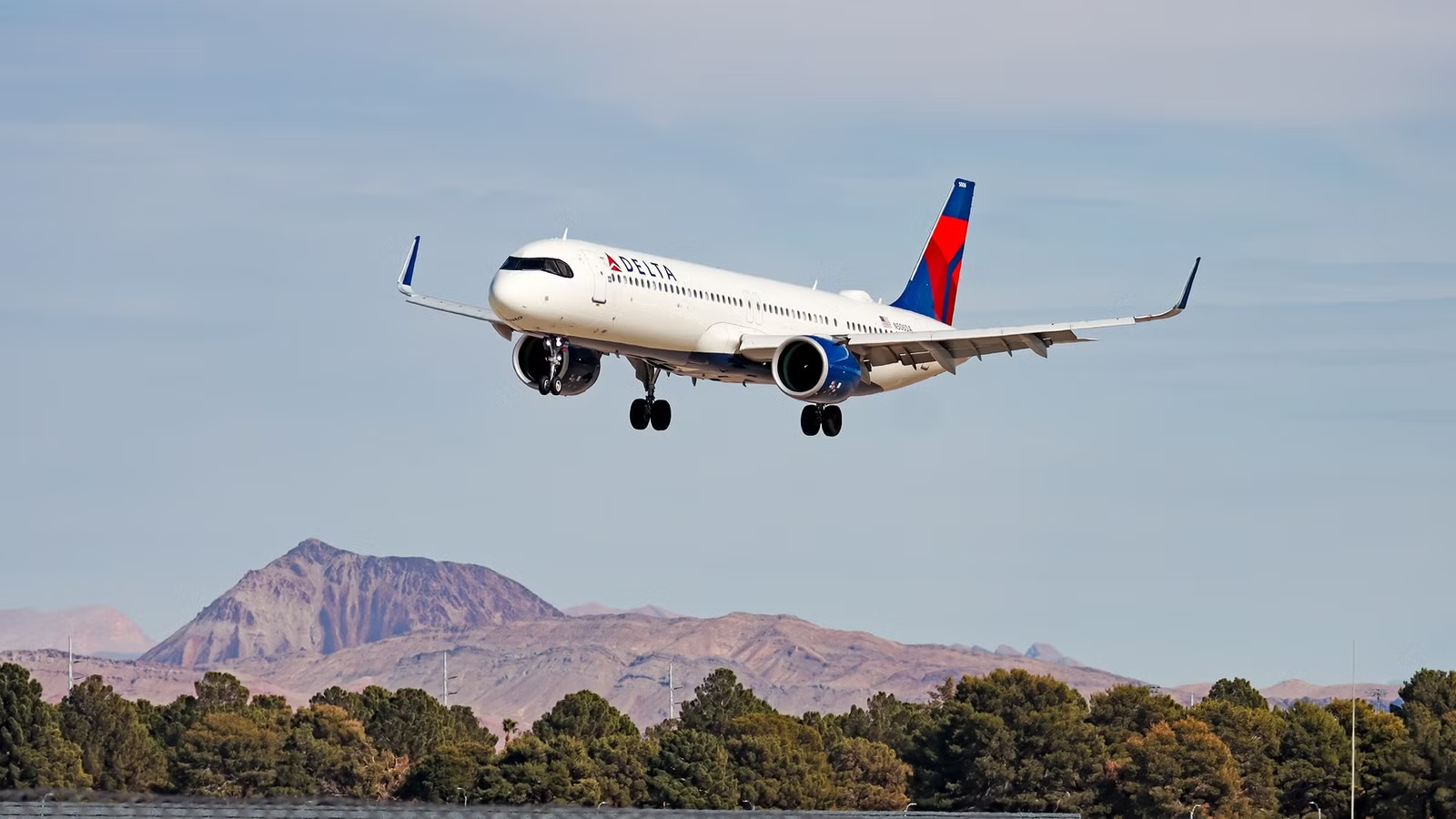
One reason why Boeing’s LEAP-1B still has chevrons is that it shares key design concepts and core architecture technologies directly with the GEnx that powers the Boeing 787. The Boeing 747-8 is also powered by a variant of the GEnx turbofan. Currently, it doesn’t look like chevrons are coming back. While the massive GE9X may be large enough to make them impractical, this leaves open questions for next-generation narrowbody aircraft.
But here CFM International (Safran and GE Aerospace) is working on a revolutionary new open fan design called RISE. In July 2026, CFM stated, “Mechanical and material tests are underway on Open Fan blades and Outlet Guide Vanes (OGVs), including impact, ingestion, fatigue, endurance, load, icing and vibration response.” This engine will need to find a new solution to solving the noise issues. GE Aerospace simply and vaguely says, “Targeting lower noise levels with Open Fan compared to current engines due to simpler design optimized with supercomputing.”

Engine chevrons can be conceptualized as an intermediate technology that provided an improvement in exhaust engine noise in the period around 2000 to 2015. Given the benefit of hindsight, chevrons are a bit like winglets in their early years, but in reverse. Winglets became more attractive due to their aerodynamic benefits despite their weight and other penalties. But future engineering was not to be as kind to chevrons.
As technology improved, the underlying problem they were built to solve was able to be solved in more efficient ways within the engine and nacelle design itself, and so they went out of vogue. Rolls-Royce’s massive UltraFan demonstrator is working to find ways to reduce noise. Rolls-Royce says, “Through the development of next-generation geared ducted engine solutions, UltraFan technologies create immediate pathways to superior fuel efficiency and durability, reduced noise and lower emissions.”
It’s worth noting that Rolls-Royce’s engine uses a reduction gearbox between the low-pressure turbine and fan, allowing the fan to rotate much more slowly and the turbine to rotate much faster. The demonstrator is targeting an extremely high bypass ratio of 15:1 or higher, reducing noise. The company is also heavily investing in advanced acoustic liners. Together with other acoustic innovations, Rolls-Royce has previously said it wants to reduce perceived noise by 35%.