dailynewsnblog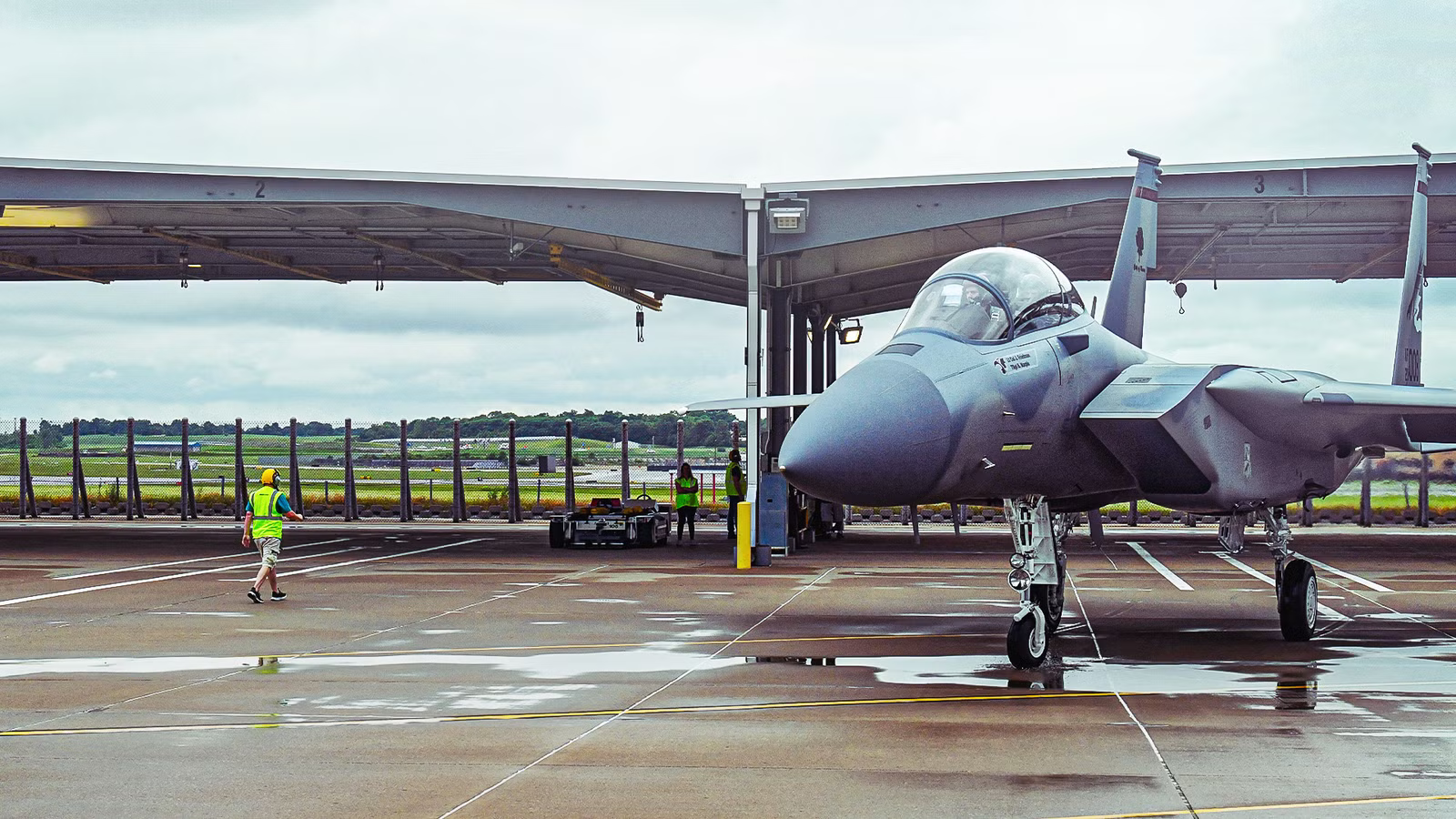
The strike began on August 4, 2025, when roughly 3,200 members of the International Association of Machinists and Aerospace Workers District 837 rejected a  Boeing contract offer. The skilled technicians are responsible for fighter and munitions production in St. Louis and St. Charles, Missouri, and Mascoutah, Illinois, as Breaking Defense reported. It became the longest labor stoppage in Boeing’s St. Louis history, running through five rejected proposals and a sixth vote before workers ratified a deal on November 13. The approved five-year contract carried a general wage increase, plus a ratification bonus, though it dropped the union’s demands for a 401(k) match.
Workers returned to the floor beginning a couple of days later, according to Alert 5. Boeing declared the strike formally the next day. The dispute directly hit F-15EX Eagle II and F/A-18 Super Hornet Block III production lines, each of which posted several billion in third-quarter 2025 revenue even as the strike dragged on. Still, the walkout had already pushed US Air Force F-15EX deliveries off schedule. Yet, in just three weeks, the Eagle II production line went from idle to full-rate output.
Despite the 105-day machinists’ strike shutting down the company’s fighter plants, the 142nd Wing at Portland Air National Guard Base received its eighth Eagle II. Tail number 21-0015 was delivered nine days after the walkout ended, on November 26, 2025, according to the Aviationist. The question the rapid strike recovery raises is not about labor. Rather, it is why factory-fresh fighters are improvising to reach full capability after Boeing hands over the keys.
The Production Line’s Rapid Restart

Two aircraft actually reached Portland during the strike itself. EX14 reached in August, which was just 15 days after the walkout kicked off, and EX15 on November 16, a day before it ended. Each was most certainly an airframe that was already deep into final assembly when the machinists walked out. The real test came after. Aircraft EX16 arrived less than three weeks after the strike’s conclusion, a pace the USAF’s F-15 System Program Office attributed to close coordination between Boeing, the Air Force Life Cycle Management Center and the Defense Contract Management Agency through the shutdown.
Boeing framed the November delivery of EX15, the 142’s eighth aircraft, the same way, calling it a product of close collaboration between production, test, logistics, and the Oregon Air National Guard. The 142 received its first F-15EX in June 2024 as the type’s first operational unit. Boeing has stated it expects St. Louis production to accelerate into this year as it catches up to fulfill the 18-jet total order.
That growth is the clearest marker of where the F-15EX program stands as it exits the strike: expanding in scale before it has finished expanding in capability. The FY27 budget request already covers 24 more F-15EX aircraft worth $2.66 billion. Production now runs through Fiscal Year 2031, and Boeing has stated its goal of reaching two-aircraft-per-month output at St. Louis by 2026, a rate the post-strike recovery suggests the plant can plausibly hit.
The 142nd Wing’s ninth Eagle II, arriving weeks after a three-and-a-half-month strike, is a genuine logistics achievement. Whether the jets landing at Portland, and eventually at Selfridge and wherever else the expanding program sends them, are actually equipped for the missions the Air Force says it bought them for is a question the delivery court alone can’t answer.
The Cost Debate The Strike Recovery Doesn’t Settle

That argument over the cost-to-value of the Eagle II is strong on both sides of the debate over the USAF’s modernization plan. Observers like the Heritage Foundation have pointed out that the F-15EX unit costs $90-97 million depending on the lot, which exceeds what the Air Force pays for 5th-generation Lockheed Martin F-35 joint strike fighters. In recent production lots, the stealth fighters are priced at roughly $82.5 million.
As the ‘missile truck’ on the low end of the new high-low fleet, the jet’s performance and payload exceed the F-35. Another key value is the minimal infrastructure and training costs associated with transitioning from legacy F-15s to F-15EXs. The F-35 comes with heavy baggage in this area, while squadrons can make the switch to an Eagle in weeks with virtually zero changes to support facilities.
Thus, the USAF’s defense primarily rests on service life and economics. For starters, the Eagle II is rated for roughly 20,000 flight hours against an F-35A’s roughly 8,000, and a 2024 report found the Eagle II operationally effective in all its air superiority roles, including defensive and offensive counter-air against surrogate 5th-generation adversary aircraft. The USAF has cited the result to rebut claims the jet can’t compete with modern adversaries in standoff in aerial combat.
The Director of Operational Testing and Evaluation did, however, flag gaps in the jet’s Eagle Passive/Active Warning and Survivability System (EPAWSS) against realistic threat representations, meaning the ‘holds its own’ verdict technically rests on incomplete test data. Still, the program of record has grown from a low of 80 jets to 129 since mid-2025, driven in part by President Trump’s decision to re-equip Michigan’s Selfridge Air National Guard base with an Eagle II squadron rather than F-35 Lightning IIs.
Why Range Is The Key Metric For The Homeland-Defense Fleet

Refocusing on the strategic value of the Eagle II and why a Cold War-era airframe is continuing to roll off the line in 2026 helps clarify the decision-making happening in the Pentagon. The 142nd Wing’s mission is airspace control and air sovereignty alert for US Northern Command, a role that leans on interceptor speed and endurance more than stealth.
Catch what other flight trackers miss
Emergency squawks, holds, NOTAMs — live signals, no signup.
Open tracker
Catch what other flight trackers miss
Emergency squawks, holds, NOTAMs — live signals, no signup.
Open tracker
The F-15EX is a twin-engine, 4.5-generation derivative of the F-15QA built for Qatar, powered by two General Electric F110-GE-129 engines and rated for Mach 2.5 with a ceiling near 60,000 feet. Its defining feature is payload. It can haul 29,500 pounds across roughly two dozen hard points depending on ordnance, including more air-to-air missiles than any other aircraft in the US inventory.
Meanwhile, today, more than 75% of the F-15C/D fleet the EX is meant to replace is now flight-restricted for speed or G-loading because of structural fatigue, and the service has already had to extend a “Platinum Eagle” subset of roughly 80 C/Ds through 2030 to bridge the gap while EX deliveries catch up.
Conformal fuel tanks are supposed to be part of the Eagle II package, as The War Zone highlighted. Those are mounted flush against the fuselage rather than slung underwing to add roughly 9,000 pounds of fuel. Additionally, on the F-15 airframe, CFTs add two additional weapons stations without the drag penalty of external tanks. Yet, as far back as 2023, those CFTs do not appear to have been funded for any of the 54 aircraft in production lots one through four.
That represents nearly half the program’s planned buy at the time. The Pentagon’s own test-and-evaluation office warned in a January 2023 report that the absence of CFTs would curb the jet’s secondary ground-attack role and reduce range on a platform whose extended legs had been a central selling point for years.
Borrowed Tanks And A Budget Reversal

Two sources told The War Zone in 2023 that the two Air Force F-15EX test jets flying with CFTs at Eglin Air Force Base were using tanks that already existed in Air National Guard inventory, effectively repurposed hardware, not tanks procured under the F-15EX program, while the USAF separately confirmed the CFTs “weren’t funded” for the production lots then in the pipeline.
Within two months of the DOT&E report surfacing the gap, the USAF reversed course and began seeking funding to buy CFTs starting in the Fiscal Year 2024 budget. That reversal has since manifested into real expenses. The ANG’s FY26 unfunded priorities list requested $417 million for 54 sets of CFTs specifically to increase combat range, as Breaking Defense covered. A capability required for Indo-Pacific operations where squadrons frequently deploy.
In response, Congress’s FY26 reconciliation package ultimately included $910 million within the F-15EX’s $3.1 billion account to exercise a CFT-buy option alongside Lot 7 and Lot 8 procurement. Air & Space Forces Magazine reports FY26 funding now covers 22 CFT-equipped jets, meaning the fix is real and moving.
Pivot To The Pacific: The Air National Guard And Agile Combat Employment

Perhaps the best argument for selecting the Eagle II instead of the Lightning II for many ANG squadrons is the cost-effective acceleration of the USAF pivot to the Pacific. It creates a high-capacity weapon truck that bridges the gap between short-range stealth fighters and long-range bombers. Armed with CFTs and massive payload capabilities, the F-15EX transforms how the Joint Force will fight across the vast distances of the first and second island chains against the People’s Republic of China.
The F-15EX serves as a vital firepower complement to 5th-generation stealth assets like the F-35, F-22 Raptor, and the Northrop Grumman B-21 Raider. Equipped with CFTs, the jet’s range far exceeds its predecessor, while its upgraded arsenal includes outsized hypersonic weapons that cannot fit inside internal stealth jet bays.
The Eagle II is also exceptionally well-suited to defending island clusters thanks to its extended loiter time, which makes it possible to keep combat air patrols longer to defend expanded maritime infrastructure. This facilitates a kind of ‘sniper and shotgun’ tactical model where Stealth fighters fly ahead undetected to find targets for the F-15EX, which lobs standoff missiles from over the horizon.
Enabling ACE relies on dispersing aircraft away from large, centralized bases like Kadena or Andersen AFB into a network of smaller locations across the Pacific to complicate PRC targeting. The F-15EX’s CFTs directly empower this through reduced dependence on vulnerable aerial refueling tankers over the First and Second Island Chains. While tried and true, reliability alongside existing ANG maintenance infrastructure allows rapid deployment to virtually any Pacific airfield with a long enough runway.