dailynewsnblog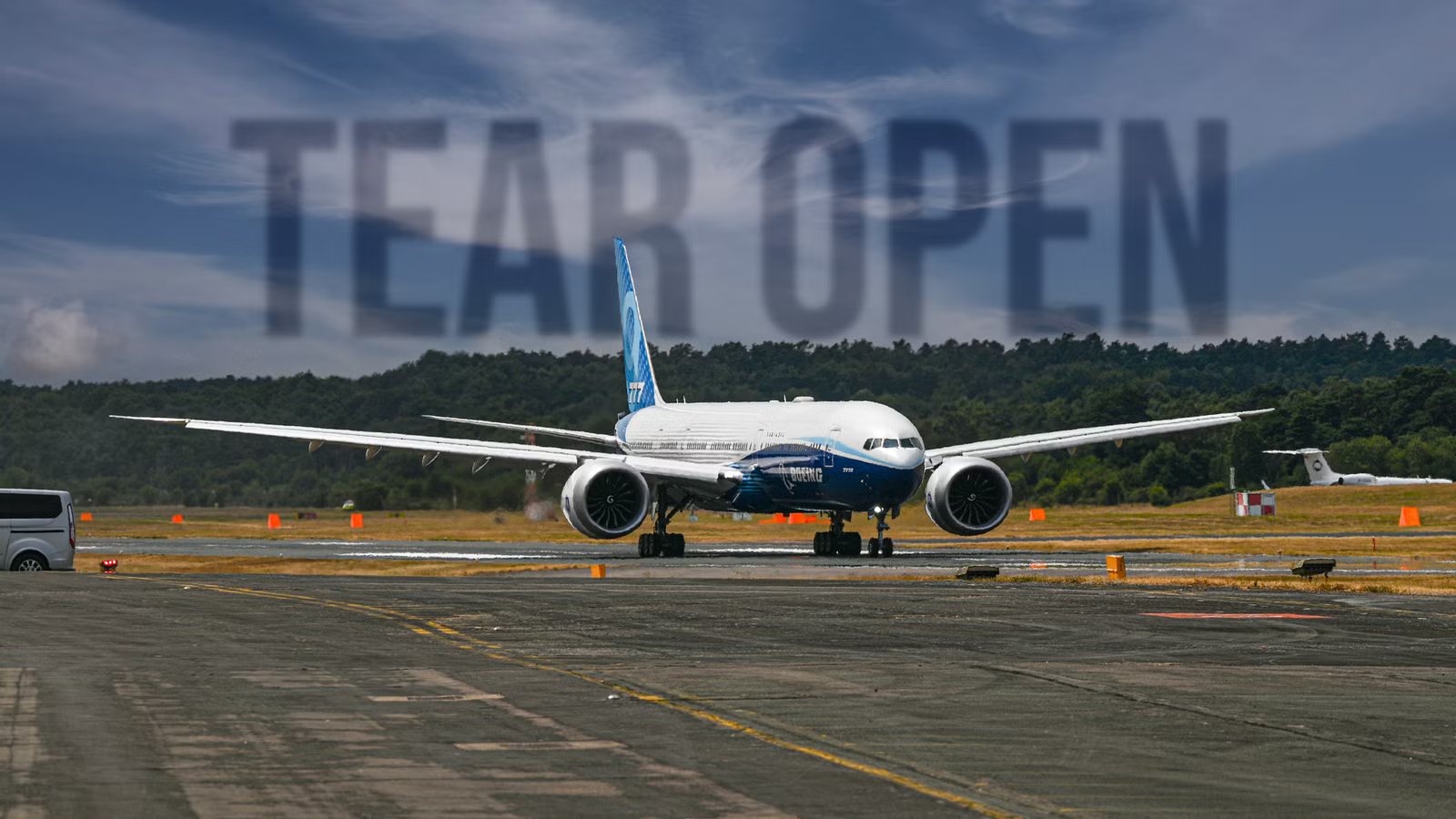
Recently, the CEO of Boeing disclosed that some completed Boeing 777X aircraft sitting in storage will require a ‘change incorporation’ process before they can be delivered to airlines. The rework stems from design changes identified during the prolonged certification flight test program: older airframes require the most extensive modifications, including structural changes, while newer builds require only minor software and systems updates.
 Boeing has assembled a dedicated team for what Ortberg called a ‘pretty massive activity,’ planning to bring all stored aircraft to a common configuration before applying final changes over several years. With first Boeing 777-9 deliveries still targeted for 2027 and the certification program now in TIA phase 4a, the disclosure raises serious questions about the true cost of Boeing’s build-and-store strategy for airlines like
  Emirates and
  Lufthansa.
This article explores, in more detail, why Boeing must tear open these 30 finished 777X jets before they can fly.
Already Built Aircraft Awaiting Major Modifications

The Boeing 777X program was launched in 2013 as a natural evolution of the successful 777 family, promising enhanced fuel efficiency, an updated wing design, and new, larger engines. The objective was to offer Boeing a competitive advantage in the highly competitive long-haul twin-aisle market dominated by Airbus’s successful A350, while providing airlines with greater capacity and efficiency. Therefore, the 777X features, among others, GE9X engines and innovative folding wingtips. It comprises two main variants: the 777-9 (426 seats) and the 777-8 (395 seats).
However, the 777X has been in production for quite some time now, earning the title of one of the most delayed aircraft in aviation history. As of early 2026, it remains in flight testing, with deliveries now expected to begin in 2027 following multiple delays. The issues with this aircraft continue to mount. During Boeing’s Q1 2026 earnings call on April 23, CEO Kelly Ortberg delivered another setback: approximately 30 already-built 777X aircraft will require a “change incorporation” process before they can be delivered.
Ortberg explained that the rework represents a significant effort, essentially involving updating early-production planes with the latest design changes to ensure they meet current certification standards. These aircraft, built years ago during the early stages of production, now sit in storage awaiting extensive modifications before they can ever enter service.
Years Of Design Evolution During Flight Tests

The rework is necessary to update aircraft that were built years ago with design changes introduced during the prolonged flight-testing and certification phases. Boeing continued producing 777X aircraft while the design was still evolving through testing and regulatory review. One of the primary reasons for building the Boeing 777X well ahead of its entry into service is to support the aircraft’s certification process. The US manufacturer requires multiple aircraft for flight testing, certification activities, and validation of the manufacturing process. As a result, several aircraft that had already been completed were never intended for immediate delivery to airlines; instead, they were designated for testing and development. However, building such a large number of airframes ahead of certification approval is quite unusual.
Boeing also chose to continue production in order to keep the 777X assembly line active and stable, as shutting down and restarting a widebody production line is extremely expensive. In addition, halting production because of certification delays could create workforce, supply-chain, and quality-control disruptions that would be even more difficult to recover from later.
However, this strategy has proven particularly costly because the approximately 30 completed aircraft represent a substantial amount of capital already invested in production. These aircraft occupy valuable storage space at Seattle Paine Field International Airport, consume additional resources, and cannot generate revenue until the required rework is completed. While the full scope of the modifications has not been publicly disclosed in detail, some assumptions can still be made based on the available information.
The Scope Of Modifications

The scope of work depends on the age of the airframe. Boeing CEO Kelly Ortberg stated that older aircraft would require “more structural-related changes,” while newer builds would need fewer modifications. This indicates that the earliest production frames were built before many certification-driven design updates had been finalized.
The older the airframe, the more outdated it is compared to the latest design, requiring more extensive changes that take longer and cost more. Industry analysts generally believe the rework effort could involve opening completed fuselage and wing sections, replacing or reinforcing structural components, updating software and avionics, modifying engine attachment hardware, retrofitting certification changes, and bringing early-build aircraft up to the final delivery standard. This explains why Boeing has described the program internally as a “massive activity” extending over several years.
Catch what other flight trackers miss
Emergency squawks, holds, NOTAMs — live signals, no signup.
Open tracker
Catch what other flight trackers miss
Emergency squawks, holds, NOTAMs — live signals, no signup.
Open tracker
Newly Established Dedicated Team

Boeing CEO Kelly Ortberg announced that the company has created a dedicated team to manage the 777X rework program. The goal is to bring all stored aircraft to a common configuration standard before applying the final certification and delivery modifications. This approach is intended to improve efficiency and simplify the process. The decision is especially significant given Boeing’s recent workforce challenges and criticism of its engineering capacity.
After the 737 MAX groundings and subsequent quality crises, Boeing announced plans in late 2024 to reduce about 10% of its global workforce. The layoffs affected hundreds of engineers and technicians, despite earlier promises to protect engineering roles.
These cuts likely created additional staffing pressures, even as the 777X program was already facing major technical challenges. Boeing appears to have underestimated the time and engineering effort needed to design and certify the fiber-reinforced polymer composite (FRPC) wing. The company also lost valuable engineering time while attempting to introduce a less labor-intensive fuselage manufacturing process. As a result, Boeing struggles to manage the complexity of the 777X development program.
Against this backdrop, the creation of a dedicated reworking team shows that Boeing recognizes the scale of the challenge. It also highlights the manufacturer’s dedication to delivering the 777X to airlines by the end of 2027.
Certification Finally Progressing

Despite ongoing program delays and the need to rework approximately 30 aircraft, Boeing achieved a significant certification milestone in March 2026 when the FAA authorized the company to begin Phase 4A of the Type Inspection Authorization (TIA) process for the 777-9. This approval allows FAA personnel to conduct formal onboard evaluations as part of the aircraft’s type certification program.
Phase 4A primarily focuses on natural icing tests that assess the aircraft’s performance and system functionality under real-world environmental conditions. These tests are intended to verify that the aircraft operates as designed and that critical systems and safety features function correctly in icing environments. Testing is currently believed to be taking place in Alaska due to its suitable climatic conditions.
TIA Phase 4 is divided into two sections, 4A and 4B, which together represent a testing workload broadly comparable to that of the earlier Phase 3 certification campaign that began in November 2025. Boeing is currently awaiting FAA approval to begin Phase 4B testing as part of the overall five-phase TIA certification process. The remaining phases, outlined in the table below, are expected to take place over the coming months.
Phase | Main Purpose | Status |
|---|---|---|
Phase 1 | Initial aircraft conformity | Completed |
Phase 2A–2D | Detailed system-by-system testing | Completed |
Phase 3 | Major flight certification testing | Largely completed |
Phase 4A | Real-world operational validation (e.g., icing) | Started |
Phase 4B | Real-world operational validation (e.g., failure scenarios) | Awaiting approval |
Phase 5 | Final approval checks | Not yet reached |
Phase 5 is expected to consist of a more limited series of certification tests and will subsequently be followed by Extended-range Twin-engine Operational Performance Standards (ETOPS) evaluations, together with Function and Reliability (F&R) testing. These stages require aircraft in a delivery-ready configuration and are intended to demonstrate operational reliability under near-commercial conditions. Assuming no major additional setbacks, Boeing is expected to have sufficient time to complete the remaining certification activities and secure final approval ahead of its targeted 2027 delivery schedule, as shown below.
When Will Airlines Actually Receive Their 777X?

Boeing has officially confirmed that the 777-9 is still on track for first delivery in 2027. In its first-quarter 2026 results, the manufacturer stated that the program “continued to make progress” on 777-9 certification and that it still “anticipates first delivery in 2027.”
Boeing is pushing for the quickest delivery possible as each delay magnifies the “cost of waiting” for airlines. Carriers like Emirates and Lufthansa must continue operating older, less efficient 777 and A380 fleets while postponing their transition to more sustainable, fuel-efficient operations. This disrupts route planning, cabin upgrade programs, and environmental targets. The first 777-8 freighter at the Everett factory was captured last month (April 2026), designated WG001, line 1844 for Cargolux, signaling tangible progress on the program.
However, it all traces back to the Boeing 737 MAX crashes in 2019 and 2020. That remains the hidden trigger for all the delays. Without those incidents and the subsequent regulatory scrutiny they triggered, this aircraft would likely be in service by now.