dailynewsnblog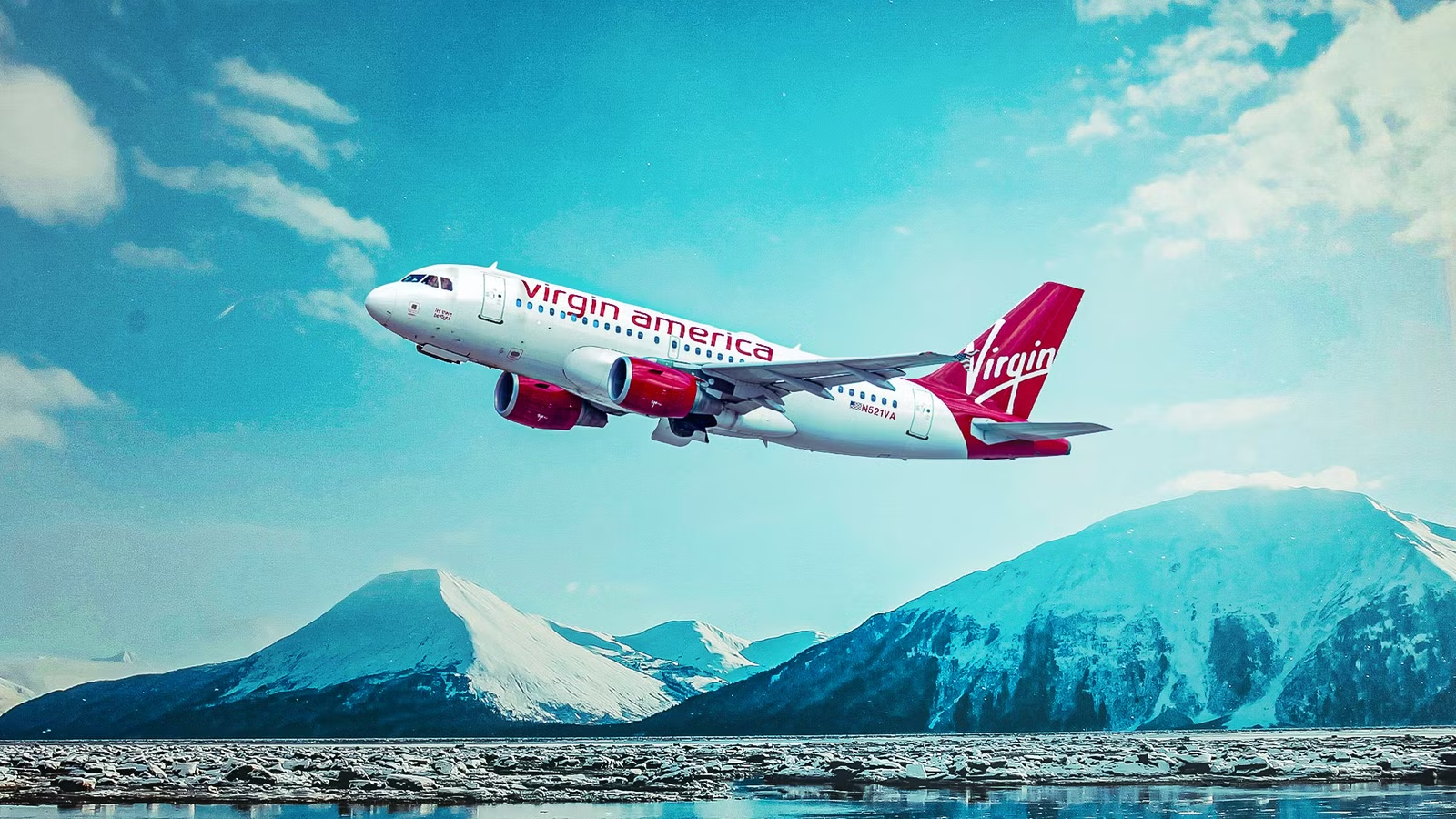
 Alaska Airlines has recently completed its acquisition of Hawaiian Airlines. While the two are now one entity and are operating on a single certificate, Alaska will maintain Hawaiian as a separate brand. Naturally, both names have ties to their geographic locations and hold strong local brand significance as a result. It’s an unusual decision since airline mergers/acquisitions usually result in only one of the names surviving, and Alaska Airlines had previously done just that with its 2016 acquisition of Virgin America.
But Alaska Airlines was even more tied to its main area of operations back in 2016 than it is today, and Virgin America was arguably the most beloved airline brand in the US at the time. Alaska promoted the acquisition with its special ‘More to Love’ livery, and yet, the famed Virgin America brand disappeared within two years of the acquisition. To this day, Alaska even pays royalties to the Virgin Group for the rights to the Virgin America name, regardless of whether it actually uses the brand.
The 2016 Acquisition Of Virgin America

Virgin America was a popular brand ever since it commenced operations in 2007, earning goodwill with passengers for its excellent in-flight service while being an early adopter of in-flight Wi-Fi, powerports, and seatback screens in the US. However, it struggled to compete against larger airlines and became a prime acquisition target. Alaska Airlines became an interested party early on, but Virgin America also popped onto JetBlue’s radar, which became the front-runner in the bid.
Virgin America was highly concentrated in California, while JetBlue’s network was concentrated on the US East Coast. What’s more, JetBlue is also known for being a low-cost carrier offering a premium experience, and both carriers primarily operated the Airbus A320 family (JetBlue also flew the Embraer E195 at the time). The two seemed like a natural fit, and the proposed merger/acquisition would have made JetBlue much more of a national threat to American, Delta, and United.
Instead, however, Alaska Airlines paid $2.6 billion in equity value for Virgin America while the transaction was valued at roughly $4 billion when including debt and aircraft leases. Alaska operated an all-Boeing 737 fleet, whereas Virgin America only flew the A320 family, and both carriers were heavily focused on the US West Coast. The acquisition ultimately didn’t change the status quo much, and not only did Alaska scale back operations at Virgin America’s hubs, but it also dumped all the A320 family aircraft.
Why Get Rid Of The Virgin America Name

Alaska’s purchase of Virgin America was mainly driven by a desire to expand on the West Coast and to stop JetBlue from winning the bid. Had JetBlue acquired Virgin America, this would have introduced significantly more competition to Alaska’s home turf. While Alaska and Virgin America didn’t necessarily compete from the same airports, they still competed for passenger traffic flows on the US West Coast, and JetBlue would have been a far stronger competitor than Virgin America.
Catch what other flight trackers miss
Emergency squawks, holds, NOTAMs — live signals, no signup.
Open tracker
Catch what other flight trackers miss
Emergency squawks, holds, NOTAMs — live signals, no signup.
Open tracker
The Virgin America brand was loved by customers and employees, but it ultimately didn’t hold much value to Alaska. The airline was focused on expanding its own operations and boosting its relevance to customers outside of the Pacific Northwest/Alaska. As such, the Virgin America name went away while the Alaska Airlines brand became much better known throughout the country, and Alaska was able to cut costs by streamlining its product offerings. Keeping the Virgin America name would have been expensive and would have weakened the Alaska Airlines brand.
Ironically, Alaska Airlines still pays royalties for the right to use the Virgin America brand name. Virgin America operated under an agreement that required it to pay the Virgin Group for the name, and Alaska stopped making payments after the acquisition, arguing that it should not pay for a brand name it no longer used. In 2023, however, the London High Court ordered Alaska to continue paying the Virgin Group until 2039, regardless of whether the name was used or not.
Alaska’s Strategy After The Acquisition

As previously discussed, Alaska’s acquisition of Virgin America did little to change the competitive landscape in the US. Before, Alaska Airlines was mainly focused on its hub in Seattle, while also running sizable operations in Portland and Alaska, while Virgin America’s primary hubs were in San Francisco and Los Angeles. However, Alaska found itself in largely the same situation as Virgin America, in that it’s a smaller carrier operating out of airports with stiff competition.
San Francisco is a fortress hub for  United Airlines, whereas Los Angeles is home to equally-sized operations by
  American Airlines,
  Delta Air Lines,
  Southwest Airlines, and United Airlines. Alaska lacked the scale and network to pose a true threat, especially considering that America/Delta/United operate long-haul flights and transcontinental flights with lie-flat premium seats. As such, Alaska has pulled back from these airports, instead further growing its network in the Pacific Northwest and also growing in San Diego, where it faces less competition.
Alaska inherited a fleet of 67 Airbus A320 family aircraft, consisting of ten A319-100s, 53 A320-200s, and four A321neos. Alaska would end up taking six more A321neos, while canceling inherited orders for the A320neo, and it ended up retiring the A319s during COVID, while the rest of the Airbuses went away in 2023 in favor of more 737s. As a whole, Alaska Airlines is largely the same airline that it was before taking over Virgin America regarding network and fleet, just larger.
The Differences With Hawaiian Airlines

When Alaska Airlines acquired Hawaiian Airlines in 2024, it may have seemed at first that the Hawaiian brand would face the same fate as Virgin America. After all, while the phase-out of the Virgin name was notable due to how recognizable and popular the brand was, it was standard practice in the industry. Hawaiian Airlines, however, is a unique case due to the local and historical significance of the carrier to the state of Hawaii. Virgin America was ultimately just another airline.
Alaska has firmly committed to keeping the Hawaiian name and will retain the airline’s livery on select aircraft. In essence, most flights to and from Hawaii will be branded as Hawaiian, while the rest will be branded as Alaska. The Airbus A321neos, A330-200s, and Boeing 717s will keep the Hawaiian livery, while some 737-800s will also be repainted into the Hawaiian livery when they replace the 717s. While the onboard service has been revised and all flights are using the ‘AS/ASA‘ code, the crew members are keeping the Hawaiian uniform.
Alaska Airlines Hubs | Hawaiian Airlines Hubs |
|---|---|
Ted Stevens Anchorage International Airport (ANC) | Daniel K. Inouye International Airport (HNL) |
Los Angeles International Airport (LAX) | Kahului Airport (OGG) |
Portland International Airport (PDX) | |
San Diego International Airport (SAN) | |
San Francisco International Airport (SFO) | |
Seattle-Tacoma International Airport (SEA) |
Some companies operate multiple airline brands (which is particularly visible in Europe with IAG, Air France-KLM, and Lufthansa Group), but the brands typically operate under separate certificates, whereas Alaska and Hawaiian are on one certificate. However, while the brands are distinct and separate, they have become more closely integrated. Alaska has launched a new frequent flyer program called ‘Atmos’ for both brands; the two use the same website, and Hawaiian is now a part of oneworld.
Alaska Airlines’ Strategy Today

Regarding Hawaiian Airlines, Alaska has mainly been focused on optimizing the network and operations rather than dramatically overhauling the carrier. The major developments have been the transfer of Hawaiian’s 787s to Alaska, along with the announcement that Alaska Airlines will refurbish the A330s with new interiors and premium economy. In addition, Alaska will replace the 717 fleet with older 737-800s, while the fate of the A321neo fleet is dependent on the economics of growing the fleet.
Once again, the group’s focus is on growing Alaska Airlines’ operations, and specifically, by expanding into long-haul flights. The benefit of acquiring Hawaiian wasn’t just the 787s, but also the fact that Hawaiian has an extensive long-haul operation that Alaska has now purchased. The carrier is expanding these operations to Seattle, having launched new routes to Tokyo, Seoul, London, and Rome (while also commencing 737 MAX flights to Iceland), with plans to serve at least 12 long-haul destinations from Seattle by 2030.
Destination | Launch Date |
|---|---|
Narita International Airport (NRT) (launched with Hawaiian-branded A330) | May 12, 2025 |
Incheon International Airport (ICN) (launched with Hawaiian-branded 787) | September 12, 2025 |
Rome Fiumicino Leonardo da Vinci International Airport (FCO) (first route launched with Alaska-branded 787) | April 28, 2026 |
London Heathrow Airport (LHR) | May 21, 2026 |
Keflavik International Airport (KEF) (launched with 737 MAX 8) | May 28, 2026 |
While it’s expensive to maintain two separate brands, Alaska and Hawaiian ultimately have very little route overlap. Alaska Air Group is pushing the Alaska Airlines name as being the global brand, but the Hawaiian name continues to serve its niche for traffic out of Hawaii. The two will continue to serve their own uses for the foreseeable future, and Alaska is investing in Hawaiian, but Alaska Airlines will receive the most focus as it focuses on growing Seattle into a worldwide hub.