dailynewsnblog
Several NATO allies in Europe are extending the service lives of or retiring frontline fighter jets without immediate replacements because next-generation programs are delayed and procurement decisions have stalled. Spain will keep roughly 60 F/A-18 Hornets flying until as late as 2035–2040, while its AV-8B Harriers are still expected to retire around 2030 with no STOVL successor confirmed. Belgium, meanwhile, plans to begin retiring its F-16s from 2026 even as F-35 deliveries lag behind schedule, thus creating a real, measurable capability gap across parts of Europe.
Based on recent fleet data from various news outlets and defense reporting, we will take a closer look at a broader structural problem affecting multiple NATO air forces. The core reason is simple: the Future Combat Air System (FCAS), Europe’s intended sixth-generation fighter, is now unlikely to enter service before the mid-2040s—leaving at least a decade-long gap where legacy aircraft must stretch far beyond their intended lifespan. European air forces operate alongside American assets in joint NATO missions and regularly integrate with platforms like the Lockheed Martin F-35 Lightning II. Any readiness gap in allied fleets directly affects coalition operations, burden-sharing, and interoperability with US forces.
We will discuss cases from the following countries: Spain, Belgium, Denmark, Greece, Portugal, and Eastern European NATO members—to explain exactly where these gaps are emerging, why they exist, and what they mean to NATO’s collective airpower in the coming years.
Spain — F/A-18 Hornets & AV-8B Harriers Flying Into Uncertainty

Spain’s evolving fighter strategy offers one of the clearest examples of how politics, industry, and military necessity can collide. Madrid has decisively ruled out the purchase of the F-35, choosing instead to invest in European-led programs such as the Eurofighter Typhoon and the long-term Future Combat Air System (FCAS). While this decision reinforces Spain’s commitment to European defense sovereignty, it also creates a complex and uncertain path forward for its current fleet.
In a parliamentary reply issued in February 2026, the Spanish government confirmed that its fleet of approximately 60 F/A-18 Hornets will remain in service far longer than originally planned — potentially until 2035 or even 2040, as per AeroTime. Extending the life of these aircraft is no simple task. As avionics systems age and spare parts become harder to source, maintenance costs are expected to rise sharply. Keeping the Hornet operational into the late 2030s will require continuous upgrades, structural reinforcements, and increasingly complex engineering work.
The Spanish Navy faces an even more acute dilemma. Its AV-8B Harrier II fleet, which is currently the only fixed-wing aviation component aboard the amphibious assault ship Juan Carlos I, is expected to retire around 2030. Unlike Italy, which acquired the F-35B — the only viable short takeoff and vertical landing (STOVL) replacement to its own aging fleet of carrier-based Harriers, Spain risks losing its carrier-based strike capability altogether. The decision to rule out the F-35B is rooted in a mix of political and industrial considerations, including tensions over defense spending expectations and a desire to prioritize domestic and European aerospace industries, as reported by Breaking Defense.
Spanish military leadership has not shied away from acknowledging the risks. Operating a fleet composed entirely of upgraded fourth-generation fighters for decades could leave Spain without stealth capabilities at a time when such features are becoming essential in modern warfare.
Belgium — F-16s Leaving Faster Than F-35s Arriving

Belgium’s experience highlights a different challenge—one driven less by political choice and more by industrial reality. The country committed to replacing its F-16 fleet with the F-35A, aligning itself with a broader NATO trend toward fifth-generation aircraft. However, delays in aircraft delivery have disrupted what was intended to be a smooth transition.
Despite a pledge to transfer 30 F-16s to Ukraine, Belgium has been unable to follow through. The reason is straightforward: it still needs those aircraft. With F-35 deliveries delayed, the Belgian Air Force must retain its aging fighters longer than planned, likely until 2029, to maintain operational readiness.
The situation is further complicated by the timing of pilot training and infrastructure readiness. Belgium’s first F-35 pilots completed their training in the United States in mid-2025, but the aircraft themselves are not yet fully operational within the country, according to Army Recognition. This creates an awkward transitional phase in which the outgoing fleet is being gradually retired while the incoming fleet has not yet reached full capability.
The result is a temporary but significant operational gap. Belgium, together with the Netherlands, remains responsible for air policing duties within the Benelux region on a rotational basis, but it must perform these tasks with a diminishing and aging fleet. It is a stark reminder that even well-planned modernization efforts can falter when timelines slip.
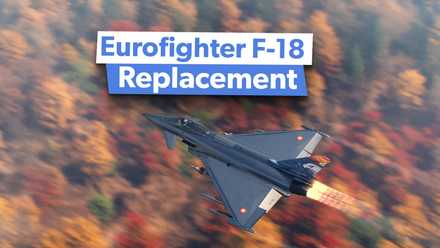
Why Spain Selected The Eurofighter To Replace Its F-18s
Spain has placed another order for domestically assembled Eurofighters while still leaving the F-35 question open.
Denmark — One Gap Already Closed, A Warning For Others

Denmark’s transition from the F-16 to the F-35 is often cited as a success story, but it also underscores how difficult such transitions can be. On January 18, 2026, Denmark officially retired its final F-16, completing a process that had been nearly a decade in the making.
The journey began years earlier, with Denmark committing to the F-35 program and receiving its first aircraft in 2023. Even then, the transition was far from immediate. Training pilots, building infrastructure, and integrating the aircraft into operational units all took time. For several years, Denmark operated in a hybrid state by relying on both its aging F-16s and its gradually expanding fleet of F-35s.
What makes Denmark’s experience particularly instructive is that even a carefully managed transition could not eliminate capability gaps entirely. There were periods when the country’s operational readiness depended on aircraft that were either nearing retirement or still being integrated.
Today, Denmark stands alongside Norway and the Netherlands as one of the few NATO members operating a fully fifth-generation fighter fleet. But for nations that are delaying procurement decisions or struggling with delivery timelines, the transition period may prove more challenging.
Greece And Portugal — Delayed By Design And Doubt

If Spain represents a politically driven decision and Belgium an industrial delay, Greece and Portugal illustrate a more complex mix of hesitation, timing, and strategic uncertainty. Both countries face the challenge of maintaining operational readiness while navigating uncertain procurement pathways.
Greece has taken steps toward modernization by ordering 20 F-35s, but deliveries are not expected until the end of the decade, likely between 2028 and 2029, according to Aerospace Global News. Until then, the Hellenic Air Force will continue to rely heavily on its upgraded F-16 fleet and the already delivered French-built Dassault Rafale. At the same time, Greece still operates the F-4 Phantom II, an aircraft whose origins date back to the Cold War. Its continued service since 1974 highlights the difficulty of retiring legacy platforms when replacements are delayed or insufficient in number.
The persistence of the Phantom is not simply a matter of nostalgia or conservatism, even though many aviation fans from around the world come to Greece to spot these rare planes at the local airshows. The Phantom’s long service reflects a pragmatic reality: in the absence of immediate alternatives, even aging aircraft can play a role in maintaining force structure. Retiring them prematurely could create gaps that newer aircraft, still years away, cannot fill.
Portugal, meanwhile, finds itself at a crossroads. Its air force has recommended the F-35 as a replacement for its F-16s, but political leaders have yet to commit. Concerns about reliance on the United States have played a significant role in this hesitation. Officials have raised the possibility that access to critical systems, such as software updates, spare parts, and maintenance support, could be restricted in times of political disagreement. Thus, like Canada, Portugal has been considering acquiring the Swedish-built JAS 39 Gripen instead.
This reflects a broader anxiety among smaller NATO members. As geopolitical dynamics shift, dependence on externally controlled systems carries risks that go beyond cost or capability. For Portugal, the decision is about more than replacing an old aircraft; it is about defining the country’s strategic autonomy for decades to come.
How The NATO Fighter Fleets Stack Up Against Russia’s In 2026
NATO vs Russia in 2026: Fighter fleets size, and the real balance of air power in Europe explained.
Other Members Retiring Or Sending Their Old Soviet Jets to Ukraine

While Western and Southern European allies grapple with delays and political hesitation, several Eastern European NATO members are undergoing a different kind of transformation. For countries such as Slovakia, Romania, and Bulgaria, the priorities are two: modernization and, even more importantly, alignment.
These nations have historically operated Soviet-era aircraft such as the MiG-29 Fulcrum and, in Romania’s case, the 2nd-generation MiG-21, which was retired in 2023 after 60 years in service. In recent years, however, all these countries have accelerated their efforts to transition to Western platforms, particularly the cost-efficient and widely accessible F-16, in part due to the retirement of this type in other countries, as we have previously covered. Slovakia has committed to acquiring 14 F-16 Block 70 aircraft, while Bulgaria has ordered 16 of the same models. Romania has taken a more incremental approach, purchasing secondhand F-16s and upgrading them to extend their operational life.
This shift is driven by both practical and strategic considerations. Western aircraft offer greater interoperability with NATO forces, improved logistics, and access to a broader support network. At the same time, many of these countries have transferred or retired their older aircraft, sometimes sending them to Ukraine as part of broader defense support efforts.
But even here, the transition is not seamless. Deliveries are staggered, training pipelines take time to establish, and infrastructure must be upgraded to accommodate new systems. As a result, after transferring its MiG-29s to Ukraine, Slovakia remained without fighter jets for about two years until the first F-16 arrived in 2024, leading to a temporary reduction in operational capability—another manifestation of the broader pattern affecting NATO as a whole.
The Bigger Problem: FCAS Is The Plan That Doesn’t Exist Yet

Beneath all these national stories lies a shared structural challenge: the absence of a near-term, unified replacement for Europe’s aging fighter fleets. The Future Combat Air System, envisioned as a sixth-generation platform that will define Europe’s airpower for decades, remains firmly in the developmental phase.
The program, led by France, Germany, and Spain, has been slowed by ongoing disputes between key industrial partners over leadership and intellectual property. As a result, its entry into service has slipped into the mid-2040s. This timeline creates a significant gap, one that many NATO members will have to bridge using upgraded fourth-generation aircraft. While these platforms can be enhanced with new sensors and weapons, they cannot fully replicate the capabilities of fifth- or sixth-generation systems, particularly in contested environments.
The implications extend beyond individual countries. NATO’s strength lies in its collective capability, and uneven modernization risks creating disparities that could complicate joint operations. The alliance is not facing an immediate crisis, but it is entering a period of uncertainty in which the future of its airpower depends on programs that have yet to fully materialize.
What emerges from this quiet wave of retirements is not a single narrative, but a complex and evolving picture. Spain’s industrial priorities, Belgium’s delayed deliveries, Denmark’s hard-earned transition, and the cautious strategies of Greece and Portugal all point to a common theme: modernization is no longer a straightforward process. At the same time, Eastern European nations are racing to replace legacy aircraft, even as they navigate their own transitional challenges. And above all of this looms the uncertain future of FCAS — a program that promises to redefine European airpower, but remains years away from delivering tangible capability.
For NATO, the main challenge is managing the transition in a way that preserves readiness, maintains deterrence, and ensures that the alliance remains capable in an increasingly complex and contested security environment.