dailynewsnblog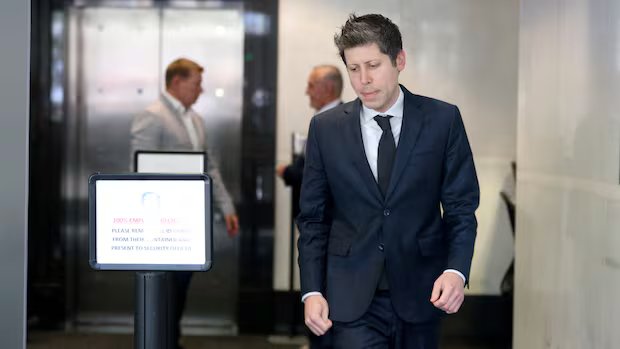
It’s a battle of the billionaires, in a court case that has invoked references to the end of humanity.
Elon Musk, the world’s richest person, has accused OpenAI CEO Sam Altman of “stealing” a “charity” and is calling for his ouster from the company’s leadership.
Closing arguments wrapped up last week in Oakland, Calif., and a jury will begin deliberations on Monday, with U.S. District Judge Yvonne Gonzalez Rogers making the final decision in a case alleging OpenAI breached its founding agreement when it became a for-profit company, for which Musk is seeking $150 billion US in damages.
The court’s decision will have a “tremendous ripple effect” on the AI market, according to Ebrahim Bagheri, a University of Toronto professor who specializes in responsible AI development.
He says at the time OpenAI was created, “I don’t think it was perceivable” to understand how powerful and profitable generative AI technology would become.
“If you now have a restructuring happening with Open AI, then that’s going to impact the services not just offered by open AI, but services offered by dozens and dozens of other other companies, big companies like Microsoft,” Bagheri said.

A parade of wealthy Silicon Valley figures have taken the witness stand over the past several weeks, while protesters outside the courthouse took aim at both sides.
“My sense is that, to the extent that the general public is paying attention to this trial, their hope is that everybody loses,” said Catherine Bracy, CEO of TechEquity, an organization focused on addressing inequality created by the tech industry.
“It’s sort of an ‘everyone sucks here’ situation.”
Here’s where the case stands as jury deliberation is set to begin.
‘The fate of civilization’
OpenAI was founded as a non-profit in 2015 by Musk, Altman and others, and has evolved into a for-profit venture that is set to go public at a valuation of $1 trillion US. Musk aims to turn OpenAI back into a non-profit and also remove its president Greg Brockman, who has a $30-billion US stake in the company.
Musk has accused OpenAI of manipulating him into giving them $38 million US and of accepting tens of billions of dollars from Microsoft and other investors. He’s seeking around $150 billion US in damages from OpenAI and Microsoft, to be paid to OpenAI’s non-profit arm.
A February 2023 email exchange that surfaced as evidence leading up to the trial highlighted a dramatic break between Musk and Altman.

After telling Musk, “you’re my hero,” Altman then said, “I don’t think OpenAI would have happened without you — and it really [expletive] hurts when you publicly attack OpenAI.”
Musk responded, “I hear you and it is certainly not my intention to be hurtful, for which I apologize, but the fate of civilization is at stake.”
In a separate text exchange with Brockman proposing a possible settlement, Musk warned that the trial will make Brockman and Altman “the most hated men in America.”
Musk’s intentions have been called into question, as his own for-profit AI company, xAI, is also eyeing an initial public offering as part of SpaceX, arguably giving him a financial motive to take down a competitor.
‘Larry Page called me a speciesist’
Musk testified over three days at the end of April, repeatedly describing OpenAI as a charity — even though it was not described as such during its formation — and saying Altman and Brockman went behind his back to turn it into a for-profit venture.
He testified that he recognized the need for an open-source non-profit AI after a conversation with Google founder Larry Page, in which Page said it would be “fine” if AI wiped out humans, as long as AI survives.
“And then he called me a ‘speciesist’ because I care about humans more than AI,” Musk said. “The reason OpenAI exists is because Larry Page called me a speciesist.”
At one point, the judge asked Musk to stop mentioning the sci-fi movie The Terminator, in which a self-aware AI system tries to wipe out humanity.
There was also pre-trial tension when Musk’s lawyers wanted to question an expert witness about the extinction risk of AI, which OpenAI opposed. “This is a real risk. We all could die,” said Musk’s lawyer Steven Molo.
The judge limited the scope of the expert’s testimony and said she thought “it’s ironic that your client, despite these risks, is creating a company that’s in the exact space.”
‘Hair-raising moment’
Altman’s leadership has been under heavy scrutiny of late, especially on the heels of a recent profile in The New Yorker magazine that painted him as dishonest.
When asked under cross-examination whether he was completely trustworthy and did not mislead people in business, Altman said, “I believe I am an honest and trustworthy businessperson.”
Molo jumped on that comment, using it to hammer Altman for not immediately giving an unqualified “yes.”

Sam Altman is back in charge as CEO of OpenAI after being ousted by the company’s board. Andrew Chang explains why the man famous for bringing ChatGPT to the world was fired, then rehired — and what it could mean for the future of one of the world’s most powerful AI innovators.
Altman testified that he had concerns about Musk’s attempts to gain more control over OpenAI, which was working to safely build a better-than-human form of AI called artificial general intelligence (AGI).
He said he didn’t believe AGI should be under the control of a single person, and described a “hair-raising moment” when Musk was asked what would happen to his control of the technology if he dies.
Altman said Musk’s response was that maybe the control should “pass to my children,” which Altman said he was not comfortable with.
Altman attributed Musk’s leaving OpenAI and the ongoing conflicts to “jealousy.”
Musk goes to China
Altman was in court for closing arguments last week.
Musk, however, was on the other side of the world accompanying U.S. President Donald Trump on a trip to China, even though the judge told him he was not excused to leave.
Molo apologized to the jury for Musk’s absence.
Molo continued to try and paint Altman as a liar and challenge Brockman’s goals for the business in his closing arguments, stating, “The arrogance, the lack of sensitivity, the failure to account for just common decency is really, really abhorrent.”
Sarah Eddy, a lawyer for OpenAI, accused Musk and his legal team of resorting to “sound bites and irrelevant false accusations.”
Eddy said by 2017, everyone associated with OpenAI — including Musk, who was then still on its board — knew it needed more money to fulfill its mission than it could raise as a non-profit.

Eddy expressed disbelief that Musk claimed he did not read a four-page term sheet in 2018 discussing OpenAI’s plan to seek outside investments.
“One of the most sophisticated businessmen in the history of the world” wouldn’t have “stuck his head in the sand,” Eddy said. OpenAI lawyer William Savitt accused Musk of having “selective amnesia.”
Potential decision early this week
Bracy, who has been following the trial, said she expects a decision to come down early this week, potentially by Tuesday afternoon.
She says the case feels like “an allegory of the age we live in,” where billionaires play by a different set of rules — and the only way they can be held accountable is if someone in their threshold of power goes after them.
“The only reason we’re here is because the richest man in the world decided he wanted to pick a petty beef with his enemy.”