dailynewsnblog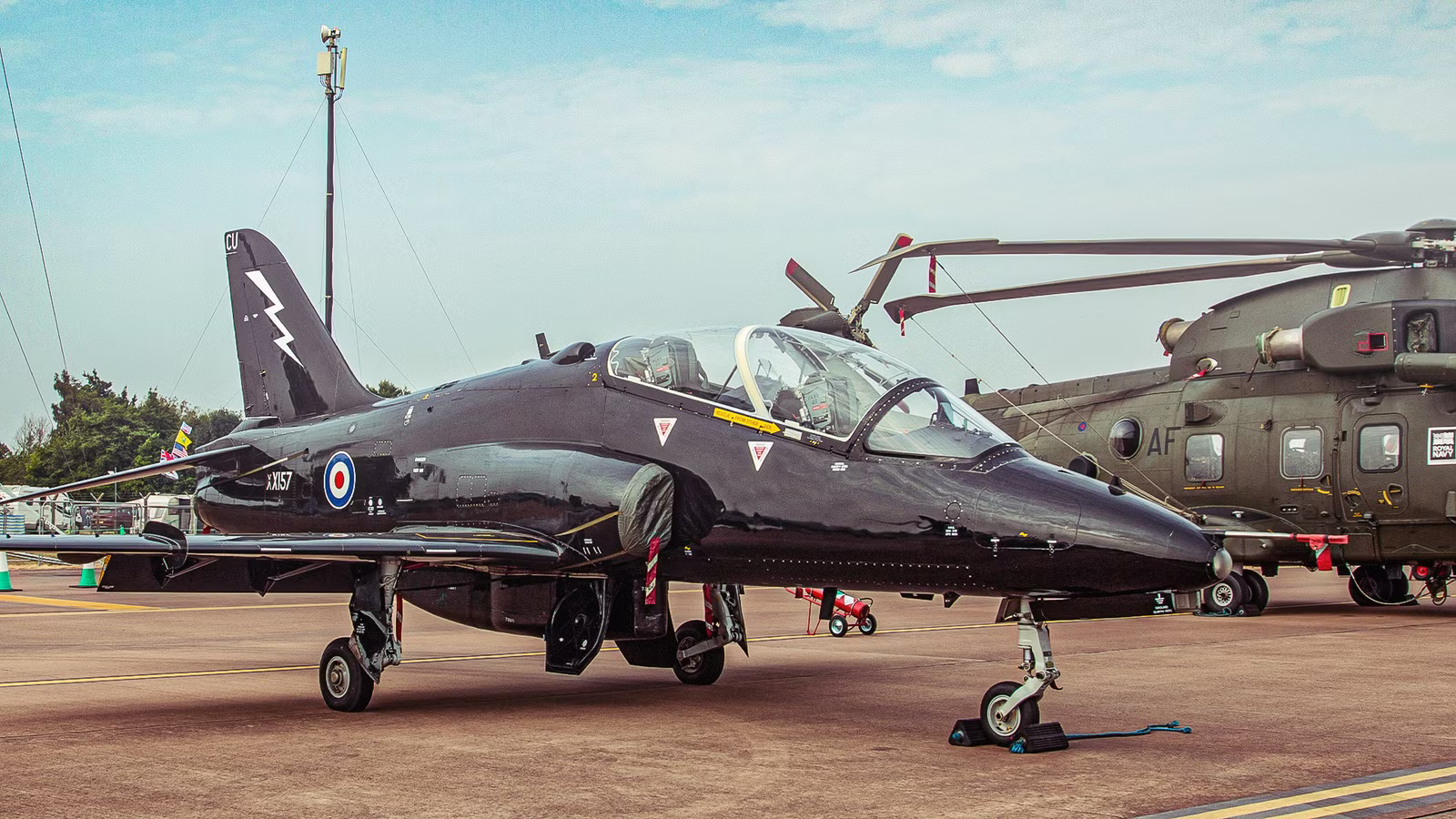
Following a crash on September 23, the Royal Air Force (RAF) grounded its entire fleet of BAE Hawk T2 planes. The 27-strong flightline of light jets now sits idle at RAF Valley in North Wales. This has brought the pipeline of fast-jet pilot trainees to a halt. As it stands now, none of the student pilots can advance in their tactical progression and transition into frontline airframes like the Eurofighter Typhoon or Lockheed Martin F-35 Lightning II.
The timing of this operational pause is highly disruptive for the United Kingdom’s RAF. The silver lining to the catastrophic mishap is that both crew members successfully ejected with minor injuries. Currently, the cause of the accident remains unestablished, making the immediate fleet-wide grounding a necessary precaution. The aging fleet is already teetering on the brink of obsolescence, with no successor ready to take up the mantle, and the fast jet program itself is being overhauled.
The mishap plane had experienced an engine emergency just weeks before it was lost, according to the Aviation Safety Network. A series of engine troubles has also slashed the fleet’s training output to roughly half of its targeted capacity. The low readiness has forced the RAF to outsource student training to the United States, Italy, and Qatar to keep pace. While a brief suspension of flights will only cost a few weeks of sorties, an extended grounding threatens to completely freeze a vital pilot pipeline already struggling to clear a backlog of trainees.
A Takeoff Roll That Ended In Two Ejections

The fiery demise of tail number ZK032 began during its takeoff roll from Runway 13 at RAF Valley. Bystander video captured flames shooting from the exhaust of the Hawk as it sped up for liftoff. Those ‘backfires’ are a major red flag for an aircraft that lacks an afterburner. After lifting off, the plane climbed briefly before twice pitching sharply nose-up as the instructor and student pilot steered it into a profile that allowed for a safe ejection.
The out-of-control jet then dived into the ground near the village of Pencarnisiog, roughly two miles east of the base. Thankfully, the direction the crew pointed the plane before ‘punching out’ avoided any casualties on the ground. On the evening of September 23, the RAF implemented a fleetwide operational pause as a precaution against further engine failures or other disastrous mechanical malfunctions, as Aerospace Global News covered.
The grounding was also temporarily extended to the Red Arrows display team, which flies an older Hawk T1 variant. Four days later, however, the RAF cleared the T1 model to resume flight operations. The decision followed detailed technical analysis and safety inspections, though the scope was not publicly disclosed. In contrast, the 27 Hawk T2s used for fast jet training remained marooned on the ramp at RAF Valley.
This selective return to flight strongly suggests that investigators do not see a systemic, cross-variant design flaw. The engine fire does not automatically pinpoint the root cause. Until the official investigation concludes, the RAF is staying quiet on whether the disaster was an isolated failure or a dangerous defect shared across the wider active fleet.
A Capable Airframe With An Engine Problem

Unpacking the technical story behind the crash of ZK032 starts with the Hawk T2’s single Adour 951 turbofan engine made by Rolls-Royce and Safran. The non-afterburning powerplant is capable of moving the two-seat, advanced trainer jet to a top speed of 555 knots (1,028 km/h). Although its design dates back to 1974, this modern variant on the flightline today entered service in 2012. The latest rash of groundings and maintenance overhauls that preceded the crash stemmed from problems inside the engine’s low-pressure compressor module.
BAE reported that this defect slashed the Safran-made engine’s planned design life from 4,000 flight hours down to just 1,700 hours. That halved its lifespan. BAE says that unless the military funds expensive overhauls, there is no way to remedy the problematic powerplants. These engine troubles have degraded fleet readiness in successive phases, with the Ministry of Defence briefly grounding all T2s in January 2023 over cracked engine blades, just as it did after the crash of ZK023.
Whether the engine itself is inherently flawed remains heavily debated. While basic flying resumed after thorough rework three years ago, a safety precaution kept dozens of turbofans permanently out of service. That left a shortage of spare engines. Identical Adour 951s operate with squadrons in Qatar, Saudi Arabia, South Africa, and Oman. However, those fleets have not accumulated the high flight hours logged before RAF engines began to fail. More importantly, the real issue of getting fast-jet pilots out of training and into action remains unresolved.
A Fleet Flying Half Its Hours And A Pipeline Full Of Waiting Trainees

The Hawk T2 fleet was already operating on dangerously thin margins long before the recent crash. Public records show that only eight advanced trainers were serviceable on an average day during the 2022 to 2023 time period, cutting available flying hours exactly in half. By March 2024, 16 aircraft were entirely unavailable for fast-jet training, leaving just nine airframes on the active flight line later that winter.
RAF leadership has worked slowly to secure a replacement, but recent woes have instilled urgency in the institution’s procurement efforts. As a result of the far-overdue fleet modernization, trainees bear the brunt of these severe shortages, remaining in limbo due to prolonged holds on training progression. Of 119 active fast-jet recruits, roughly 40% have reportedly been stuck in administrative backlogs, held over between courses or waiting for spots at operational conversion units.
These stranded pilots are forced to fill their time with non-flying ground duties, a delay that drains flying currency and wastes defense funding. Compounding this gridlock, a severe instructor shortage has stretched a standard two-to-three-year training cycle to seven years. The combined effects have driven total RAF pilot manning down to roughly 73% of the staffing baseline and brought morale to all-time lows. The facts all point to one conclusion: the Hawk alone cannot sustain the fast jet pilot force.
Why Every Fast Jet Pilot Passes Through Valley

The path to an RAF fighter cockpit runs through several phases, with RAF Valley managing the final steps before reaching the front line. Fast jet candidates move from elementary flight screening to the Texan T1 turboprop at Valley, then progress directly to the Hawk for advanced training. The T2 phase introduces students to a modern glass cockpit designed to mimic the Typhoon and F-35 in a plane with jet performance and handling.
The aircraft uses data links to feed synthetic radar contacts into the cockpit for intercept practice, while onboard systems simulate electronic warfare threats such as enemy missile batteries. This allows trainees to rehearse complex tactical missions that would otherwise require more expensive combat jets. Following graduation, pilots move to an operational conversion unit to learn their assigned active duty airframe in depth.
The UK has no backup aircraft or alternative training program if this line stalls out. The legacy Hawk T1s are concentrated in the Red Arrows, and the nine Hawk variants Qatar operates at RAF Leeming train only a handful of students each year. This lack of supplementary planes leaves the entire pipeline dependent on the Valley fleet.
Furthermore, the government purchased these Hawks directly in 2006 for $588 million (£450 million). That makes the Hawk the only government-owned jet in a training system otherwise managed by private contractors under the £6 billion Military Flying Training System deal. This distinction complicates the supply chain for a trainer that has proven notoriously difficult to keep in the air as its age becomes more apparent.
The Overseas Safety Valve Has Narrow Limits

To bypass these domestic deficits, the RAF has outsourced training overseas, sending roughly 27 recruits to international flight schools before they return for front-line conversion. Under strict long-term agreements, 14 pilots joined the NATO program at Sheppard Air Force Base in Texas, while others attended the International Flight Training School in Sardinia.
A newer agreement also routes trainees through Qatar, but that relies on nine Hawk Mk 167s stationed at RAF Leeming. These jets share an identical design baseline with the grounded T2, meaning any fleetwide engine finding would likely stall this pipeline too.
Moving pilots abroad fails to address the capacity crisis and directly undermines leadership’s long-term goal of leveraging a reliable domestic training system. Shortages facing the fast-jet pipeline remain an undeniable vulnerability that international outsourcing can only temporarily patch.
The recent Anglesey crash has landed just as the RAF begins producing a successor to the platform. In August, the Ministry of Defence issued a request for information for a new Jet Training System to replace the Red Arrows’ older T1s by March 2030 and all Hawk T2s in the early 2030s.
A Replacement Still Years Away

Earlier this year, the MoD did officially declare that the T2 no longer meets the advanced requirements needed to prepare pilots for fifth and sixth-generation combat jets, accelerating its retirement from 2040. In August, the RAF finally made earnest efforts to begin acquiring a new Jet Training System (JTS) an official priority. However, the funding remains highly lopsided.
The government allocated £860 million to keep the current Hawk fleet operational until the transition, but only £360 million to develop the replacement system, a figure Observers warn falls well short of a one-for-one fleet purchase. Prospective bidders include the BAE/Boeing T-7A Red Hawk, the Leonardo M-346, the Lockheed Martin TF-50, and the Turkish Aerospace Hürjet.
One UK startup, Aeralis, dropped out of the earlier design reviews in Spring of this year, leaving only BAE’s joint program with Boeing as the sole domestic supplier option. Even after a winner is chosen, none of these new platforms will enter service before the early 2030s. Ultimately, that means the Hawk T2 will remain the RAF’s only domestic fast-jet training route for years to come.
This timeline places immense pressure on the current crash investigation. If the failure is isolated to a single airframe, the fleet could resume operations quickly with minimal impact. However, if a systemic engine or structural fault is determined, the 27 remaining jets will face more restrictions and groundings for maintenance, which will further worsen the fast jet pilot training backlog that is already heavily impacted.
Catch what other trackers miss
Emergency squawks, holds, NOTAMs — live signals, no signup.
Open tracker
Catch what other trackers miss
Emergency squawks, holds, NOTAMs — live signals, no signup.
Open tracker