dailynewsnblog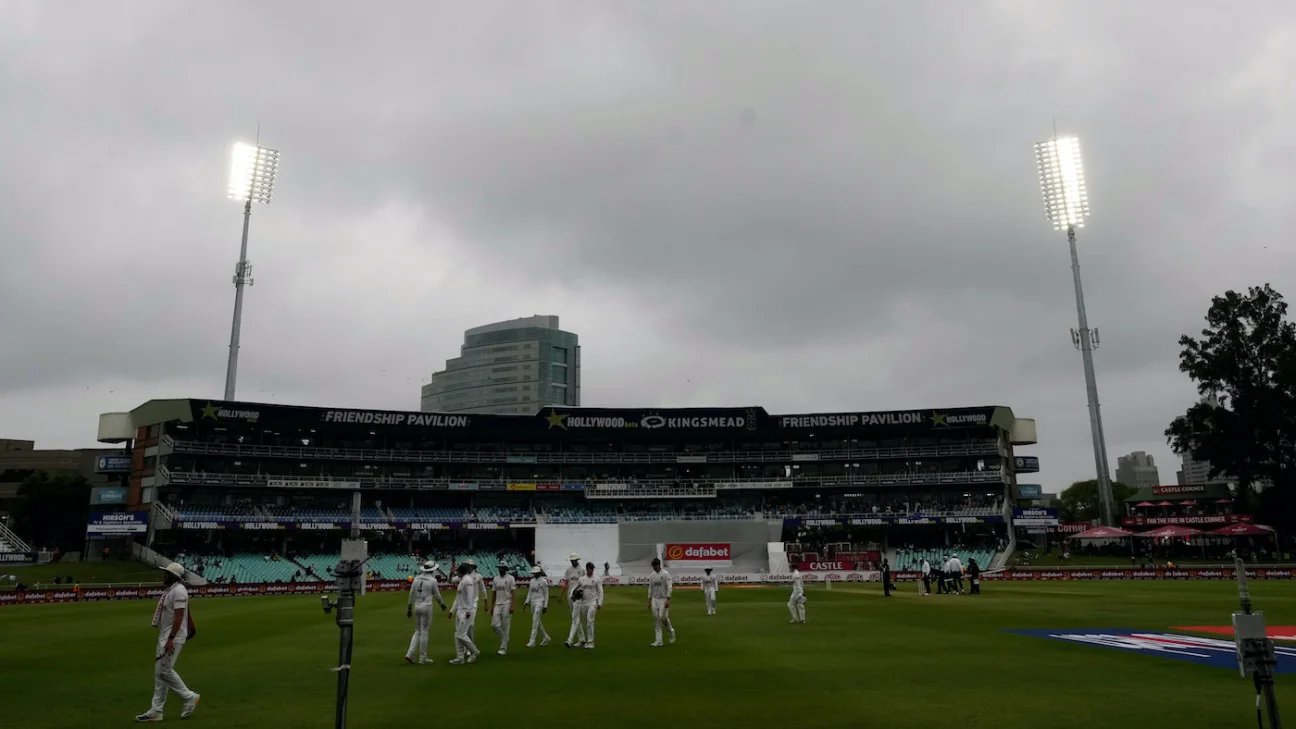
Each day of the match has finished early due to fading light – caused by cloud and haze – which was always a likely scenario in Durban where the sun sets earlier, with around 45 overs lost so far. If that pattern continues there could be at least 30 fewer overs remaining than the official tally to force a result, meaning how Australia’s second innings progresses will be vital.
“There’s nothing that we can do about it,” Nathan Lyon said. “Whether it’s cloud or smog or whatever way you want to describe it, it is playing a role, but we can’t control it.”
At the close of the third day, Australia held a lead 139 after a brisk opening stand between Nic Maddinson and Travis Head. Maddinson, playing his first Test in nearly 10 years, began the innings on a pair but avoided that fate by pulling the first ball for four. He had flicked a six over square leg two deliveries before the players left the field, with Ryan Rickleton in the deep indicating he had not picked up the ball.
An ideal scenario for Australia is to probably score at around four runs an over for 50 overs which would extend the lead to the region of 350 midway through tomorrow afternoon before putting South Africa back in. The home side, of course, could bowl them out before then, especially if they take the aggressive approach that South Africa’s batting coach Ashwell Prince expected.
“I think tomorrow, starting with the 100-run lead, we might see a lot more of what we saw this evening from their approach, coming out aggressively, putting the team ahead of self. Meaning, we want to get as far ahead as possible with trying to make up time,” Prince said. “As you say, you’re going to be losing overs in the evening. So, I can anticipate them coming out aggressively and trying to stretch the lead as quickly as possible. Obviously, we have to be alert to that.”
A win for South Africa is not out of the question after the last two wickets added 87, if they could bowl Australia out for around 200. Prince indicated the home side would not go completely on the defensive, with the hope the spinners, Simon Harmer and Keshav Maharaj, could have more of an impact on the fourth day.
“You’ve got to look to take wickets,” Prince said. “At the same time, you’ve got to control the run rate. You might say, well, you’re trying to cover both ends. In the first innings, they put a big score up on the board, but they went at 2.8 runs. They can afford to take a few more risks [in this innings], but I think we’ll see a [bit] more of the spinners tomorrow, maybe a few innovative field placings and put the ball in their court to come and play.”
“For me, outside of a day-night Test, it’s got to be a red ball,” Prince said. “Obviously, some nations have played a lot more pink-ball cricket than others. So, therefore, to get both captains to agree is always going to be a challenge. Some teams will feel that they simply don’t have enough experience of it. I think it will be very difficult to get both captains to agree. But for me, Test match [cricket] is a red ball.”
Shaun Pollock, who sits on the ICC Cricket Committee which introduced the pink-ball option, believes teams need to be open the change.
“I’m not saying for one moment that we should have used the pink ball and played a day-night game. I just believe we should have used the pink ball for the day game,” Pollock said on SuperSport. “Don’t be scared to use the pink ball.”
Andrew McGlashan is a deputy editor at Cricinfo