dailynewsnblog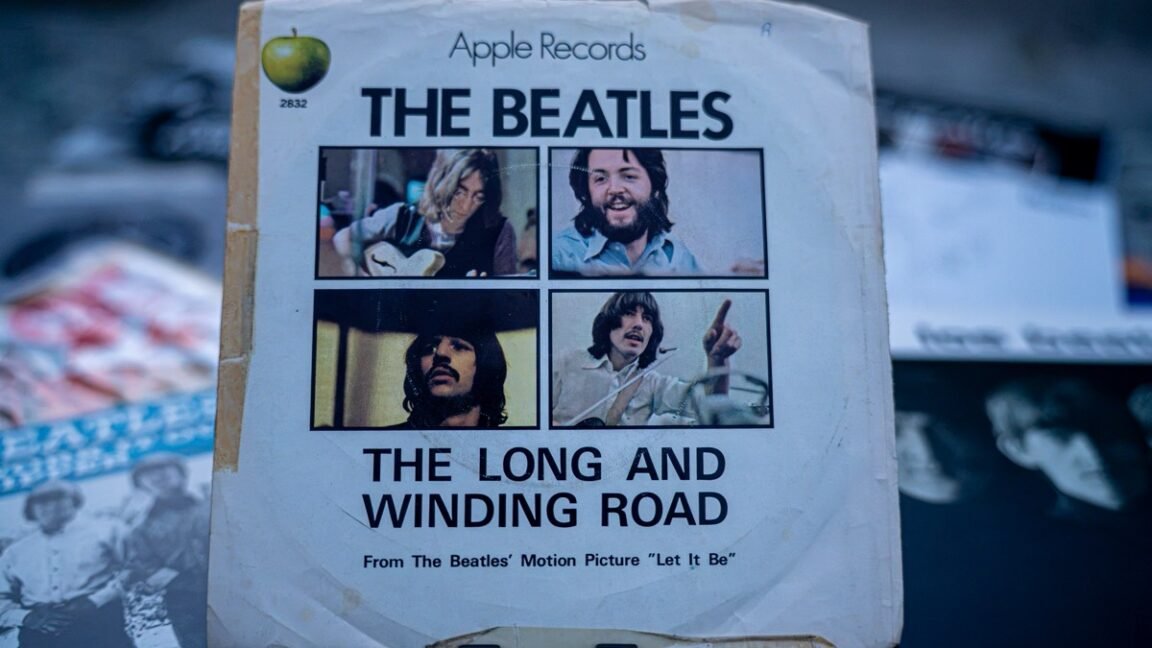
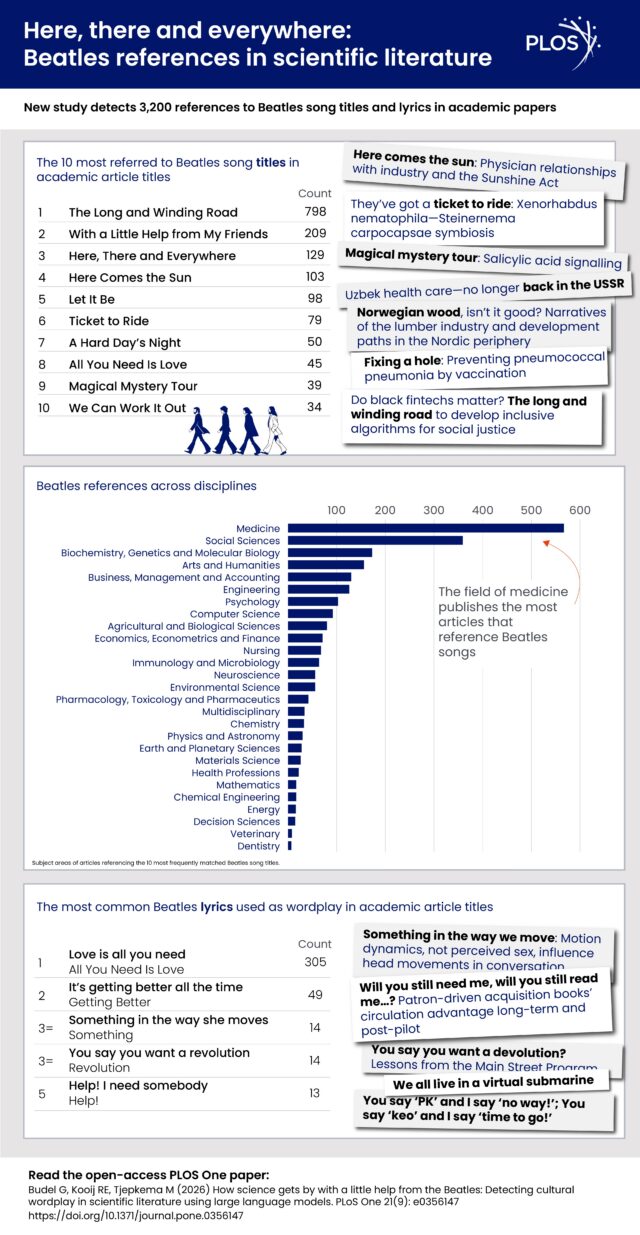
The 2017 paper that invented the architecture behind ChatGPT, with the wordplay title “Attention is all you need,” is the most cited overall (89,737 citations). The top three most highly cited papers with exact Beatles song references: “Good day sunshine: Stock returns and the weather” (1,009 citations); “Seizure prediction: The long and winding road” (954 citations); and “Th17 cell differentiation: The long and winding road” (599 citations). Beatles lyrics seem to blend particularly well with biomedical themes: although references to Beatles songs span every subject area on Scopus—bolstering the authors’ argument that this is a cross-disciplinary phenomenon—medicine clearly dominates, along with social sciences.
When Budel et al. broke down the data by year, they found a marked steady increase in the use of Beatles songs in scientific literature since 1990, particularly between 1995 and 2005—a surge that happens to coincide with the release of The Beatles’ Anthology project (1995–1996). The authors suggest Anthology introduced new generations to The Beatles’ music, and once their music became widely available on streaming platforms like Spotify (late 2015), the trend was reinforced.
Meanwhile, there was a rapid digitization going on in academic publishing, placing more pressure on authors to stand out in the crowd. A 2023 study suggested that using song references in titles is a great way to grab a reader’s attention while avoiding the usual highly technical jargon. Budel et al. also think their work provides “concrete evidence that academic writing is becoming more informal and more attentive to its readers.”
While one might argue that the overall impact of references to “The Long and Winding Road” has been weakened by overuse, “More innovative wordplay still offers appeal,” the authors wrote. “For example, few fans of the White Album will fail to smile upon encountering titles such as ‘Happiness is a warm theorem,’ or ‘Everybody’s got something to hide except me and my patented monkey: Patentability of cloned organisms.’”
Credit:
Anthony Lewis, PLOS/CC-BY 4.0
PLoS ONE, 2026. DOI: 10.1371/journal.pone.0356147 (About DOIs).