dailynewsnblog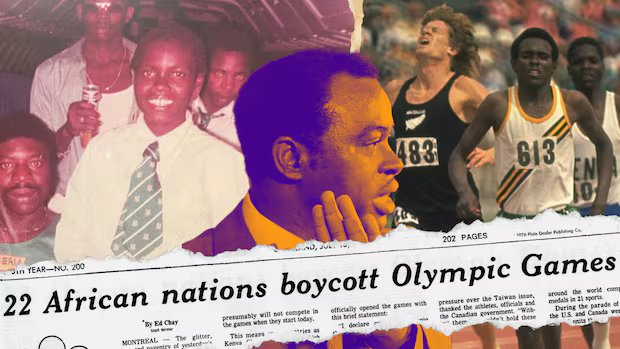
Nigerian sprinter Gloria Obajimi had just purchased a new camera at the Olympic Village when she learned she had an hour to pack up and leave the site of what was supposed to be her first Olympics: the 1976 Montreal Games.
Barely 20 years old, Obajimi had spent two weeks prior to that news acclimatizing to Montreal. She says she felt “on top of the world,” mingling with athletes she had always looked up to and even being photographed for a couple of articles about life in the Village.
But, on July 16, 1976, while she was fantasizing about all the photos she would take herself, the president of the Nigerian Olympic Committee, Maj. Gen. Olufemi Olutoye, announced Nigeria was joining what would be the first major boycott in the Games’ history.
That year, 29 countries, mostly African, withdrew from the competition in protest of New Zealand’s participation, after its rugby team kicked off a tour of apartheid South Africa – mere weeks following the deadly Soweto uprising. That massive student-led protest saw South African police brutally crack down on thousands of demonstrators protesting the introduction of Afrikaans as a language of instruction in Black schools.
As Olutoye put it at the time, the boycott was “an eloquent protest at New Zealand’s blatant disregard for human dignity by its avowed and open support and collaboration with racist South Africa in sport.”

The day after the announcement, Obajimi watched the opening ceremony of the Games at Heathrow Airport during a fuel stop on her way back to Lagos.
“We were all in tears. I couldn’t believe it. It was a big shock,” she said.
As Montreal marks the 50th anniversary of the only Summer Olympics held in Canada, the 1976 Games stand out to Obajimi as a fleeting moment that brought pain — yet enduring pride.
“I was glad that I could beat my chest to say that, for apartheid to end in South Africa, we were part of those that paid the big price.”
The great race that never was
Tanzania’s track star Filbert Bayi says he accepted the news of the boycott soon after learning about it. He had already been pulled out of events involving New Zealand earlier that year over the country’s decision to invite South Africa to take part in a softball tournament.
Headlines speculating about Bayi’s highly anticipated appearance at the 1976 Games had been swirling for months. His 1500m race against New Zealand’s John Walker was supposed to be a showdown for the ages, with the two setting and outdoing each other’s records in the leadup.
But, the Supreme Council for Sport in Africa (SCSA) had been threatening a boycott since at least May after New Zealand’s rugby team announced the South Africa tour.
After many negotiations, the International Olympic Committee (IOC) ultimately did not grant the African nations’ request to bar New Zealand from participating at the Olympics. As far as it was concerned, rugby was not an Olympic sport, therefore the matter fell outside the IOC’s jurisdiction – and it had already barred South Africa from competing since 1964 due the country’s apartheid policies.
“And then we said ‘OK fine, if they agree and share this Olympics with the people who shared [with] South Africa … Let it go,’” said Bayi.
Tanzania officially withdrew its contingent from the competition a week before the start of the Games.
Bayi read about Walker’s winning time at the 1976 Games in the newspaper. It was five seconds slower than what Bayi says he himself had run at a competition just two months earlier.
“I could have won, if not gold medal – the first gold medal for Tanzania – maybe silver or any medal,” he said.
To this day, Tanzania’s medal count includes just two silvers, both won in the 1980 Moscow Games — one of them by Bayi.
“I was ready [in 1976] and I’m sure John Walker was very happy when I wasn’t there,” he said, adding that Walker has assured him since those Games that he was, in fact, not happy.
Although the two met on several occasions after that, it was never again on the racetrack.
Did the boycott work?
The 1976 boycott movement started slowly and then unfolded all at once, with the majority of the participating nations pulling out the day after the opening ceremony.
Jean Lévesque, who teaches history at UQAM, says the 1976 boycott was a step in a larger process.
Years earlier, when the IOC suggested it would invite South Africa to the 1968 Games, the threat of an African-led boycott stopped it in its tracks. Most of the African countries that issued ultimatums had just gained their independence and entered the IOC.
“If they didn’t win many medals, at least they had a platform to voice and have more support [internationally],” said Lévesque.
Immediately following the 1976 boycott, South Africa was expelled from the international federation governing track and field.
The following year, in a bid to save the 1978 Commonwealth Games, the association’s member states, including New Zealand, agreed to cut all sports ties with South Africa so long as it continued its policy of apartheid.

The 1976 protest also set the stage for the 1980 boycott of the Moscow Games, according to Lévesque, which was related to the Soviet Union invasion of Afghanistan and Cold War divisions.
“Montreal was a precedent,” said Lévesque. “Once you use the boycott … to raise your voice and to make a statement and try to influence policies, it’s easy to get back to it.”
On politics and athletes
Despite the abusive effects of South Africa’s policies on its Black athletes, the question of whether sports should mix with politics was raised constantly by officials involved in the 1976 Games.
The question continues to arise today, but sports historian Helen Lenskyj says the answer was already evident in 1976.
“Of course it’s political,” she said. “It involves politicians, it’s geopolitical in the sense it involves nation states fighting to get gains.”
She says the world hasn’t seen a repeat of the Olympic boycotts from the 70s and 80s because the strategy has evolved to target, most notably, sponsors.
Obajimi and Bayi both say that, in hindsight, they don’t think governments should use their athletes to push political agendas, given the sacrifice that training for the Olympics entails.
Bayi says he believes he was at his prime in 1976.
“It [the 1976 Games] will remain as history to me. It is history. It has passed. It will never come and I will not be the same as I used to be,” he said.
In 2000, Obajimi visited South Africa, finding herself being able to move around and exist as a Black person in a way that would not have been possible just a decade earlier.
“I was happy. This is the South Africa that we boycotted the 1976 Olympic Games for,” she said.
Obajimi did fulfil her Olympic dream by representing Nigeria in Moscow in 1980, but stress related to her university exams meant those didn’t go so well. She says that for some time, the 1976 Games left a vacuum inside her.
Now 70 and retired, Obajimi sees her status as an almost-Olympian at 20 as a win.
“I had gone there [to the 1976 Olympics] although I wasn’t able to compete. But it’s all part of life. And then we move on from there,” she said.
“And looking at my life in its entirety, I can see that I don’t have any regrets about that.”