dailynewsnblog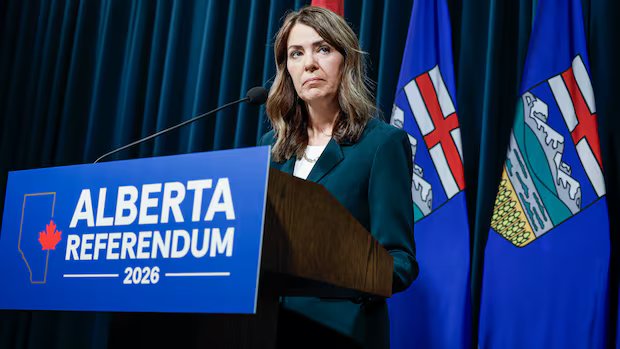
If Albertans vote yes to the five immigration questions on this fall’s referendum, many of Alberta’s 260,000 temporary workers and other non-permanent residents could lose their health and education coverage — while all the rest could have to pay access fees on top of the taxes they pay.
When it comes to the most prominent question on Alberta’s Oct. 19 ballot, Premier Danielle Smith has said she is against separating. But she endorses and has vowed to campaign for the other nine questions she’s put to Albertans on immigration and constitutional reform.
She’s pitched them as a third-way option for supporters to express frustration with Ottawa without going as far as endorsing secession.
“If you want to send a message, you should vote for the nine other questions. Give us a mandate to pursue greater and greater autonomy,” she told a gathering of UCP members in the town of Edson last month, according to a segment posted to social media.
Some of those nine might verge more on the symbolic or directional, especially questions on constitutional reform and the one on wresting from Ottawa more control over immigration.
But others ask Albertans to mandate the province to take real action on real people — to pass laws restricting real services and supports those people rely on.
Critics say these ballot measures may have significant ramifications for temporary residents, a group that includes asylum seekers, student visa holders, temporary foreign workers and their families. But it’s confusing to really figure out how.
“They don’t make sense on their own, a lot of them,” said Avnish Nanda, an Edmonton immigration lawyer and leader of Our Alberta Advantage, a group campaigning against the referendums. “And when you read them together, you can lead to these contradictory results.”
Here, CBC News does its best to parse them, with the information the province has made available.
Welcome mat no more
The first of five immigration referendum questions in October asks if voters support the provincial government taking increased control over immigration so it can decrease the pace of newcomers.
After encouraging rapid population growth earlier in her term, Smith has more recently taken a rhetorical turn against immigration and its costs to the provincial government. That’s come after a sharp rise in non-permanent residents earlier this decade pushed up the population throughout Canada, adding to strains on housing supply, class sizes and health-care access.
However, new federal restrictions have caused those numbers to sharply drop in recent years. Far more non-permanent residents have left Alberta than arrived over the past year.
Let’s also quickly dispense with the fifth immigration referendum question. It asks about requiring proof of citizenship when voting, which has been a larger talking point south of the border than in Canada.
Questions 2 to 4 all deal with provincial services and supports, in overlapping and wordy ways. Here they are:
2. Do you support the government of Alberta introducing a law mandating that only Canadian citizens, permanent residents and individuals with an Alberta-approved immigration status will be eligible for provincially-funded programs, such as health care, education and other social services?
3. Assuming that all Canadian citizens and permanent residents continue to qualify for social support programs as they do now, do you support the government of Alberta introducing a law requiring all individuals with a non-permanent legal immigration status to reside in Alberta for at least 12 months before qualifying for any provincially-funded social support programs?
4. Assuming that all Canadian citizens and permanent residents continue to qualify for public health care and education as they do now, do you support the government of Alberta charging a reasonable fee or premium to individuals with a non-permanent immigration status living in Alberta for their and their family’s use of the health care and education systems?
It might appear these questions are overlapping or would cancel each other out. Would voters potentially choose to block temporary residents’ social services and make them wait a year and pay a fee for services?
Let’s explore.

For the third question, focus on the term “social support programs,” which makes it different from the other two. “This refers to things like childcare subsidies, student aid, and other benefits and income supports, not standard health care and education,” states the government’s referendum website.
(The Smith government referred all of CBC News’ detailed questions to the website and its FAQ. Joseph Schow, Alberta’s minister of immigration, did not have time for an interview over a three-week period, his press secretary said.)
Questions 2 and 4 are the ones that are most like interlocking policy building blocks.
If Albertans vote yes only to 2, they are endorsing future legislation to make temporary residents ineligible for publicly covered health and education, unless they are deemed to have “Alberta-approved immigration status.” The government says it will only define after the referendum which classes of foreign students or work-permit holders will qualify for this status, and therefore basic social services.
Those lacking that status would have to get private health insurance coverage or pay out of pocket, like visitors to Canada. “Temporary individuals should be treated as that — temporary and tourists,” Smith told reporters in February.
If voters only say yes to 4, they are endorsing charging all temporary residents a “reasonable fee” to access public health and education — note that there’s no exclusions listed here for “Alberta-approved” temporary residents. Fee size to be determined after the vote, though the province’s FAQ notes it already charges foreign students at least $11,000 tuition for public elementary or secondary school.

Settlement agencies fear the loss of federally-funded services will hurt Ukrainian newcomers as they try to learn English and find housing and employment. They fear waitlists for some programs, including English language training, will only get longer.
What happens if Albertans vote yes to both 2 and 4, which is what Smith wants?
In that policy scenario, “Alberta-approved” newcomers would need to pay the fee for provincial health and education, according to the government’s FAQ. Other temporary residents and their families would remain left out like they would in Question 2.
Essentially, this would create three separate classes of Alberta residents: the citizens and permanent residents who enjoy the health and education coverage that all residents now enjoy; the “Alberta-approved” immigrants who pay an extra premium for social services; and the temporary residents who lack “approved” status, and would lack coverage altogether.
The provincial government declined to clarify a few other points CBC News asked: whether these policies would apply to temporary residents who are already in Alberta, or just new arrivals after October; and whether these restrictions would affect the thousands of Ukrainians who arrived on special permits since the 2022 Russian invasion, but have not yet become permanent residents or citizens.
(And remember, all of these referendum questions are non-binding, giving the province plenty of latitude to interpret the results and fashion a response. Remember, too, that the provincial government could enact these policies without a referendum mandate.)
“The details of new legislation to implement the will of Albertans as expressed in the referendum will be decided by the legislature thereafter,” the premier’s spokesperson Sam Blackett wrote in an email.
One thing is clear, however: the federal government already covers asylum seekers’ health care in all provinces, so Alberta couldn’t deny health coverage to that group of residents.
Questioning the questions
There is a stunning lack of information or public outreach from the government on these major questions affecting immigrants, said Bukola Ojemakinde, who left industrial engineering in 2020 to launch two charities that serve women and seniors with African and Caribbean heritage.
“A lot of newcomers don’t even know what this is about. They don’t know the implications of it,” she said.
“We seem to hear if this doesn’t happen, our social institutions will crumble. But if it happens, what does it actually mean?”
Ojemakinde said there’s been much “devaluing” of immigrants’ contributions recently. And that doesn’t only include the taxes they pay, but also their volunteerism, cultural contributions and more.

She stressed that she is expressing her own views, not speaking on behalf of her charities. Laws restrict the types of political advocacy that charities can engage in.
Nanda, the immigration advocate, argued that the actual policy outcomes of the referendums might not be the point.
“This is politics more than policy,” he said. “This is part of that same effort to appease that same rump of the United Conservative Party for Danielle Smith to maintain her position.”
Day 610:02Why calls to deport get the biggest cheers at Alberta independence rallies
As the fallout over a leaked voters’ list continues, Calgary writer Marcello Di Cintio says you can learn a lot about the Alberta independence movement by watching what gets the loudest and most reliable cheers at rallies. He says it’s not equalization payments, pipelines or carbon taxes — it’s immigration and deportation.
The lack of clarity and open-endedness of the questions may be deliberate, he said, so that Smith’s cabinet has freer rein to act as they please after the vote.
“It’s giving the province a mandate to do something,” Nanda said. “What that something is, it’s for the province to decide, but I think they’re seeking a mandate to go a bunch of different ways.”
These questions have garnered far less attention than the headlining question on separatism, although that one would merely lead to a subsequent binding referendum, if Albertans voted that way.
But these less discussed, less understood questions would have a direct impact on which taxpayers and residents of Alberta do or don’t receive public services like everyone else.
Clarity on what they mean before the vote on Oct. 19 would help the public understand their options, if the government indeed wants voters to understand.