dailynewsnblog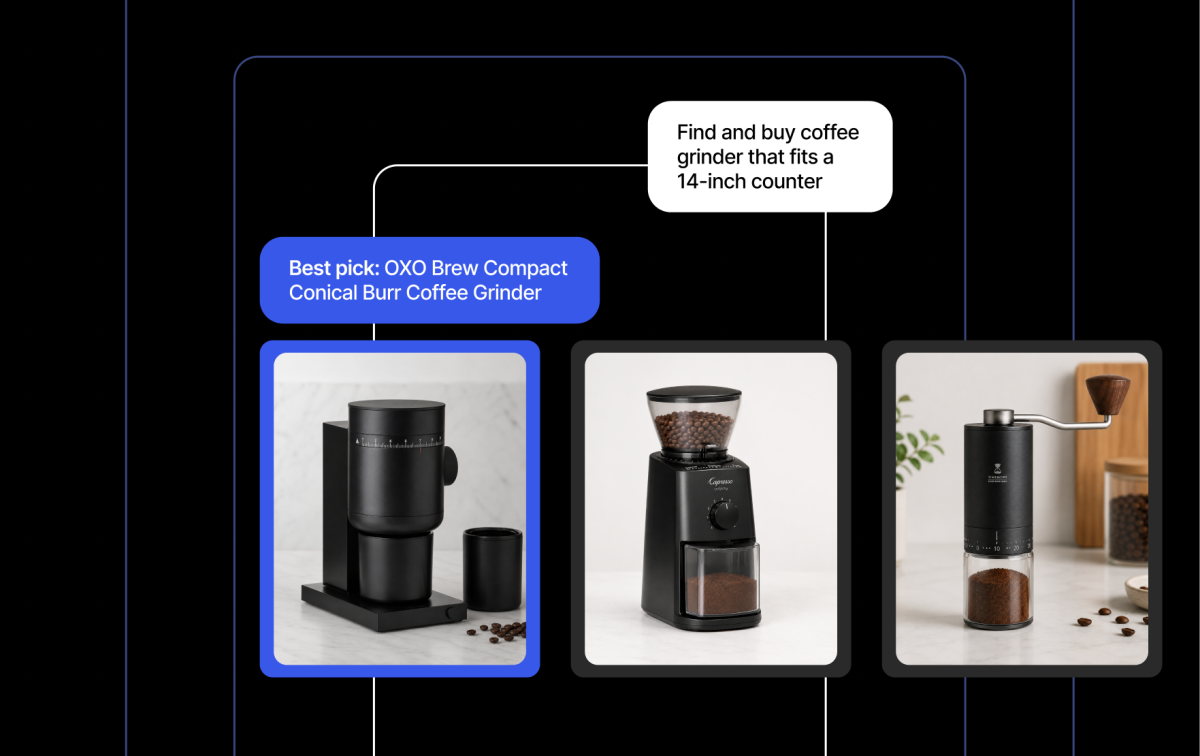
AI agents are increasingly shopping for people, not just suggesting what to buy.
Ask your AI helper to “find a coffee grinder that fits a 14-inch counter,” and it can pull up options, compare them against that constraint, and send you to the store to finish the purchase.
If your product details are vague, difficult to find, or missing, the agent may never include your store in the comparison.
Shoppers are already moving this way. Reuters, citing May 2026 Adobe Analytics data, reported that US shoppers referred from LLMs generated 53% more revenue per visit than non-AI traffic.
Earlier Adobe holiday data also showed a sharp rise in traffic from AI-powered shopping assistants and chatbots. So this isn’t a far-off ecommerce trend. It’s already changing.
We’ll show you how to get your products listed on LLMs like ChatGPT, and everything in between.
TLDR: Agentic commerce is when an AI assistant finds, compares, and buys products on a shopper’s behalf, and it can only do that for stores it can reach and read.
What is agentic commerce?
Agentic commerce is online shopping where an AI agent does the work for the buyer.
The shopper gives the agent a goal, a budget, a few must-haves, maybe a deadline. The agent finds products, compares options, and either starts the checkout process or sends them to the store to finish.
This behavior is not yet fully mainstream, but it is moving from research into the purchase path.
A 2025 Omnisend survey reported by TechRadar found that 34% of US consumers would allow AI tools to make purchases on their behalf, while most still preferred to make purchase decisions themselves.
How an AI agent shops
In practice, the flow is simple:
- AI discovers products that match the request.
- It compares them to the criteria set by the shopper.
- It either buys the item or directs the shopper to the store to complete the transaction.
Take this coffee grinder for example. The agent reads the product details and stock status across the stores it can see, rules out anything that won’t fit a 14-inch counter, and surfaces the best match, often with a reason for the selection.

So why would an agent choose your store over another that sells the same product? OpenAI has published how ChatGPT weighs product results: the products it recommends are ranked on relevance to what the shopper asked for.
When more than one store sells the same product, the pick comes down to availability, price, quality, and whether you’re the primary seller (the source of a product, rather than a reseller).
Those signals decide how often agents put your products in front of shoppers.
Where agentic commerce stands today
Right now, agentic commerce is a mix of product discovery, cart-building, and, in some cases, checkout inside the assistant.
The details are changing quickly, and most programs are only available in the US or with selected merchants.
ChatGPT
OpenAI’s current merchant page focuses on product discovery, comparison, and merchant-owned checkout. Shoppers can discover and evaluate products in ChatGPT, but OpenAI says purchases are completed on the merchant’s website or app. The older Instant Checkout launch still matters as context for agentic commerce, but it shouldn’t be treated as the current default.
Google has also expanded AI shopping through Gemini and Universal Cart. AP reported that Google was teaming with Walmart, Shopify, Wayfair, and others to support product discovery and instant checkout in Gemini. At I/O 2026, Google announced Universal Cart for Search and Gemini, with integrations for YouTube and Gmail to follow. It can help track prices, availability, compatibility, and checkout options, though the exact checkout path depends on the merchant and product.
Perplexity and Microsoft Copilot
Both platforms support in-chat checkout with participating merchants. Perplexity first introduced “Buy with Pro” for US Pro users and later added PayPal-powered Instant Buy for supported merchants. Microsoft Copilot Checkout lets shoppers complete purchases within Copilot, with PayPal, Shopify, and Stripe powering payments. Claude is also moving into shopping-adjacent workflows through app connectors such as Instacart, but Anthropic says Claude asks users to confirm the selection before it makes purchases or reservations.
| Assistant | Finds and compares products | Completes checkout in chat today |
|---|---|---|
| Perplexity | ✓ | ✓ |
| Microsoft Copilot | ✓ | ✓ |
| Google (Search and Gemini) | ✓ | Rolling out |
| ChatGPT | ✓ | ✗ (merchant-owned checkout) |
| Claude | ✓ | ✗ (partner apps handle checkout) |
These details will keep changing, but the basic merchant requirement won’t: agents need enough information to recommend a product and route a purchase.
Payments still need the shopper’s approval
In the major checkout programs covered here, the shopper confirms the purchase, and your store remains the merchant of record, so the sale and the customer relationship stay yours.
The payment networks are still working through some key questions, such as how refunds and chargebacks work when an AI agent places the order.
Shoppers are cautious, too. In the same Omnisend survey reported by TechRadar, more than half of respondents said they were worried about data mishandling, and 66% still preferred making purchasing decisions themselves.
Accurate product data, clear checkout confirmation, and reliable fulfillment are what earn trust from both the agent and the person behind it.
What this means for small, independent stores
For small, independent stores, agentic commerce can be an advantage rather than a threat.
Big brands may show up first, but agents also reward facts they can verify: accurate stock, clear specs, and reliable fulfillment. A small store can often do that better than a household name with a huge, messy catalog.
Adobe’s 2026 data coverage report emphasized that retailers need to make pages compatible with AI systems, and its travel-site analysis found that roughly a third of the content on some product pages was not readable by AI.
This is where your platform matters. Open, well-structured stores tend to make product pages, schema, feeds, APIs, and checkout integrations easier to access. Closed marketplaces and app-first catalogs may still participate through partnerships, but merchants have less control over which agents can see or transact with their products.
The infrastructure is moving toward shared protocols, but participation still depends on each platform, merchant, and checkout partner. OpenAI’s Agentic Commerce Protocol, built with Stripe — WooCommerce is a launch partner — is designed to let agents and businesses complete purchases while merchants retain control of payments, fulfillment, returns, support, and customer relationships. Google’s Universal Commerce Protocol is also emerging as a route for agent-led checkout.
How to get your store ready for agentic commerce
Getting ready mostly means making your catalog easier for agents to understand.
A shopper might be choosing between refill sizes, matching a spare part to a specific product model, or finding a gift under budget that can arrive by Friday. Use that specificity as your checklist: Can your store answer size, fit, stock, price, delivery, and checkout questions clearly?
Focus on three things, none of which require code:
- Clear product information: Write titles, descriptions, and attributes that say plainly what a product is, what it does, and who it suits. This is the copy you’d write anyway, just clearer. Vague or thin descriptions make it easier for an agent to skip over you.
- Structured product data: Give agents clean, consistent details (known as schema markup) they can read without guessing, such as price, availability, dimensions, sizes, materials, and categories, each in its proper place rather than buried in a paragraph. That turns your catalog into something an assistant can compare cleanly.
- Being reachable: Make sure the agents and shopping channels you care about can actually get to your store. Your robots.txt file tells visiting crawlers what they can access, so check that yours isn’t blocking the AI crawlers you want. Beyond that, being reachable is the one thing on the list that your platform largely decides for you.

Think of your catalog as part of the storefront now. It still powers the back end, but it also helps agents decide whether to recommend you. For the practical next step, see WooCommerce’s guide on how to prepare your store for AI-driven commerce.
Turn AI discovery into direct sales with WordPress.com
WooCommerce, the ecommerce platform behind many independent stores, gives merchants direct control over the product details AI agents need.
Our WordPress.com Commerce plan runs managed WooCommerce, so your catalog can stay structured, accessible, and under your control while hosting, security, backups, and support are handled for you.
The work does double duty: the same structured data that earns you AI search for ecommerce visibility is what helps you show up when someone asks an assistant to shop.
The next shopper might arrive through search, social, email, or an AI assistant. Wherever they start, your store will be ready to be found, understood, and bought from.
Already selling online? See how to set up ecommerce on WordPress.com.