dailynewsnblog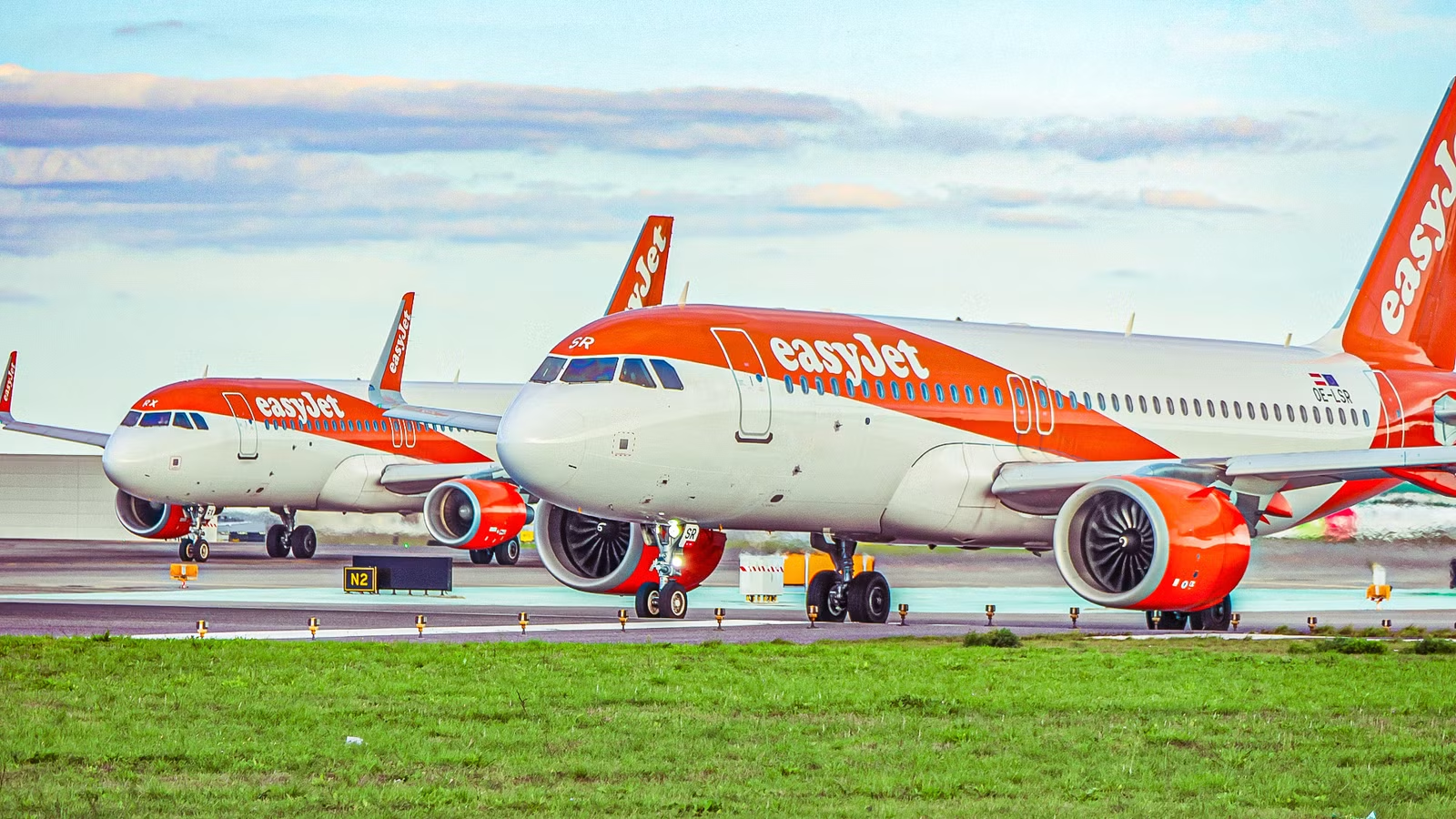
By the end of September 2022, shortly before easyJet reported its annual results, the British low-cost carrier’s market capitalization had fallen to around $2.5 billion, one of its lowest levels in years. For context, that was below the approximately $2.8 billion in net assets recorded on the airline’s balance sheet. It was also equivalent to just 39% of annual revenue, less than $8 million for each of the 320 aircraft in its fleet, and approximately $36 for every passenger carried during the year.
While easyJet’s market value increased again in subsequent years, the low price of the company made it unsurprising that potential buyers began watching the company. In October 2022, there were speculative reports of a potential IAG takeover, while roughly one year earlier, Hungarian low-cost airline Wizz Air had also made a bid for the company. As consolidation within the European airline industry continued in the following years, easyJet remained frequently named as an attractive acquisition target. Despite the airline’s continued attractiveness as an acquisition target, no formal or public acquisition attempt has come to fruition in recent years.
Why EasyJet Is Such An Attractive Takeover Target

Considering easyJet’s relatively low price, it is not difficult to see why the airline is an attractive acquisition target. Since the British carrier returned to post-pandemic profitability, operating margins increased steadily from 5.8% for the financial year 2023 to 7.0% in 2025. While still below the strong margins of low-cost rival Ryanair, these are nevertheless solid results, broadly in line with the wider airline industry.
Contributing to these margins is the airline’s growing easyJet Holidays segment, offering package deals bundling flights and hotels. Compared to the airline business, the holiday segment returns significantly higher margins for easyJet. Illustrating this is the segment’s 38% share of profit before tax (PBT) in the last full financial year, despite only generating 14% of revenue. By 2030, the carrier aims to grow Holidays’ profits by 80% to over $600 million.
easyJet’s true value to its potential buyers might actually have more to do with the airline’s assets. As is the case for many airlines, one of its most significant assets is its aircraft fleet. At the end of the last full financial year, easyJet owned 205 of its 356 aircraft, equivalent to almost 58% of the total. By comparison, IATA estimated that airlines owned only around 30% of Europe’s commercial aircraft fleet at the end of 2023. A potential buyer would therefore gain control of an unusually large portfolio of tangible assets that could be retained, used as collateral or potentially monetized through aircraft sales and sale-and-leaseback transactions.
EasyJet Bases FY26 | |
|---|---|
Number of aircraft | Airport |
More than 70 |
|
20-29 | Bristol Airport (BRS); London Luton Airport (LTN); Milan Malpensa Airport (MXP) |
10-19 | Edinburgh Airport (EDI); |
5-9 | Glasgow Airport (GLA); Belfast International Airport (BFS); Manchester Airport (MAN); Liverpool John Lennon Airport (LPL); Birmingham Airport (BHX); |
Less than 5 | London Southend Airport (SEN); Nantes Atlantique Airport (NTE); Bordeaux–Mérignac Airport (BOD); |
Source: easyJet H1’26 Results Presentation | |
 London Gatwick Airport
 Berlin Brandenburg Airport
 Amsterdam Schiphol Airport
 Paris Charles De Gaulle Airport
 Barcelona-El Prat Airport
An asset arguably even more valuable than the low-cost carrier’s fleet is its extensive portfolio of slots at some of Europe’s most congested airports. easyJet holds strong positions at several primary slot-constrained airports, including London Gatwick (LGW), Amsterdam Schiphol (AMS), and Milan Linate (LIN). This has long been a core element of the airline’s strategy, which explicitly focuses on building and maintaining leadership at capacity-constrained airports. Compared to pre-pandemic levels, this capacity at constrained airports grew by 20 percentage points. For the financial year 2026, 87% of the carrier’s capacity is scheduled at constrained airports
Catch what other flight trackers miss
Emergency squawks, holds, NOTAMs — live signals, no signup.
Open tracker
Catch what other flight trackers miss
Emergency squawks, holds, NOTAMs — live signals, no signup.
Open tracker
These Are The Public Plans Of Apollo And Castlelake

A partial explanation for the lack of serious takeover attempts is the regulatory hurdles that such a transaction would entail. Most large European airline groups would face competition concerns, making a full acquisition difficult or potentially impossible, while non-EU investors must navigate complicated European airline ownership rules. Nevertheless, two US investment firms, Castlelake and Apollo Global Management, have recently entered a bidding war for the British airline.
Castlelake was the first to publicly disclose its interest in easyJet, confirming on May 29 that it was in the early stages of considering a possible offer. The first non-binding bid for the company was submitted on June 12. The investment firm has extensive experience investing within the aviation industry, including its participation in the 2023 consortium agreement to acquire Scandinavian Airlines (SAS) alongside Air France-KLM and other investors. After four rejected proposals, easyJet’s board said on July 5 that it was minded to recommend the financial terms of Castlelake’s fifth proposal. The offer of £6.90 per share valued easyJet at approximately £5.5 billion.
Apollo submitted a higher competing proposal on July 8, before easyJet announced on July 10 that it had reached an agreement in principle with the firm. Apollo’s offer of £7.15 per share valued the airline at approximately £5.7 billion and represented an 81% premium to easyJet’s undisturbed closing share price on May 28, the final trading day before Castlelake’s interest became public. The board consequently withdrew its support for Castlelake’s proposal and said it was instead “minded to recommend” Apollo’s offer, having reached an agreement in principle on its key financial terms.
How The easyJet Takeover Proposals Compare | |||
|---|---|---|---|
Valuation Point | Value Per Share | Valuation* | % difference |
Market value on May 28, 2026 | £3.94 | £2.99 billion ($4.0 billion) | – |
Castlelake’s final proposal | £6.90 | £5.5 billion ($7.34 billion) | 75% |
Apollo proposal | £7.15 | £5.7 billion ($7.6 billion) | 81% |
*GBP/USD exchange rate on July 25, 2026. | |||
Apart from the higher valuation, easyJet’s board appears to have responded positively to Apollo’s support for the company’s existing strategy and growth plans. This includes accelerating fleet renewal and upgauging, expanding ancillary and loyalty products, and scaling the highly profitable easyJet Holidays business, while retaining the existing brand-licensing agreement with easyGroup. Apollo has also said it intends to identify and retain key employees.
Castlelake has similarly said that it wants to strengthen easyJet and support its fleet-modernization program, although it has made fewer detailed public commitments regarding the airline’s future commercial strategy.
Both parties will certainly need to be creative and find a way to please European regulators and navigate foreign ownership rules, likely involving a European national or entity. Castlelake has already partnered with two former airline executives, both EU nationals, who would own and control an EU company holding a controlling interest in the proposed acquisition structure. Apollo has said it is committed to taking all necessary steps to secure the required regulatory clearances, although it has publicly provided less detail about its proposed ownership structure. However, on July 22, Reuters reported that the European Union is preparing a review of airline ownership rules to prevent foreign investors from gaining effective control of carriers.
Given the reputation of private equity firms for maximizing returns, sometimes through restructuring businesses or selling valuable assets, it is unsurprising that speculation has emerged about easyJet potentially being broken up under new ownership. At the same time, neither bidder would be likely to emphasize such possibilities while trying to secure the board’s support, meaning some strategic details may remain undisclosed during the bidding process. Another potential way to generate returns could be through aircraft sale-and-leaseback transactions, which would release capital from easyJet’s owned fleet and appears realistic given the aviation-finance expertise of both Apollo and Castlelake.
These Airlines Might Want A Part Of easyJet

Neither Apollo nor Castlelake has publicly indicated that it intends to break up easyJet. However, a sale of individual assets remains one possible hypothetical scenario under private ownership. If easyJet’s future owner were to strip down the airline and sell the company in parts, several speculative scenarios would be possible. Given their earlier interest, two companies that could still emerge as buyers for selected assets are Wizz Air and IAG.
At the end of its most recent financial year, Wizz held a cash position of more than $2 billion, providing sufficient financial flexibility to acquire parts of easyJet’s operations or asset portfolio. Despite this, the airline has recently faced several operational and financial headwinds while increasingly coming under competitive pressure from Ryanair. Although an acquisition could help strengthen its strategic position, it might ultimately conclude that preserving its cash or investing elsewhere would offer a better return with fewer risks.
Moreover, it is questionable whether easyJet would be a natural strategic fit for Wizz, although much depends on how the airline’s assets are ultimately divided. The biggest challenge is the difference in cost structure, largely reflecting easyJet’s long-standing focus on operating from expensive, slot-constrained primary airports.
While Wizz has increasingly expanded into these airports as well, it still reported a cost per available seat kilometer (CASK) excluding fuel of €0.03 in the last financial year, compared to easyJet’s €0.05. This gap in cost base suggests that integrating significant parts of easyJet’s business could dilute one of Wizz Air’s key competitive advantages.
Why IAG Could Be A Better Fit

IAG, on the other hand, might be far better positioned to acquire part of easyJet’s business. The parent company of British Airways and Iberia has outperformed the wider airline industry in recent years, and had a significant cash position on its balance sheet at the end of the company’s last financial year. Moreover, IAG has not completed a major airline acquisition since abandoning its planned purchase of Air Europa in 2024. This leaves the group with the financial capacity and organizational stability to consider new opportunities.
Considering easyJet’s large presence in the United Kingdom, and particularly in London, as well as one of Europe’s largest international air travel markets between the UK and Spain, IAG can expect significant regulatory hurdles limiting how much of easyJet’s business the group could realistically acquire. In an interview with the Financial Times following Castlelake’s initial approach, IAG Chief Executive Officer Luis Gallego acknowledged the difficulty of a potential transaction:
“It’s something that we can explore, but with the current competition regulations, I see it as very, very difficult.”
Nevertheless, easyJet would arguably be a relatively natural strategic fit for IAG, particularly through potential synergies with Vueling. The Spanish low-cost airline reported an ex-fuel CASK of €0.046 last year and similarly concentrates on primary airports while targeting higher-yield passengers.
While Vueling has recently prioritized its Barcelona hub and Spain for growth over other markets, acquiring parts of easyJet might nevertheless be an interesting opportunity. In particular, easyJet’s large base at Milan Malpensa (MXP) could prove particularly attractive, as the Milan market shares quite some similarities with Barcelona, Vueling’s largest base. Similar to Barcelona, Milan is one of Europe’s largest origin-and-destination markets, combining strong business demand, year-round leisure traffic and a relatively wealthy local catchment area.
These Other Airlines Might Also Be Interested

After Wizz Air and IAG, Air France-KLM could also emerge as a serious candidate for selected parts of easyJet. In June, Air France-KLM Chief Executive Officer Benjamin Smith told Bloomberg that the group would be open to discussing participation in the Castlelake bid.
easyJet’s operations at Amsterdam Schiphol and the two main Paris airports would probably prove difficult to acquire because of competition concerns. However, parts of its businesses in Switzerland, Portugal and regional French markets could complement Transavia, Air France-KLM’s low-cost subsidiary. Such an acquisition could also strengthen the north-to-south network axis Air France-KLM is attempting to build. The group already owns 19.9% of SAS and is seeking to acquire a majority stake, while it has also submitted a non-binding offer for a minority interest in TAP Air Portugal.
Another potential candidate is Lufthansa Group, although competition concerns could significantly restrict what it would be permitted to acquire. The group already holds strong positions in several of easyJet’s most important markets, including Germany, northern Italy and Switzerland. It could also strengthen its position in Portugal depending on the outcome of TAP’s privatization. While some synergies with Eurowings would exist, these would arguably be smaller than those available through Vueling or Transavia. Lufthansa may be reluctant to take on another major integration project while it continues integrating ITA Airways and restructuring parts of its existing airline portfolio.
Ryanair, meanwhile, appears unlikely to emerge as a serious buyer. easyJet’s higher-cost operations at expensive primary airports would conflict with the standardized fleet, airport strategy and exceptionally low cost base underpinning Ryanair’s competitive advantage. Ultimately, acquiring easyJet in full would probably prove impossible for any major European airline group. Its portfolio of slot-constrained bases and strategically located operations could nevertheless make individual assets highly attractive if the airline were broken up.