dailynewsnblog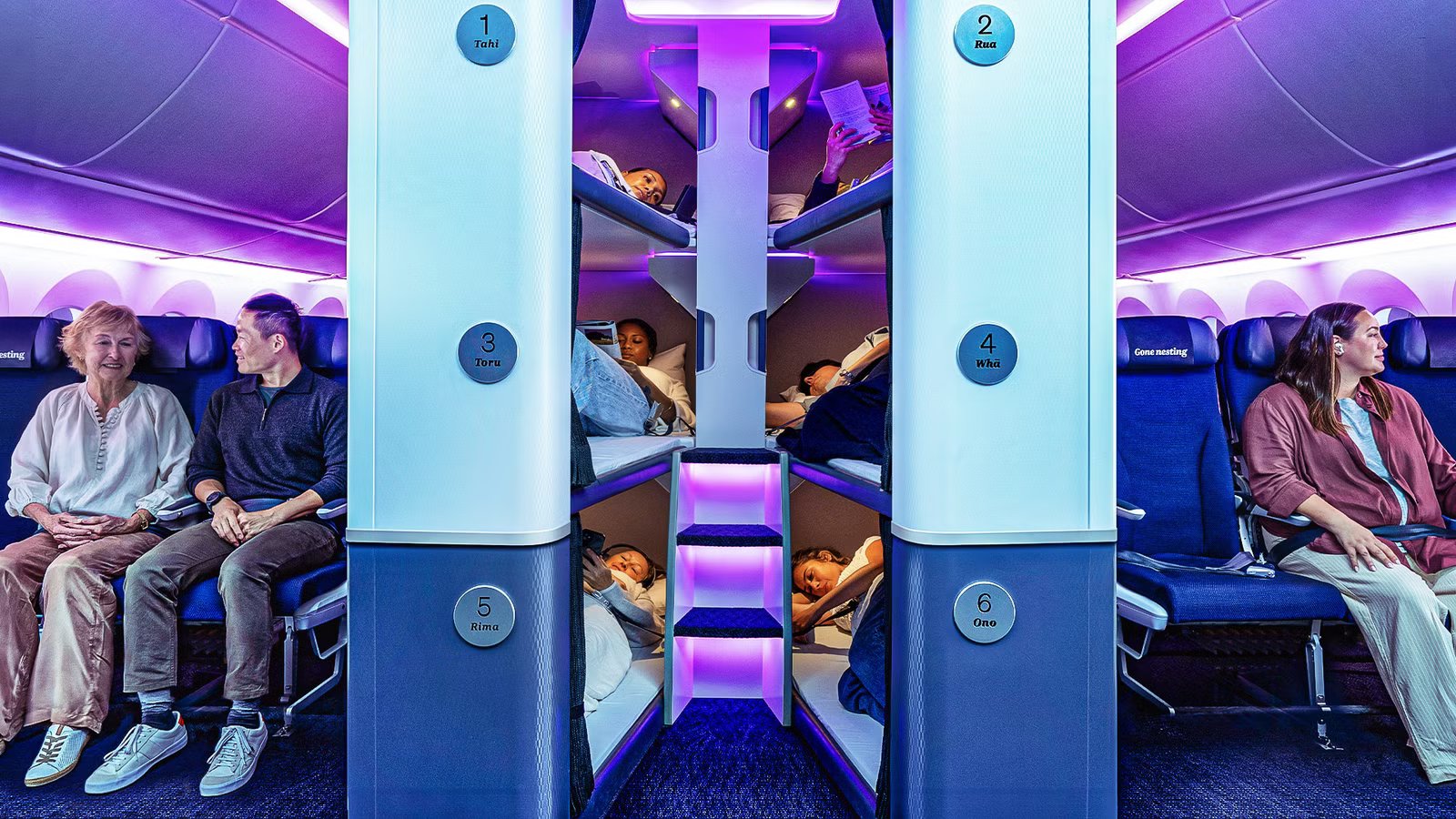
Air New Zealand’s new Economy Skynest has been marketed as one of the most inventive ideas in the world of long-haul travel, consistently grabbing headlines. Six lie-flat bunk-style sleep pods that economy passengers can book for four-hour rest periods are certainly something the aviation industry has never seen before. At first glance, the headline price sounds surprisingly attainable, with sessions starting at $292.
This makes it look far cheaper than paying outright for an upgraded cabin, which will likely cost you significantly more. However, that headline is only part of the overall story. Skynest is not a ticket class in its own right. It is an add-on that sits on top of an existing economy or premium economy fare, and it only buys a limited sleep window rather than a better seat for the entire journey. That distinction is ultimately what makes this product so interesting from a commercial perspective.
For travelers on ultra-long-haul routes such as Auckland to New York, the real question is not whether $292 sounds cheap in isolation, but whether adding Skynest to a standard economy fare actually delivers better value than simply booking premium economy from the start. Once seat comfort, baggage, meal service, airport perks, and all-flight personal space are factored in, Air New Zealand’s world-first bunk beds and more are a carefully priced upsell, and passengers should definitely be aware of the difference.
What Is The Basic Idea Behind This?

At a very high level, there is a natural idea behind the Air New Zealand Skynest. It also makes more and more sense, given that the airline operates ultra-long-haul services across the Pacific Ocean. The idea behind the Skynest is to separate sleep from the traditional premium-cabin bundle and sell it as its own product. Normally, if a passenger wants to lie flat on a long flight, they have to buy Business Class tickets, or at least pay for a more comfortable cabin.
Air New Zealand is effectively asking a different question. The carrier wants to know whether some passengers do not need champagne, lounge access, or a wider seat for the whole journey, but still care enough about getting a few hours of proper sleep to justify the higher expense. That is ultimately the commercial and passenger logic here. On ultra-long-haul routes, especially from a geographically remote country like New Zealand, the rest becomes one of the most valuable parts of the passenger journey. The carrier believes it can monetize this.
In this sense, it is both a comfort innovation and a pricing innovation. It also creates a new middle ground in the cabin. Rather than forcing travelers into a simple economy-versus-premium choice, Air New Zealand can monetize unused demand from people who want something better than a standard seat, but cannot justify the full jump to Premium Economy or Business Class. We will simply have to wait and see whether the carrier achieves its monetization objectives.
A Look At The Skynest’s Design

In terms of the cabin’s unique design, Skynest is much less like a new seat and more like a compact sleep compartment built directly into the aircraft. Air New Zealand has created a dedicated zone of six lie-flat pods, positioned between Premium Economy and Economy, on its Boeing 787-9 aircraft, which serve as the flagship models of a growing, increasingly diverse long-haul fleet. Each nest is long enough for adults to sleep in and quite wide around the shoulders, though the pods narrow toward the feet.
Thus, the layout is extremely optimized for sleeping rather than lounging. The pods are arranged across the top, middle, and bottom levels, with the upper nests accessible via small central steps and handrails. The middle nests are easier to slide into, and the lowest nests are optimal for passengers who are comfortable sleeping near the floor. Inside each pod, the airline has attempted to recreate the essentials of a simple bed rather than a suite.
Passengers who are lucky enough to find themselves in one of these will enjoy a full-size pillow, sheets, a blanket, an eye mask, earplugs, socks, and basic toiletries, while the nest itself includes a mesh privacy curtain, ambient lighting, and a reading light, as well as extensive personal storage space. USB-A and USB-C charging, ventilation, a seat belt, and a crew call button are also available. There is ultimately no in-flight entertainment screen in the pod, and only water is allowed for beverages, reinforcing the idea that the space is designed specifically for rest.
A Unique Kind Of Financial Incentive

The financial appeal of offering Skynest is that it enables Air New Zealand to sell a premium benefit without allocating a premium seat. Instead of moving a traveler into Premium Economy or Business Class for the entire flight, the airline can charge an additional fee for just four hours of lie-flat rest while that passenger still occupies and pays for an Economy or Premium Economy seat. This creates a new ancillary revenue stream on top of the base fare rather than a simple cabin upgrade.
Air New Zealand explicitly sells Skynest as an add-on, and the product is limited to six pods, bookable in four-hour sessions, on select ultra-long-haul flights from Auckland International Airport (AKL) to John F. Kennedy International Airport (JFK) starting in November 2026. The broader incentive is thus margin and segmentation. On very long flights, sleep is one of the most valuable parts of the onboard experience, but many travelers cannot justify the full price jump to a higher cabin, according to Forbes.
Skynest allows Air New Zealand to capture some of that willingness to pay from the middle market. Passengers who want more than a standard economy seat but less than Premium Economy or Business Premier are thus the target demographic here. That also helps protect premium-cabin pricing, because the airline is selling a narrower product focused on rest rather than bundling in priority services, extra baggage, premium dining, and larger personal space for the whole journey.
Has This Kind Of Thing Ever Been Done Before?

Commercial passenger airlines did offer sleeping berths decades ago, especially in the propeller era, when long-haul flying was slower and far more luxurious. Historical aircraft such as the Douglas Sleeper Transport and later Boeing Stratocruisers could be configured with beds or berths for overnight passengers. So the broad idea of people sleeping in actual beds on airplanes is not new at all.
What is more novel, however, is the way in which Air New Zealand has packaged this new product. The carrier has a dedicated six-pod bunk zone, installed inside a modern widebody cabin, and sold as a time-limited add-on to Economy and Premium Economy passengers rather than as the world’s first lie-flat sleep pods in the sky for Economy and Premium Economy travelers.
There have been modern partial versions of this complex idea. Air New Zealand had a previous Skycouch concept that let passengers turn a row of economy seats into a couch-like surface, and Lufthansa’s Sleeper’s Row sells an empty row of economy seats with a mattress topper and bedding. But neither is a purpose-built bunk-bed product separate from the seat itself. That is why Skynest can credibly be presented as a genuine first, even if aviation has flirted with airborne beds in the past.
Why Might Passengers Choose This Product?

Passengers might choose this kind of product because it directly targets the single hardest part of ultra-long-haul economy travel: the lack of sleep. For many travelers, the worst part of a 15- to 18-hour flight is not food or entertainment, but arriving exhausted, stiff, and completely unable to function properly for the first day or two. Skynest offers a way to buy the actual rest without paying for an entire premium-cabin ticket.
That ultimately makes it especially attractive to travelers who are price-sensitive but still willing to spend selectively on comfort. Someone may not want, or be able, to justify the full jump to Premium Economy or Business Class, but may happily pay extra for four hours lying flat. It could also appeal to passengers connecting straight to work, meetings, or onward travel.
These are all places where sleep has real value beyond comfort. In that sense, the product is not just about luxury, but rather about buying a specific benefit at a lower entry point. Better recovery, less fatigue, and a more manageable long-haul journey overall are all key objectives for passengers.
The Bottom Line

At the end of the day, passengers will almost always choose cabin products that best serve their needs. This is a fundamentally new kind of product, and one that the market is not really all that used to. However, if there is a place where such an offering would prove successful, it would be on exactly this kind of long-haul route.
These services are not only places where ultra-long-haul endurance requires passengers to sit in small economy seats for unbearable lengths of time, but also places where customers are price-sensitive. Getting them to upgrade requires a carefully tailored product that really serves their unique needs.
The challenge, however, is that this concept is much harder to pull off than it may seem. The airline clearly believes it can generate more revenue from this pod system than simply using the space for additional seats. Soon enough, we will see if this program proves remotely successful.